Amygdala Hijack During Public Speaking
When your brain mistakes a podium for a predator, the nervous system hijacks your ability to speak.
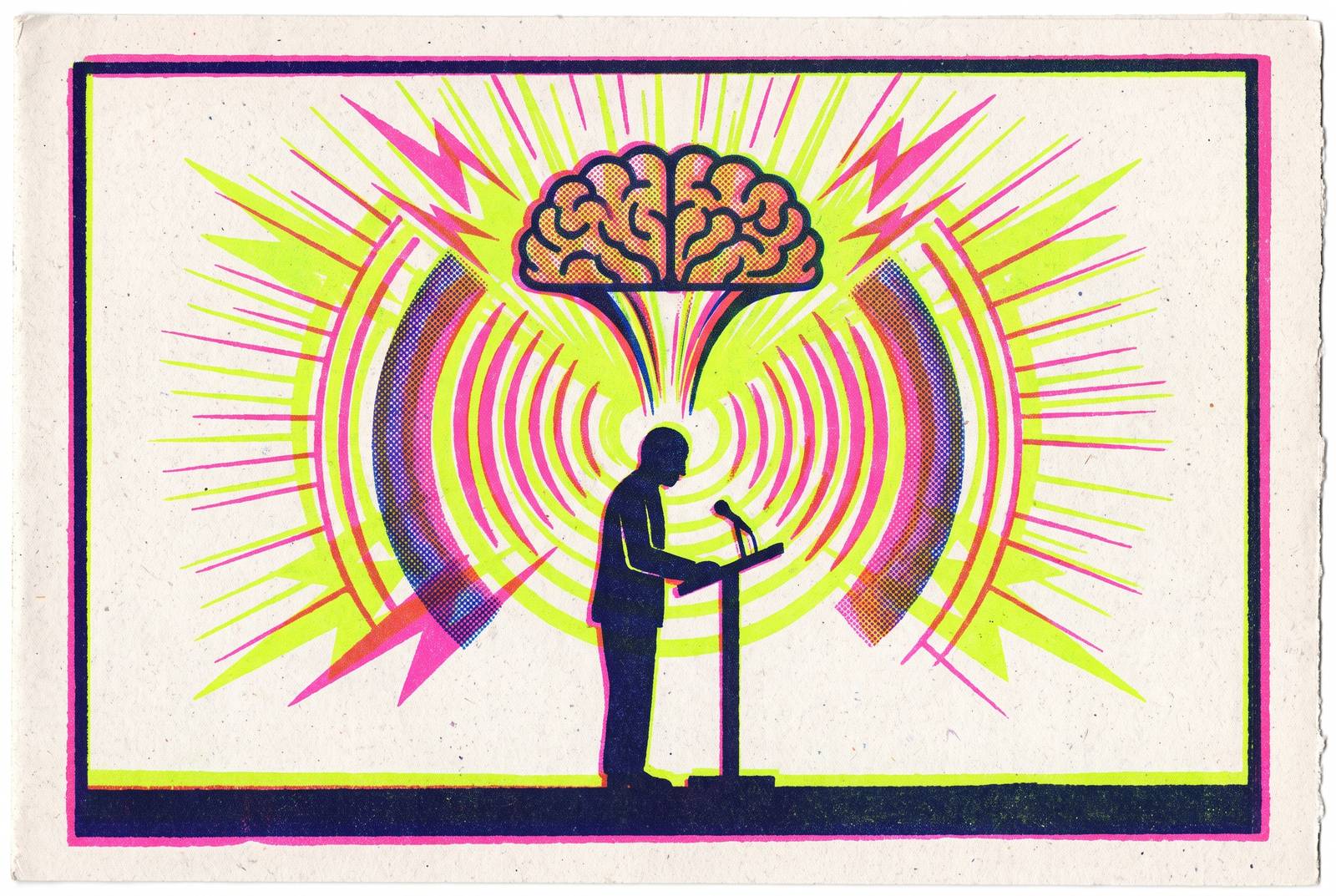
An amygdala hijack is a specific neurological event: an immediate, overwhelming emotional response disproportionate to whatever triggered it. It names an immediate, overwhelming emotional response that is disproportionate to whatever triggered it, because the brain has registered a threat bigger than the one actually in the room. Psychologist Daniel Goleman coined the term in his 1995 book, Emotional Intelligence: Why It Can Matter More Than IQ, and it has since held up as a formal concept within affective neuroscience rather than fading into pop-psychology shorthand.
The amygdala's job, stripped of any drama, is threat detection. It consults the hippocampus, which holds the brain's record of past experience, and asks a fast, blunt question: does this situation match something that once meant danger? If the answer comes back yes, even approximately, the amygdala does not wait for a second opinion. Sensory information reaches the amygdala before it reaches the neocortex, the part of the brain responsible for reasoning, language, and judgment, so the amygdala fires first and asks permission later. That timing gap is the entire mechanism. By the time the rational brain has an opinion, the body has already acted on one.
What follows is not metaphorical. The hypothalamic-pituitary-adrenal axis, the HPA axis, gets triggered, rational brain function gets overridden, and the body mobilizes to physically escape a threat that has no physical form. Heart rate climbs, adrenaline and cortisol flood the bloodstream, and the system prepares for a sprint or a fight that isn't coming. The wiring evolved for encounters with actual predators, tested across a long evolutionary timeline in which hesitation was expensive and speed saved lives. It was never built with boardrooms or lecture halls in mind, which sets up the exact collision this piece is about: ancient threat-detection machinery, still running the same code, now getting triggered by a podium and a slide deck.
A Room Full of People Looks Like a Predator
Public speaking is close to a perfect stimulus for an amygdala hijack, because it activates every threat trigger the amygdala monitors, all at the same moment. Four conditions fire simultaneously the moment someone stands up to speak: being visibly exposed, being evaluated, being unable to escape, and facing an outcome that hasn't happened yet. Any one of those alone would get the amygdala's attention. Stacked together, they read less like a presentation and more like an ambush, at least to the part of the brain doing the reading.
That misreading is literal. The amygdala interprets a room of attentive faces not as colleagues waiting to hear a quarterly update but as something closer to a predator sizing up its next move. One raised eyebrow or a single frowning face in the third row can register as evidence of total failure, which pumps out more adrenaline and tightens the loop further. The brain runs the only threat-assessment software it has, and that software does not distinguish well between a lion and a skeptical audience member.
The physiological cascade that follows is precise enough to map. The amygdala signals threat, the hypothalamus answers by flooding the body with adrenaline and cortisol, and the prefrontal cortex, the seat of executive function, language processing, and rational thought, goes dark to conserve resources for a fight-or-flight response the body thinks it's actually going to need. Voice trembling traces back to sympathetic activation creating tension in the larynx. Dry mouth happens because the sympathetic nervous system suppresses salivary function as digestion gets deprioritized. A racing heart is cardiac acceleration, priming the body for a sprint. Going blank, the most feared symptom of all, is simply the prefrontal cortex losing power. The speaker still knows the material. The brain has just cut off access to it.
Stanford University researchers studying people with anxiety disorders found that the amygdala's subregions show abnormal connectivity patterns, both with each other and with other brain regions. Practically, an anxious brain has trouble telling a serious threat apart from a mild one, so the overreaction doesn't feel like a choice, and it isn't one. Goleman's own framing sums up the mismatch well: the emotional system evolved to answer one question, "Do I eat it, or does it eat me?", in under a second, and it was never asked to evaluate whether a conference room is dangerous. It answers anyway, because that's the only question it knows how to ask.
Who Gets Hijacked Most
Public speaking anxiety is not a fringe phobia affecting a small, unlucky minority. It affects up to three-quarters of the population, activating the amygdala and triggering the same fight-or-flight response described above, with neuroimaging confirming the disruption to prefrontal cortex function. At that scale, the condition looks less like an individual quirk and more like a near-universal feature of how brains handle evaluation under exposure.
The cost appears in résumés and bank accounts as well as sweaty palms. Nearly half of workers have turned down a promotion or skipped applying for a job because of this anxiety, and it measurably suppresses both wage growth and leadership advancement across a career. Communication has ranked as the most in-demand skill on LinkedIn for a second consecutive year. The gap between what employers want and what anxious speakers avoid is widening rather than closing.
The generational split makes the stakes sharper still. 25% of 16-24-year-olds say they feel confident speaking to an audience, compared with more than two-thirds of adults over 45. Nearly three-quarters of Gen Zers report fearing public speaking outright, a pattern broad enough to qualify as structural rather than a collection of individual anxieties. A majority of Gen Zers and millennials script or rehearse conversations before making a phone call, and they name public speaking, asking for help, and job interviews as the situations they find hardest. A large majority of both groups say poor communication skills have already cost them money or opportunities. One likely explanation: a generation raised on text-based, asynchronous communication has had fewer involuntary reps at live, evaluated, uneditable speech, leaving the amygdala with less evidence that an audience is not, in fact, a predator. A Fortune investigation found generational communication gaps creating real confusion around email etiquette, office jargon, and professional norms, a divide framed as an active workplace crisis, with nervousness and anxiety named among the contributors to ineffective communication on the job.
None of that makes the hijack a personal failing. It does make ignoring it a choice with a price attached, which is exactly the pivot the rest of this piece turns on: if the mechanism is biological, the mechanism can be retrained.
Why the brain can unlearn the threat response
The amygdala's reaction to public speaking is a learned association, not permanent wiring. It's a learned association, and learned associations are exactly the kind of thing neuroplasticity, the brain's capacity to reorganize itself by forming new neural connections, can revise.
Neuroscientist Joseph LeDoux offers the honest version of this claim rather than an inflated one: once the emotional system learns something, it tends not to let go of it entirely. That sounds discouraging until the next part lands: what changes with training is not whether the amygdala remembers the threat, but how loudly it insists on acting on it, and how quickly the prefrontal cortex can override that insistence. So does the hijack always lurk somewhere in the background, even after training? Probably, in some diminished form. But that's the wrong question to be optimizing for. The relevant metric is intensity and duration, not elimination. Elite speakers still feel the adrenaline. They just stop losing to it.
The evidence for that kind of change is concrete rather than motivational. Researchers at the University of Zurich used fMRI scans to track brain activity during public speaking and found that participants with social anxiety showed hyperactive amygdala responses at baseline. After eight weeks of communication training, the same participants' scans looked different: the amygdala stayed quiet, and the participants reported less dread and more control. The timeline compresses further than that eight-week window might suggest. After just six hours of public speaking training, the brain no longer reacts the same way, with neurological shifts measurable on brain scans, neural pathways strengthening, and the amygdala's grip loosening. Six hours is a modest but meaningful number. That's roughly a single working day.
There's a second mechanism working alongside the amygdala's own recalibration, routed through the basal ganglia, a brain structure involved in routine-building. A pre-speaking habit, rehearsed enough times, signals to the brain that this particular situation is familiar and safe rather than novel and dangerous, which further lowers the amygdala's trigger sensitivity before a word gets spoken. Repetition weakens the threat response directly and teaches the brain to classify the whole situation as routine rather than risky.
What the science actually says about calming down before you speak
Most people facing a hijack try to calm down, and most conventional advice tells them to. Research out of Harvard Business School suggests that instinct is aimed at the wrong target.
Alison Wood Brooks published research in the Journal of Experimental Psychology: General examining public speaking, karaoke singing, and math performance, and found that people who reappraised their anxious arousal as excitement consistently outperformed those who tried to talk themselves down. Anxiety and excitement are both high-arousal states, built from the same chemical footprint of adrenaline, cortisol, and an elevated heart rate. Telling an anxious brain to calm down asks it to drop from high arousal to low arousal, a genuine physiological shift that's hard to pull off on command, which is part of why the advice so rarely works in practice. Relabeling anxiety as excitement asks for something much smaller: a shift in how the same arousal gets interpreted.
Saying, out loud, "I am excited for this," moves the brain from a threat mindset that narrows attention to an opportunity mindset that broadens it, letting the adrenaline power the delivery instead of derailing it. Brooks's 2014 study backs this up directly: reappraising physiological arousal as excitement improved objective ratings of speech quality, including perceived persuasiveness, competence, and confidence, compared with attempts to calm down, though that particular study did not measure amygdala threat-coding directly. The gap between what gets measured and what gets claimed matters here. Researchers documented the behavioral result. The exact amygdala-level mechanism behind it is a reasonable inference, not a proven one, and the honest version of this argument says so.
The deeper shift Brooks's work points toward involves where attention goes, not just what arousal gets called. Public speaking fear can be understood as a symptom of self-evaluation, a speaker's brain running an internal self-monitoring loop instead of pointing attention outward at the audience and the message. High-impact speakers tend to adopt something closer to a service mindset, treating the talk as something being delivered to the room rather than a performance being judged by it. That reframe moves brain activity away from the amygdala's self-protective loop and toward the prefrontal cortex's task-focused one. It's the conceptual hinge the next section's techniques hang on: almost every in-the-moment tool that works does some version of redirecting attention outward, away from the self, and toward the audience, the breath, or the task at hand.
In-the-moment techniques that interrupt the hijack while it is happening
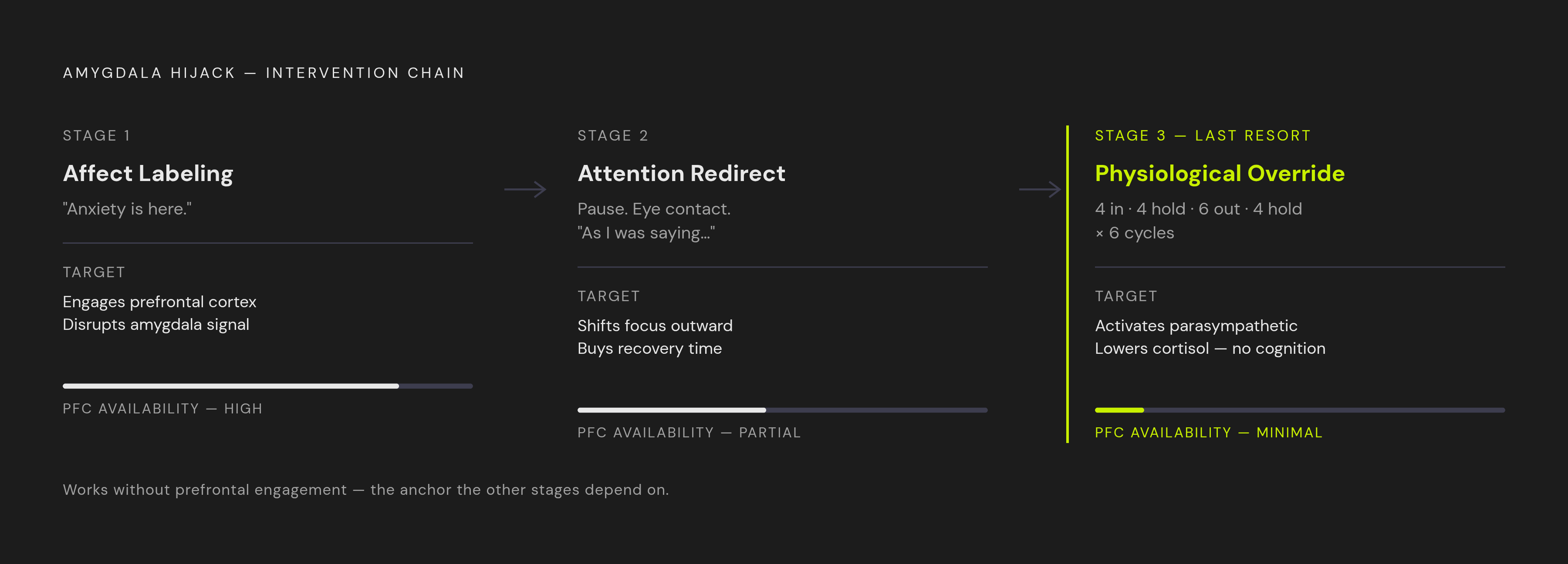
Once a hijack is underway on stage, a small set of techniques can interrupt the cascade, each aimed at a different point in the chain described earlier, and each buying enough time for the prefrontal cortex to come back online. Affect labeling is one of the simplest: naming the emotion in the third person, saying "anxiety is here" rather than "I am anxious," engages the prefrontal cortex through language processing and measurably disrupts amygdala activity in the process. Shapiro uses this technique with executives as a real-time regulation tool, because it requires no props, no pause in the room's attention, and no visible break in composure.
A second technique addresses the moment speech actually derails rather than the moment before it starts. Coach Katie Stoddart's method for onstage recovery involves pausing, holding eye contact with the audience, and repeating the last few sentences prefaced with "As I was saying," a sequence that calms the amygdala and creates room to recover without drawing attention to the stumble. A close variant works just as well: inviting the audience to breathe along, framed as a moment of shared reflection rather than a personal rescue. Both versions do the same job. They shift attention outward, toward the audience, which buys recovery time while looking, from the outside, like a deliberate pause rather than a panic response.
The third tool operates at a purely physiological level, bypassing cognition. A specific breathing pattern, four counts in, a four-count hold, six counts out, a four-count hold, repeated six times, activates the parasympathetic nervous system and measurably lowers cortisol. Box breathing, the 4-4-4-4 version of the same idea, works through the vagus nerve to physically slow the heart rate, directly countering the cardiac acceleration described earlier as one of the hijack's first physical signs. What makes breathing techniques distinct from the other two is that they don't require any cognitive reframing at all. They work on the body directly, mattering most in the moment when the prefrontal cortex is least available to do any reframing.
Taken together, these three tools map onto the three points where the hijack can be interrupted: the labeling of the emotion, the redirection of attention outward, and the direct physiological override of the stress response. None of them promise to stop the amygdala from firing in the first place, and none of them should, given everything the neuroplasticity research says about intensity and duration being the realistic target rather than elimination. What they offer instead is a foothold, a few extra seconds for the rational brain to catch up to a threat response that, biologically speaking, was never really about the audience.
Sources
- Public Speaking Anxiety: A 5-Step Approach
- The #1 Reason Why You Fear Public Speaking - SpeakWell Partners
- Amygdala hijack
- Overcome Public Speaking Anxiety: Lead with Total Confidence
- New Research: The Scientific Solutions to Public Speaking Anxiety
- Public Speaking Statistics 2025: Global Fear & Trends
- Public Speaking Statistics (2026): 40+ Data Points on Glossophobia, Career Impact, and the Speaking Economy — VoxBooster
- Public Speaking Anxiety Statistics 2026