Vagal Tone and Vocal Steadiness Under Pressure
Higher vagal tone steadies the voice when nervous systems detect threat.

The voice thins out, climbs half an octave, starts to flutter on certain vowels. Anyone who has stood in front of a room and felt this happen knows the sensation is closer to a physical malfunction than a character flaw, and that is because it is one. A shaky voice under pressure is the audible output of a nervous system that has already decided, well before the first word leaves the mouth, that the room is dangerous.
The vagus nerve runs from the brainstem down through the neck and chest, and it wires directly into the larynx through the recurrent laryngeal and superior laryngeal branches. One branch, the recurrent laryngeal nerve, controls the muscles that open and close the vocal folds. The other, the superior laryngeal nerve, adjusts pitch by tightening or relaxing the cricothyroid muscle. Neither branch consults the speaker's opinion about how the talk is going. They respond to signals arriving from deeper in the brain, and those signals arrive before any conscious thought about grammar, word choice, or the next slide.
Stephen Porges, the psychiatrist behind Polyvagal Theory, gave this pre-conscious scanning process a name: neuroception. L|The nervous system continuously and unconsciously checks faces, voices, and context for cues of safety or threat, and it registers being evaluated as one of those threat cues, often before the speaker feels any nervousness. Standing at a podium, waiting to be called on in a meeting, dialing into a client call: all of these read to the nervous system as a scenario where the "threat detector" fires first and the vocabulary system fires second. That ordering explains why willpower alone rarely fixes a shaky voice. Telling the throat to relax while the nervous system is still broadcasting danger is a bit like yelling at a smoke detector to stop beeping while the toast is still burning. The mechanism that produces the shake sits below the layer where willpower operates, so the fix has to start there too. That is the argument this piece works through: not a pep talk about confidence, but a map of the actual physiological lever, called vagal tone, that governs whether a voice holds steady or falls apart under pressure.
M|How vagal tone governs the voice
Vagal tone describes the baseline activity of the vagus nerve, most often measured through heart rate variability, or HRV: the natural variation in time between heartbeats. Higher vagal tone is not a fixed trait handed out at birth. F|It sits on a continuum, and someone with higher resting HRV shows greater neuro-visceral flexibility along with a lower resting heart rate, according to a study by Lopez Blanco and Tyler at the University of Alabama at Birmingham. G|Vagal tone functions as a dial that determines how much parasympathetic control a speaker actually has over the throat, the breath, and the pitch of the voice at any given moment.
Polyvagal Theory splits the vagus nerve's function into two distinct pathways. K|The older, unmyelinated dorsal branch handles shutdown, producing the freeze response, the collapse, and the voice that goes flat and distant under extreme threat. The newer, myelinated ventral branch handles something closer to composure. D|It supports social engagement, relaxed facial muscles, and a voice with natural prosody that rises and falls in a way that sounds warm rather than flat or clipped. When the ventral vagal complex is running the show, speakers also tend to retrieve words faster and think more flexibly, because the same branch that calms the larynx also seems to free up cognitive bandwidth elsewhere.
The recurrent laryngeal nerve converts raw phonation, essentially just air passing over vocal folds, into intelligible speech by controlling how those folds open and close. F|Meanwhile, the external branch of the superior laryngeal nerve contracts the cricothyroid muscle and adjusts vocal fold tension, setting pitch in the first place, according to a meta-analysis on laryngeal function. Under stress, that cricothyroid muscle tightens, subglottic pressure builds, and pitch climbs, a direct mechanical consequence rather than a vague symptom of nerves.
The cognitive payoff of higher vagal tone extends past the voice. D|Lopez Blanco and Tyler's 2025 study linked higher resting HRV to faster reaction times and fewer errors on a neuropsychological battery: the benefit of a well-regulated vagus nerve includes sharper word retrieval under pressure and a calmer-sounding voice. F|A scoping review in the journal Biology, led by Morales-Luque and colleagues, found that speaking and singing place simultaneous demands on breathing, muscular control, and the autonomic nervous system, and that in people with high vocal demands, such as singers, teachers, and actors, this interaction shapes autonomic balance even in the absence of any diagnosed voice disorder. The throat, in other words, is wired straight into the same circuitry that governs the heart rate. Training one changes the other.
What the research shows when stress hits the voice
C|The vagal-to-vocal link is visible as a measurable acoustic signature in speakers' voices under stress. A 2025 systematic review and meta-analysis by Veiga and colleagues at the Santa Casa de São Paulo School of Medical Sciences, published in the journal Stress and Health, pooled studies from 2010 through 2024 and found a significant, consistent increase in vocal fundamental frequency after stress. Fundamental frequency is the acoustic term for pitch, so this finding confirms in aggregate what most speakers already suspect from experience: stress makes the voice climb, and it does so reliably enough to appear across more than a decade of separate research.
The review's authors were careful to flag publication bias and heterogeneity across the included studies as real limitations, and they stop short of calling fundamental frequency a validated biomarker for stress. B|Taking that caveat at face value matters, because it shows the review's authors are honest about where the evidence still falls short. Fundamental frequency looks like a promising signal, one that tracks stress in a directionally consistent way, but it has not yet cleared the bar of a clinically validated measurement tool. J|Science reporting on the body tends to oversell early findings, so a review that names its own limits is doing what a reader should want it to do.
What makes this section matter for the rest of the argument is the direction the relationship runs, and it runs both ways. F|Low, warm vocal tones increase vagal tone and improve HRV, while high, clipped tones suppress it, according to Jim Donovan, an educator who cites a study by Gregory and colleagues in Frontiers in Human Neuroscience. Voice and nervous system sit in a loop, each one influencing the other continuously rather than one simply reporting on the state of the other. That bidirectionality is the hinge the rest of this piece turns on, because a loop that runs in both directions is a loop a speaker can deliberately enter from either side.
M|Why speakers face this at the worst moments
E|The training gap here is structural, a predictable outcome of the tools available rather than any one person's failing when walking into a meeting unprepared. A large majority of Gen Z employees name instant messaging as their preferred internal communication channel, and only a small fraction prefer face-to-face conversation, according to workforce data cited by cake.com⟀c11. A RiseGuide survey of Gen Z and millennial respondents found that a substantial share avoid phone calls altogether, and among that group, 78% reported that avoidance had cost them earnings or opportunities.
That last figure deserves a second look, because it is not describing a mild inconvenience.
F|A survey by Intelligent found that hiring managers specifically flag nonverbal and vocal confidence gaps among Gen Z graduates. The skill being scrutinized in interviews and high-stakes meetings turns out to be precisely the one that gets the least live repetition beforehand. And here is where the picture gets genuinely strange: a CNBC and SurveyMonkey survey found that Gen Z rates its own in-person social skills as confidently as older generations do. So the gap is not one most young speakers can feel coming. It hides behind a level of self-assessed confidence that does not match how hiring managers score the same interactions, which makes the gap harder to close precisely because it goes unrecognized from the inside.
There is a thread of self-awareness buried in the data, though. Across generations, active listening was named the skill most lacking in young people, including by Gen Z respondents describing themselves. B|Beneath that confidence sits an intuition that something in live conversation is not landing the way text does.
None of this reads as a generational shortcoming so much as a predictable outcome of the tools available. Text is asynchronous and low-stakes. L|There is no real-time vocal signal for the nervous system to threat-scan, so text never triggers the neuroception-level alarm that live voice does. Avoiding live speech does not build tolerance for it; it just defers the exposure to whatever future moment finally demands it, usually a job interview or a high-pressure client call, which is close to the worst possible place to be encountering the sensation for the first time. The good news buried in the physiology from the sections above is that vagal tone is trainable at any age and any starting point, so the gap described here is closable rather than fixed.
Breathing rate as the most direct lever for raising vagal tone
Slow, paced breathing is the best-supported way to raise HRV quickly; it gives a speaker something close to real-time control over the laryngeal muscles that a shaky voice depends on. The specific target most often cited is resonance-frequency breathing, sometimes called coherent breathing, at roughly six breath cycles per minute. At that pace, the cardiovascular and respiratory systems fall into sync with each other, producing the largest and most reliable HRV increases measured in the biofeedback literature, and this rate forms the foundation of most HRV biofeedback training protocols.
Box breathing, the four-count inhale, four-count hold, four-count exhale, four-count hold pattern popular among military and first-responder trainers, does not produce quite as large an HRV increase as six-breaths-per-minute pacing. A 2025 study in Applied Psychophysiology and Biofeedback still found that box breathing meaningfully improved HRV and was particularly effective at boosting focus and a subjective sense of control, both of which matter to a speaker seconds away from walking on stage. Six breaths per minute produces larger HRV increases, but box breathing still improves HRV and is particularly effective for boosting focus and a sense of control for someone standing in a hallway outside a conference room.
Lopez Blanco and Tyler's 2025 research, already cited above for its cognitive findings, also confirmed that acute HRV elevations produced through slow-paced breathing correlate with sharper executive function and better cognitive resilience under pressure. Slow breath before a talk is not a soothing ritual borrowed from yoga class. C|It functions as a direct input into the vagal brake that governs laryngeal tension, producing a steadier voice and a sharper memory for what comes next in the sentence. Athletes warm up before competition with a structured physical routine.
M|What humming and toning add beyond breathing
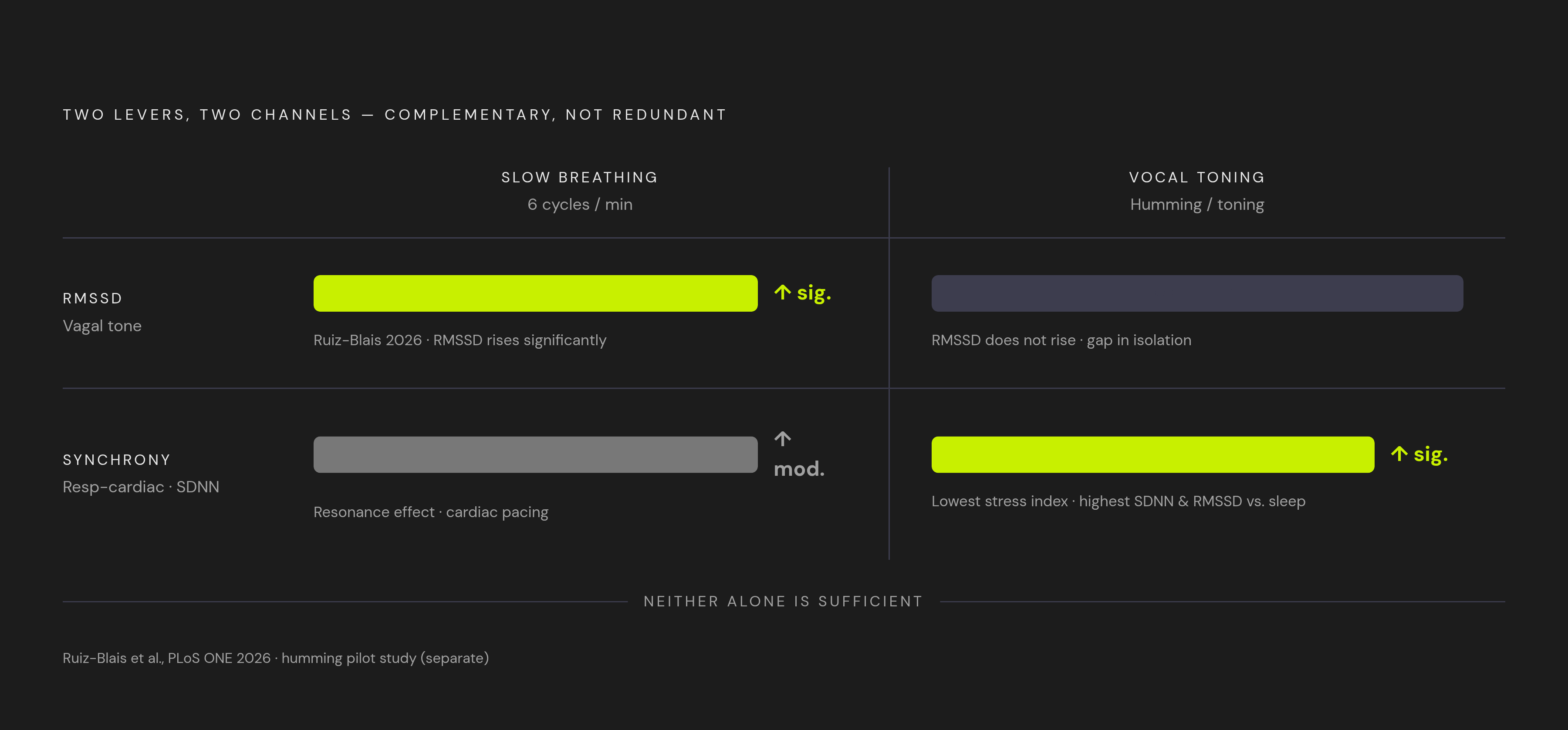
Breathing is not the only lever, and it is not a redundant one either. H|Humming, toning, and chanting activate the vagal pathway through a mechanism distinct from paced breathing. The two practices complement each other rather than duplicate the same effect.
A 2026 study published in PLoS ONE by Ruiz-Blais and colleagues drew out the distinction with some precision. Respiratory-mediated HRV rose significantly during both toning and toning-matched slow breathing, but vagal tone specifically, as measured by RMSSD, increased only with slow breathing, not during vocalization itself. That single finding carries more weight than it might first appear to. Slow breathing strengthens the autonomic brake, the vagal tone that governs baseline regulation, while vocal toning strengthens respiratory-cardiac synchrony and neural engagement, a related but separate channel. A speaker chasing vagal steadiness needs both inputs, because each one is doing a job the other cannot fully cover on its own.
Other findings point in a similar direction. A pilot study found humming produced the lowest stress index of any condition tested, lower even than sleep, alongside the highest SDNN and RMSSD values recorded in that study. F|OM chanting has been shown to increase HRV and promote autonomic balance, and Bhramari pranayama, the humming bee breath technique drawn from yogic practice, positively impacts HRV and vagal tone, per NCVS citing Inbaraj and colleagues, and Latha and Lakshmi.
The proposed mechanism is mechanical before it is mystical. Vocal vibration physically travels through the tissue surrounding the vagus nerve in the neck and chest, and the larynx, chest, mouth, and skull all act as resonating chambers that the nervous system reads as incoming information. A 2026 study in The European Physical Journal Special Topics found statistically significant shifts in HRV parameters among vocalists after a combination of physical, breathing, and vocal exercises, consistent with a real rebalancing of sympathetic and parasympathetic activity. Jim Donovan's own recommended practice, which he calls "Vocal Unwind," is disarmingly simple: hum lightly for a few breaths after a long or draining conversation. It is less a performance technique than a recovery protocol, proof that the voice can reset the nervous system just as easily as the nervous system shapes the voice.
Register, prosody, and the feedback loop
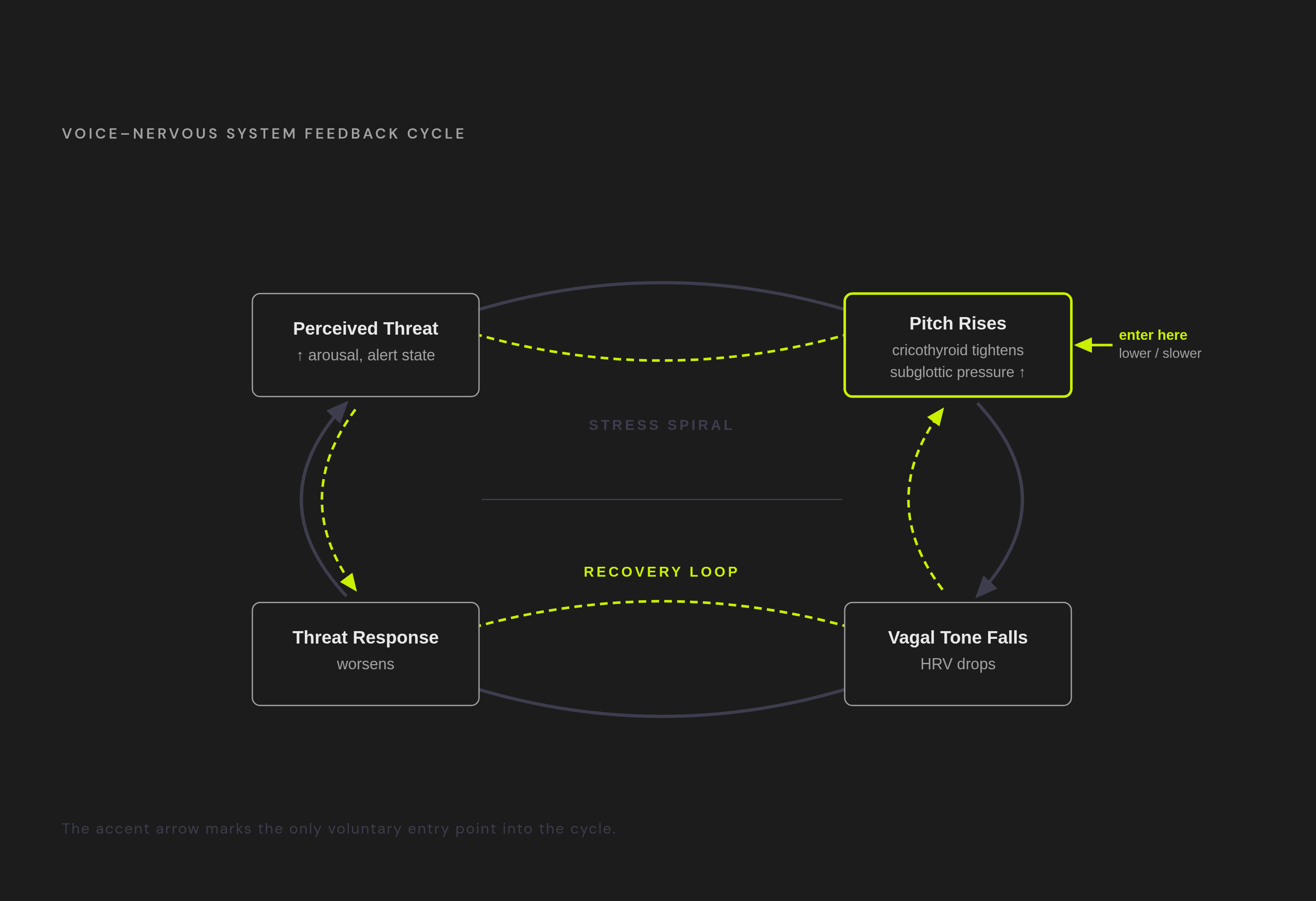
Register and prosody are not just cosmetic features of how a voice sounds. They function as inputs into the vagal system, feeding back into the same loop they are shaped by. This is the part of the mechanism most speaking advice skips past entirely, treating tone and pacing as stylistic flourishes rather than physiological levers with a measurable effect on the speaker's own nervous system.
The loop runs like this: a perceived threat raises pitch, a raised pitch suppresses vagal tone, suppressed vagal tone worsens the threat response, and the worsened threat response pushes pitch even higher. Each turn of that cycle feeds the next. The reverse sequence holds with equal force, and it is just as trainable. A speaker who deliberately lowers and slows the voice is not performing calm for the audience's benefit. The lowered, slower voice is producing calm inside the speaker's own body, through the same mechanism that pushed the pitch up in the first place, only running in the opposite direction.
Connected Speech Pathology, founded by speech-language pathologist Allison Geller, draws a useful clinical line here. Stress-induced voice shake, caused mainly by muscular tension and shallow breath control, is a different condition from structural or neurological tremor, which requires a laryngologist's evaluation. The first kind responds to practice within weeks. H|The second does not respond that way, and no amount of breathing exercises will change that; the distinction matters before anyone assumes their shaky voice is purely a training problem.
Deliberate pauses do double duty in this loop. A brief, intentional silence in place of a filler word signals composure to an audience, and it simultaneously buys the nervous system a beat to regulate, functioning as both a perceptual tool and a physiological one. Connected Speech Pathology's coaches report that most clients notice meaningful improvement within four to eight weeks of consistent practice, particularly when tension and breath control are the primary drivers, with some seeing change even sooner. Prosodic warmth, speaking with real modulation instead of a flat, clipped monotone, also triggers Polyvagal-informed safety cues in listeners, making the audience more receptive in turn. A regulated voice does not just describe the speaker's internal state. It co-regulates the room.
How practitioners have built training around vagal safety
C|Lining up the mechanism from earlier sections against the way independent practitioners actually structure their coaching reveals a clear pattern. Speech pathologists distinguishing tension-based shake from neurological tremor, breathing researchers converging on six breaths per minute as a biofeedback standard, vocal coaches building humming into recovery routines: none of these approaches were designed by committee, yet all of them land on the same underlying premise, that felt physiological safety has to be established before technique layers on top of it.
That convergence is the strongest evidence in this entire piece that the vagal-tone framework describes something real rather than a tidy theory imposed after the fact. Clinical practice at Connected Speech Pathology treats stress-based shake as trainable within weeks, precisely because the underlying tension and breath control are physiological targets, not personality traits. Vocal researchers found statistically measurable shifts in autonomic balance among vocalists after structured practice, and a recovery ritual as simple as humming for a few breaths turns out to rest on the same laryngeal-vagal wiring described at the very start of this piece.
The shaky voice and the steady one draw on the same nerve, the same muscles, and the same continuum of tone. The only variable that changes is how well that continuum has been trained, and the research reviewed here suggests it responds to training a great deal faster than most people assume walking into the room for the first time.
Sources
- The Vagus Nerve and Voice - NCVS - National Center for Voice and Speech
- Influence of physical, breathing, and vocal exercises in vocalists on the central regulation of changes in heart rate variability parameters | The European Physical Journal Special Topics | Springer Nature Link
- The Hidden Vibration of Speech
- The Fundamental Frequency of Voice as a Potential Stress Biomarker: A Systematic Review and Meta–Analysis
- Mapping the Neurophysiological Link Between Voice and Autonomic Function: A Scoping Review
- Full article: The Role of the Vagus Nerve in Speaking and Singing
- Stalking the calm buzz: how the polyvagal theory links stage presence, mammal evolution, and the root of the vocal nerve: Voice and Speech Review: Vol 11, No 2
- PLOS One | https://doi.org/10.1371/journal.pone.0328833 July 24, 2025 1 / 28