Credibility Signals in the First 30 Seconds of a Speech
Audiences decide whether to trust a speaker in the first 30 seconds before conscious thought begins.
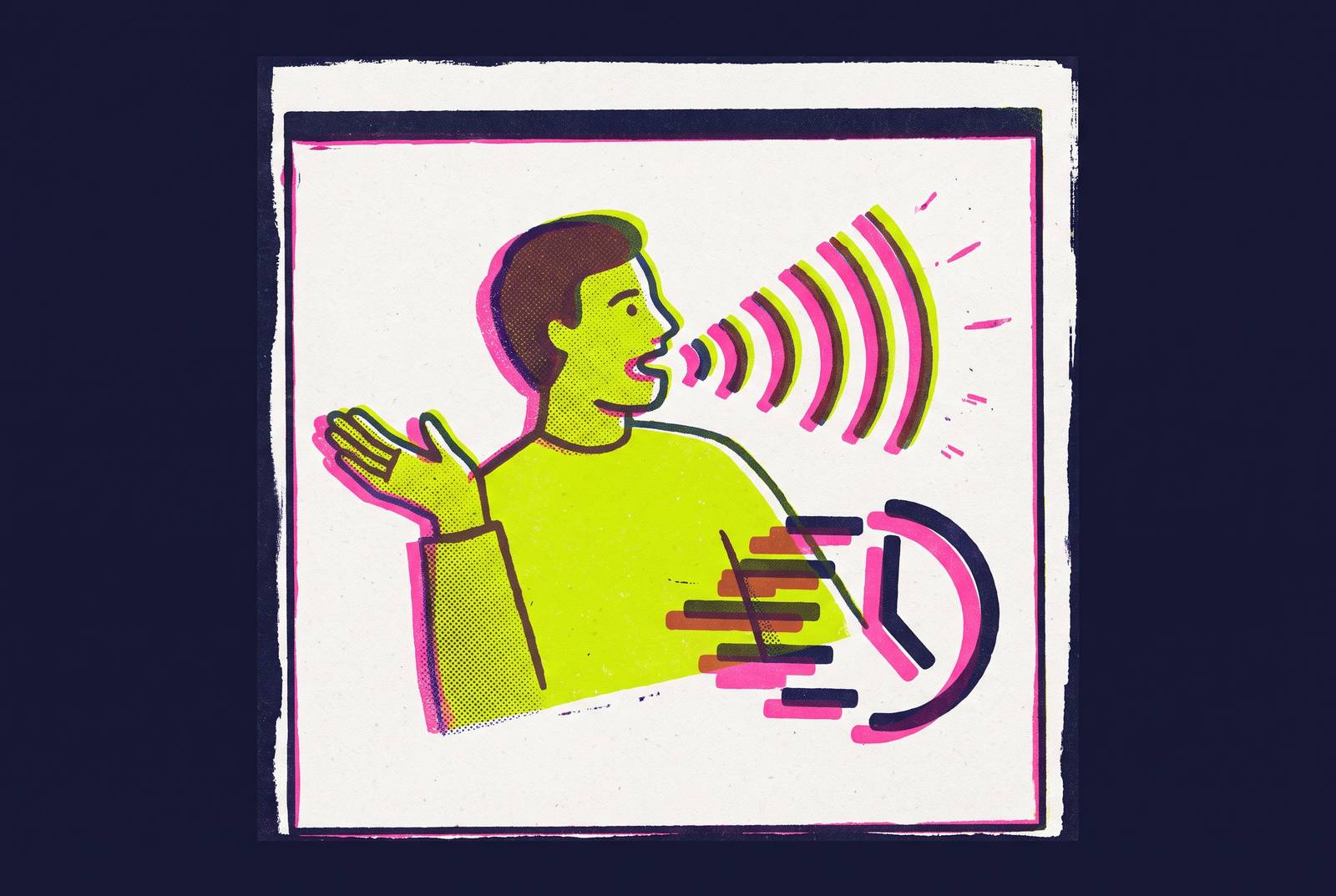
Credibility in a speech gets decided before most speakers think the speech has started. The first 30 seconds work as a stack of specific, measurable signals, vocal, physical, and verbal, that an audience reads almost instantly and mostly without noticing they're doing it. Princeton research has found that people form trustworthiness judgments in as little as one-tenth of a second. The verdict is already forming while the speaker is still walking toward the microphone. Understanding what gets read in that window is the first real step toward controlling it.
Credibility researchers generally split the arc of a talk into three phases: initial, derived, and terminal. Derived credibility builds as the speech unfolds and the speaker delivers on what got promised early. Terminal credibility is the impression left as the audience walks out. This piece cares about the first phase, because it works as the launchpad for the other two. Get it wrong and the speaker spends the next twenty minutes convincing a skeptical room to give the argument a fair hearing. Get it right and the room leans in and extends the benefit of the doubt before a single argument gets made.
Body communication before the first word
Roughly two-thirds of a first impression is nonverbal, so the body starts talking before the mouth does. Posture, gait, and expression are already broadcasting information while the speaker is still crossing the room to reach the front.
Posture is the opening announcement, and it's the one most speakers get backwards by treating it as an afterthought instead of the first sentence of the talk. A meta-analysis covering more than 125 studies confirmed that expansive, open postures reliably raise self-reported confidence, and the effect runs in both directions: standing tall doesn't just look confident, it seems to help produce the feeling of it. Audiences read a collapsed chest and rounded shoulders as uncertainty walking in the door. An upright, grounded stance reads as someone who has done this before and plans to do it again. The walk itself matters too. Hesitation, a rushed shuffle, or a head kept down while crossing the stage all register as data points before a word gets spoken.
Eye contact signals something different from posture: sincerity rather than composure. Steady eye contact says the speaker is actually present with the audience instead of narrating from inside their own head. Two behaviors that look similar land differently. Sweeping the room in a fast, darting pattern reads as anxious, while landing briefly on individual faces, one at a time, reads as commanding. Same eyes, same room, opposite verdict.
Facial expression follows the same logic. A neutral or open face reads as composed. A visibly tense jaw or a frozen half-smile reads as someone who would rather be anywhere else, and audiences pick up on that mismatch fast.
Then there's gesture, and it turns out to be more countable than people expect. Speakers who use illustrative hand gestures, the kind that map onto what they're actually saying, come across as about 9% more persuasive. Among the most-viewed TED speakers, average gesture counts run around 465 per talk, nearly double the rate of the least-watched presenters. Gesture is built through practice, not handed out at birth as a fixed personality trait. The wooden, arms-crossed presenter and the animated one are usually separated by rehearsal hours, not temperament, which is good news for anyone who assumes they were simply born stiff.
Appearance rounds this out, and it has nothing to do with fashion sense. It comes down to matching what the room expects. A pitch to a boardroom and a talk at a community workshop call for different registers of "put together," and reading that room correctly is itself a small credibility signal before anyone says a word.
The vocal signals audiences use to assess whether a speaker is worth following
Mehrabian's widely cited 7-38-55 rule puts vocal characteristics at 38% of how attitude gets communicated, a figure often invoked by communication faculty (including at a well-known business school) even though it doesn't come from that school's own research. Whatever its exact academic lineage, the point holds up: voice does an enormous share of the persuasive work in those opening seconds, arguably more than the words themselves.
A 2025 systematic review in Frontiers in Psychology, covering 24 studies published between 2012 and 2024, found that 21 of those studies zeroed in on pitch or pitch-related features. Twelve of those 21 also looked at pitch range, intonation, loudness, pause length, and speech rate together. Pitch alone doesn't decide credibility. Perception of a credible voice is layered, built from several acoustic ingredients working at once rather than one dominant variable.
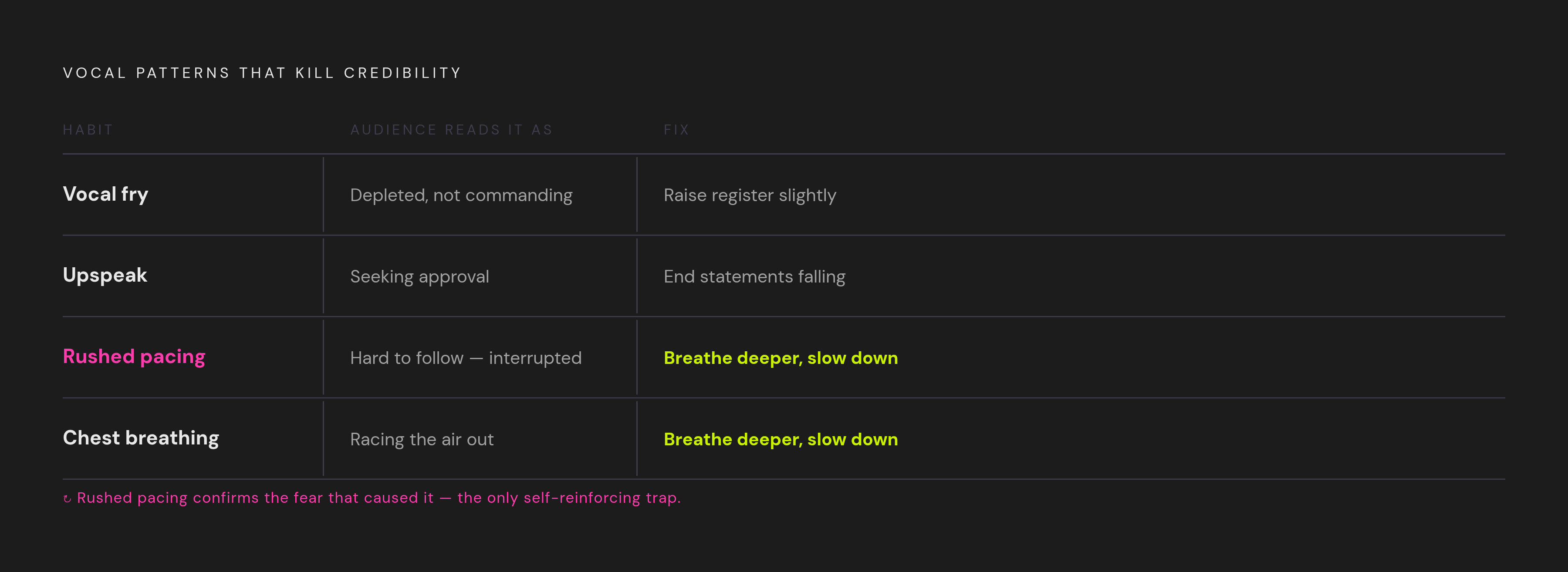
Practitioner research repeatedly names four vocal habits as credibility killers, and the most misunderstood one is vocal fry. That creaky, low-register rasp appears at the end of sentences when breath support runs out, and speakers often lean into it thinking it sounds weighty or serious. It does the opposite: it reads as depleted, not authoritative, the vocal equivalent of a phone with barely any charge left trying to convince you it's fully charged. Upspeak, where a flat statement picks up an upward lilt at the end and starts sounding like a question, signals the speaker is seeking approval rather than leading the room. Rushed pacing driven by a fear of being interrupted creates its own trap: speeding up makes a speaker harder to follow, which makes interruption more likely, which confirms the fear and speeds things up further. Shallow chest breathing forces a speaker to race through a sentence before running out of air entirely. That one has a fix with nothing to do with willpower: breathe from the diaphragm instead of the chest, and the rushed pacing often clears up on its own.
So what does a credible voice actually sound like? Steady pace. Pauses that land on purpose instead of out of panic. Pitch that moves with meaning instead of flattening out or spiking at random. Consistent breath support produces all three at once. A 2025 study in the Journal of the Acoustical Society of America, led by Steffens and colleagues, found measurable acoustic differences between speech judged as credible and speech that read as neutral or ironic, differences a machine can pull straight out of the waveform. These aren't just impressions people report after the fact. They show up as differences a machine can pull straight out of the waveform.
A 2025 study in PNAS found that microphone quality on video calls lowers listener judgments of intelligence, hireability, and credibility, all else being equal. Microphone quality correlates with socioeconomic status, so what looks like a judgment about the speaker is partly a judgment about the hardware they happened to buy. Anyone presenting over a video call on a cheap built-in laptop mic is fighting a handicap the audience can't even name, no matter how well-rehearsed the opening line is.
A 2025 study in the Journal of Nonverbal Behavior found that vocal stereotypes, assumptions tied to how a voice sounds rather than what it says, consistently distort how accurately listeners read a speaker. The fix is removing the specific patterns, fry, upspeak, rushed pacing, shallow breath, that trip the negative shortcut in a listener's head before the words even register, rather than manufacturing some generic "authoritative voice," a thing that doesn't exist outside movie trailers anyway. It's removing the specific patterns, fry, upspeak, rushed pacing, shallow breath, that trip the negative shortcut in a listener's head before the words even register.
What a speaker says in the first 30 seconds to claim authority
An audience doesn't owe anyone their attention. The first 30 seconds are the argument for why they should bother giving it.
That argument needs a credibility statement embedded early: who is this person, why is this topic theirs to speak on, and what backs that up. Not a full biography, just a targeted claim. Per one continuing-education program, 68% of people point to demonstrated expertise in a field as the basis for seeing someone as a thought leader in it. Stating a credential up front does the audience a favor. It hands them the information they need to decide how much weight to put on what follows, instead of making them guess for the next ten minutes.
What happens when there's no formal title to lean on? Earned credibility still works, and arguably works harder. Explaining why the topic matters personally, and showing the depth of research or effort behind the talk, sends a similar signal without needing a diploma to back it. What lands is specificity, proof the work actually happened.
Audience-first framing matters just as much as personal credentials, and it's the piece most speakers skip because it feels like a nicety instead of a mechanism. Opening by naming what the audience needs or cares about does more than build rapport. It functions as a competence signal, since it shows the speaker understands the room well enough to speak to it directly rather than reciting a version of the talk built for nobody in particular.
A few openings reliably undercut all of this, and the worst offender is the borrowed-authority move: leading with a famous quotation. That opens by centering someone else's authority rather than establishing the speaker's own, which undermines the credibility-building work the opening needs to do. A lecturer at a well-known business school and the 2025 recipient of the Golden Gavel award has flagged this specifically, along with a second habit: preambles like "let me tell you a story," which delay the actual signal instead of delivering it. His advice is to start the story already in motion, the way an action movie opens mid-chase instead of with a slow establishing shot. Apologies or throat-clearing ("sorry, let me just find my notes") are credibility negatives before any real content has landed, the verbal equivalent of tripping over the doormat on the way in.
A strong hook does two jobs at once: it grabs attention, and it signals that what follows deserves that attention. It works as a credibility instrument as much as an entertainment device. That matters even more given the serial position effect, the well-documented tendency for people to remember what comes first and last far more reliably than what falls in the middle. A strong opening doesn't just start the talk well. It becomes the lens the audience uses to remember the entire thing.
Storytelling in the opening as a credibility mechanism, not just a warm-up
Facts light up only the language-processing regions of the brain. Stories light up the parts responsible for emotion, sensory detail, and memory. A speaker who opens with a story isn't performing a warm-up act before the real content shows up. That speaker is recruiting a wider share of the audience's brain from the first sentence, before the actual argument has even started.
There's a deeper mechanism at work too, and it concerns what a story reveals rather than what it entertains. A well-chosen story demonstrates judgment, because it shows the speaker knows which details actually matter. It demonstrates empathy, because it shows they've thought about what the audience needs to feel in that moment. And it demonstrates conviction, because telling something specific and personal takes a level of exposure that a generic statement never asks for.
Coaching work out of the Moxie Institute offers one clean example: a pharmaceutical executive giving quarterly investor calls used to open with financial figures straight out of the gate. Swapping that opening for a patient impact story, then moving into the numbers afterward, made the financial data land as more credible. The story built the stakes first, so the numbers arrived already carrying weight instead of asking the audience to assign it themselves on the spot.
The principle of how to enter a story runs against how most people naturally start: skip the narration and setup, and drop the audience straight into motion. No "so this one time," no scene-setting preamble. Just the scene, already moving, with the audience realizing they're inside a story a beat after they're already in it.
Rehearsal habits quietly sabotage speakers here, and this is the part most people get backwards. The opening carries more weight than any other 30-second stretch in the entire talk, so it deserves isolated, repeated rehearsal until it runs on something closer to muscle memory than script.
A hook that opens a curiosity gap creates a pull toward resolution that's hard to ignore, drawing the audience forward before they've consciously decided to follow.
Why anxiety physically dismantles these signals and how to counteract it before stepping up
As of 2025, a large share of people report some fear around speaking in front of others. That's most of the room, on both sides of the podium, not a fringe condition affecting a nervous minority. Experience appears to be the real differentiator, not some innate gift a lucky few are born with. Separately, fear of public speaking among undergraduates is widely reported at high rates, a number that lines up with what anyone at that stage of life already suspects about the room around them.
Anxiety doesn't just feel bad. It directly attacks the exact signals covered earlier in this piece, and the mechanism runs on mechanics, not morality. Stress raises vocal pitch and speeds up pacing, the same two patterns already flagged as credibility killers. Tunnel vision under stress narrows spatial awareness, and eye contact often falls apart right when it matters most. Shallow breathing, a classic anxiety response, triggers the same rushed delivery pattern covered in the vocal section. Shaky voice, tangled words, and the occasional total brain freeze are not signs of incompetence. They're what adrenaline and cortisol do to a nervous system, full stop, and treating them as a character flaw instead of a chemical event tends to make the anxiety worse.
One small, well-documented reframe helps: saying "I'm excited" out loud right before starting converts nervous energy into something closer to enthusiasm, because the physiological arousal, the racing heart, the adrenaline, is nearly identical between fear and excitement. The body doesn't need to calm down. It needs a different label for what it's already feeling, which sounds almost too simple to work and yet keeps appearing in the research anyway.
Diaphragmatic breathing appears twice in this piece for a reason. Earlier, it works as a delivery tool that fixes rushed pacing. Here, it doubles as a pre-performance regulation tool, the same mechanical action solving two different problems depending on when someone reaches for it.
None of this is destiny. These symptoms are common, and they respond to repeated exposure the way most physiological stress responses do: reliably, with practice.
Building these signals as a daily practice rather than a pre-speech ritual
Knowing what these signals are isn't the same as controlling them under pressure. The speaker who holds steady eye contact and even pacing while nervous didn't get there by reading a list of tips an hour beforehand. That speaker made the behavior automatic through repetition, the boring kind, done many times over.
That brings back the rehearsal asymmetry: most speakers are practicing wrong. They run the whole talk top to bottom the same number of times without ever isolating the first 30 seconds for extra reps. The highest-stakes stretch of the entire talk gets the least specialized attention. The fix is unglamorous. Pull the opening out, run it alone, and repeat it until it stops requiring conscious thought.
Short daily practice beats occasional marathon prep sessions. A speaker who records a 30-second answer every day and actually plays it back builds physical memory, vocal control, and a feedback loop that one big rehearsal the night before a talk can't replicate. Repetition spread across days changes something a single long cram session never touches.
Feedback has to be specific to work at all. "That felt okay" tells nobody anything useful. Listening back and naming the exact failure, upspeak creeping in around word twelve, pacing collapsing in the second sentence, posture dropping the moment eye contact breaks, is what actually closes the loop between practice and improvement.
This has particular urgency for younger speakers right now. A 2024 Censuswide survey found more than half of surveyed Gen Z respondents who worked or studied remotely believed their social skills had declined as a result. Less in-person interaction during formative years leaves a real gap, and it doesn't close on its own. It closes through the kind of deliberate, repeated practice described above, the unglamorous kind nobody posts about.
Credibility in the first 30 seconds comes down to a stack of specific, learnable signals, vocal, physical, verbal, and the person who has rehearsed them the most is usually the one the room decides to listen to.
Sources
- The 4 Vocal Patterns That Instantly Destroy Your Credibility (and How to Fix Them)
- 5 Ways to Establish Your Credibility in a Speech - Professional & Executive Development | Harvard DCE
- 17 Body Language Presentation Cues to Use in Your Next Speech
- ncbi.nlm.nih.gov
- frontiersin.org
- journals.sagepub.com
- arxiv.org
- pubs.aip.org