Strategic Pause Length in Influential Speech
Silence between sentences shapes how listeners learn and judge speakers.
Most people treat the pause as a matter of nerve, not knowledge. You either hold your breath and let the silence sit, or you panic and fill it, and either way the decision feels like instinct rather than a measurable skill. That instinct turns out to be unreliable in a specific, demonstrable way: speakers consistently misjudge their own pause length in real time. The internal clock cannot be trusted to self-correct. A skill whose core variable you cannot accurately perceive while performing it is a timing problem, the same category as a sprinter's start or a pitcher's windup, and timing problems get solved the way every other timing problem gets solved: through measurement and repetition, not vibes. What follows is an attempt to put numbers on something that most speakers have only ever approached by gut, starting with what is actually happening in a listener's brain during those few seconds of nothing.
What a pause does to the brain
Silence during a speech is an active cognitive event, and the listener's brain is doing something specific and time-bound during it. Working memory has a ceiling: Miller's classic estimate put the capacity at somewhere between five and nine new pieces of information held at once, and more recent work suggests the real number may be closer to four. Either way, the ceiling is low, and without an interruption, new information simply overwrites what came before it, the way a tape gets recorded over before anyone's had a chance to listen to it. A pause breaks that overwrite cycle. Researchers describe the effect as a "cognitive bookmark": a two-second break after a key point gives working memory the room to encode and consolidate what it just received before the next sentence arrives.
The same mechanism cuts the other way for the person doing the talking. Training that teaches speakers to tell a hesitation pause (not knowing what comes next) apart from a planning pause (knowing what comes next, and choosing to let the listener catch up) shifts the speaker from reactive scrambling to proactive control over the shape of the delivery. Filler words are what happens when that distinction hasn't been trained. An "um" or an "uh" is the sound of a speaker reaching for a pause and not trusting themselves to let it stand, and the cost is not merely aesthetic: research published in Advances in Physiology Education found that excessive filler use both reduces a speaker's perceived credibility and impairs how well the audience comprehends the message. If silence is doing real cognitive work for the listener, then it follows that different amounts of silence will produce different amounts of that work; a quarter-second gap and a five-second gap cannot be doing the same job, and the next section is where that logic gets a number attached to it.
The pause taxonomy, mapped by duration
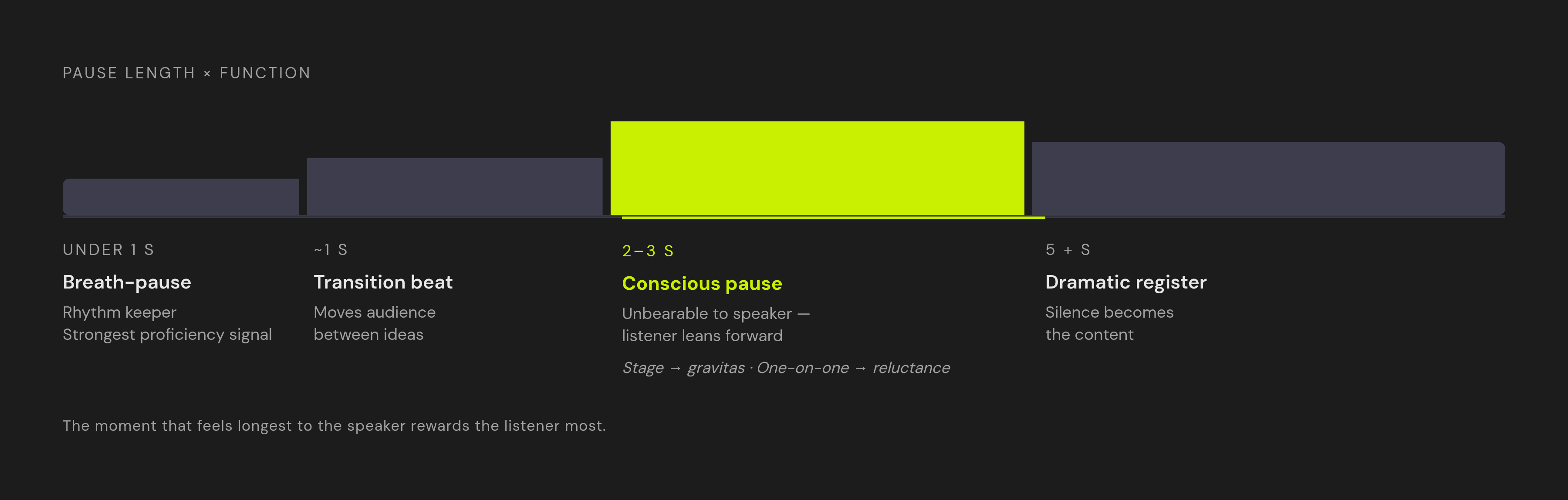
Treat pause length the way a musician treats rest value: there is no universally correct duration, only the right duration for the function being performed at that moment in the piece. Getting the length wrong for the context is a mistake in its own right, not a lesser version of not pausing.
Under one second is the breath-pause register, the rhythm-keeper of conversational speech. It is short enough that it doesn't register consciously as a "pause," yet a 2025 study in Language Testing found that even pauses shorter than a quarter of a second were the strongest predictor of both proficiency ratings and perceived fluency scores in monologue speech. Even the briefest hesitation is a legible signal to a listener's ear, whether or not the listener could tell you why they just revised their opinion of the speaker.
Around one second marks the transition beat, the pause that moves an audience from one idea or section to the next without creating a full stop. Research in Frontiers in Psychology found that at sentence boundaries, a range of durations (not a single fixed number) received the highest naturalness ratings, which is a useful detail for anyone who assumed there was one "correct" pause length to memorize and deploy identically every time.
Two to three seconds is where a pause starts to register consciously as a pause, by the audience and often, uncomfortably, by the speaker delivering it. Heldner and Edlund, researchers at KTH Royal Institute of Technology in Stockholm, found in 2010 that pauses of two to three seconds in conversation are perceived as noticeably long. The length that feels unbearable to the person speaking is close to exactly the length that makes a listener lean forward.
Five seconds and beyond belongs to the dramatic register, where the pause itself becomes the content. At that length, the silence communicates that what was just said deserves to be sat with, transferring the responsibility for staying engaged onto the audience.
None of this is an argument for pausing constantly. The goal of training pause length is not to insert more silence into a talk but to make the pauses that already occur land on purpose instead of by accident, at the duration the moment actually calls for.
What pause length does to how a speaker is judged
Duration doesn't only shape what a listener retains. It shapes what a listener concludes about the speaker's confidence, intent, and even goodwill, and that second effect turns pause control from a comprehension aid into a competitive skill.
On the authority side, researchers at the University of Michigan found that interviewers who used frequent short pauses were more persuasive than interviewers who spoke with perfect fluency, and interviewers who paused not at all posted the lowest persuasion scores of the group. Fluency, in other words, is not the asset it's often assumed to be; unbroken speech can read as rehearsed, evasive, or simply exhausting to track. Systematic pause and silence training has also been shown to cut most paralinguistic markers of reactive cognitive control, the pauses, false starts, and self-corrections that betray a scrambling mind, by more than 40 percent in trained interpreter trainees. An audience's sense that a speaker is composed is a direct readout of how well that speaker controls silence.
But pause length has a darker, more complicated social reading, and this is the finding that should stop anyone from concluding "longer pauses are always better." Research from the University of Vienna, led by Theresa Matzinger, found that a long pause before responding to a request is read by many listeners as a sign of lower willingness to help; for native speakers in the study, a longer delay before an answer was interpreted as reduced willingness to comply. That means the exact same three-second silence that projects gravitas from a stage can register as reluctance, even rudeness, when it follows a colleague asking for a favor. Context-reading is load-bearing: the same duration that builds authority in one setting signals resistance in another, and a speaker who can't tell the difference is applying a tool without reading the room it's being used in.
Negotiation is where this tension gets sharpest and most expensive. Most professionals, by one account, lose ground in a salary negotiation roughly four seconds after making their ask, because the silence that follows feels unbearable and they soften their own number before the other side has said a word. MIT researchers measured silence with a computer algorithm set to flag intervals of at least three seconds and found that pauses of that length or longer tended to precede breakthroughs, the moments where a creative option surfaced and both parties found something worth moving toward. The discomfort a speaker feels while holding that silence is the exact pressure that gives the other side room to move, and training the pause is, in a very literal sense, training the tolerance for that discomfort.
What practiced speakers show that matches the research
Speakers who get studied for their pause technique, rather than simply admired for "charisma," tend to share one trait: the silences are deliberate and timed, not an accident of personality. Barack Obama is a frequently cited example because the pausing in his delivery is structural throughout his speeches. It functions as part of the architecture of a speech, placed to let a line land, not as decoration dropped in for effect.
Steve Jobs offers a sharper case because it tests the limits of the taxonomy. Responding to a harsh audience critique during a Q&A, Jobs took a long pause, visibly thought, then delivered a measured answer, followed by a second pause before continuing: a moment that has since become a reference point in business communication. That pause ran well past the three-second mark where discomfort usually sets in, into territory research would flag as outside the normal comfort zone for silence. The pause worked because the visible thinking, the body language, and the quality of what followed all justified the silence, and that length only pays off when paired with intent and a follow-through that earns the wait. That raises the obvious next question: if the pause itself can be named, timed, and tied to outcomes this specifically, why doesn't everyone just do it?
Why the gap between knowing and doing is real
Knowing the taxonomy is not the same as executing it with an audience watching, and the gap isn't a character flaw. Two separate, compounding problems explain it.
The first is a calibration problem. Speakers reliably misjudge their own pause length: what feels like a confident three-second hold is frequently under one second in reality, and what feels like a dangerously long silence is often still well inside the range research calls natural. That means simply resolving to "pause more" without any outside check produces only modest change, because under the pressure of live speaking, the internal clock drifts right back to its miscalibrated baseline. Trying to fix a timing error using the same broken internal sense that caused the error is a bit like trying to tune a guitar by ear when the ear itself is the thing that's out of tune.
The second problem is a volume problem, and it's less about any one generation's character than about sheer repetition. Research that recorded more than 2,000 people across their daily lives found that people now speak far fewer words per day than they did in 2005, with the steepest drop among people under 25. Psychologists tie this to something closer to a freeze response than to shyness, a function of simply logging fewer hours of unscripted, real-time conversation. Pause control is a timing skill, and timing skills erode without repetition the same way any motor skill does; fewer unscripted conversations mean fewer natural chances to recalibrate. None of this should read as a verdict on anyone's communication abilities. It's a description of why deliberate, structured practice is necessary rather than optional, and it sets up the only real question left: what specific practice actually closes the gap?
Building pause precision as a repeatable practice
Pause control improves fastest with practice that is short, frequent, and scored, the same structure that builds any skill where timing is the whole point.
Fixing the calibration requires external measurement. Practicing specific target durations, 0.6 seconds, one second, two seconds, three seconds, against an actual timer trains the felt sense of silence to match its real duration. This isn't a single-session fix; it's a recalibration that has to be reinforced across many repetitions before it holds under pressure. Recording a practice session and reviewing the audio afterward adds the second half of the loop: it shows exactly where the pauses actually landed versus where they were intended to land, and that gap between intention and execution is the actual target of the training, not a side effect of it.
The filler reflex responds to substitution. Instead of "stop saying um," the more workable instruction is "replace the um with a counted silence," because giving the silence a specific duration to hit turns it into a positive action.
A few drills target the specific contexts covered earlier. A question-response drill, where a partner asks unpredictable questions and the speaker practices holding a full two-to-three second pause before answering without filling the gap, builds comfort with exactly the kind of silence that reads as gravitas rather than hesitation; the discomfort shrinks with repetition, and the quality of the answers tends to improve once the cognitive space is actually preserved. A negotiation drill, stating a number or position and then holding three full seconds of silence, builds tolerance for the exact discomfort that causes most people to soften their position before the other side has responded.
None of this works as a one-off. Programs like the one at the University of Wisconsin-Madison, which coaches instructors in how to facilitate discussion and treats talking as a skill to be explicitly taught rather than a trait some people simply have, point at the structural piece that makes practice compound: a feedback loop. Practice without scoring repeats the same miscalibration it started with; practice with scoring corrects it. The honest measure of progress is recordings that show a speaker consistently hitting the two-second consolidation beat after key points, with a filler rate that has measurably dropped across sessions. Vague encouragement produces vague results. Scored, measured repetition produces results that appear on the tape.
Sources
- Pauses, silences, and cognitive control: psycholinguistic markers of speech planning in interpreter training - PMC
- Exploring the optimal thresholds of silent pauses for measuring second language utterance fluency in monologic and dialogic speaking - Jianmin Gao, Peijian Paul Sun, Chenxin Li, 2025
- ORIGINAL RESEARCH published: 11 February 2022 doi: 10.3389/fpsyg.2022.778018