Recording and Reviewing Yourself for Speech Improvement
Seeing yourself speak exposes habits your brain can't catch alone.
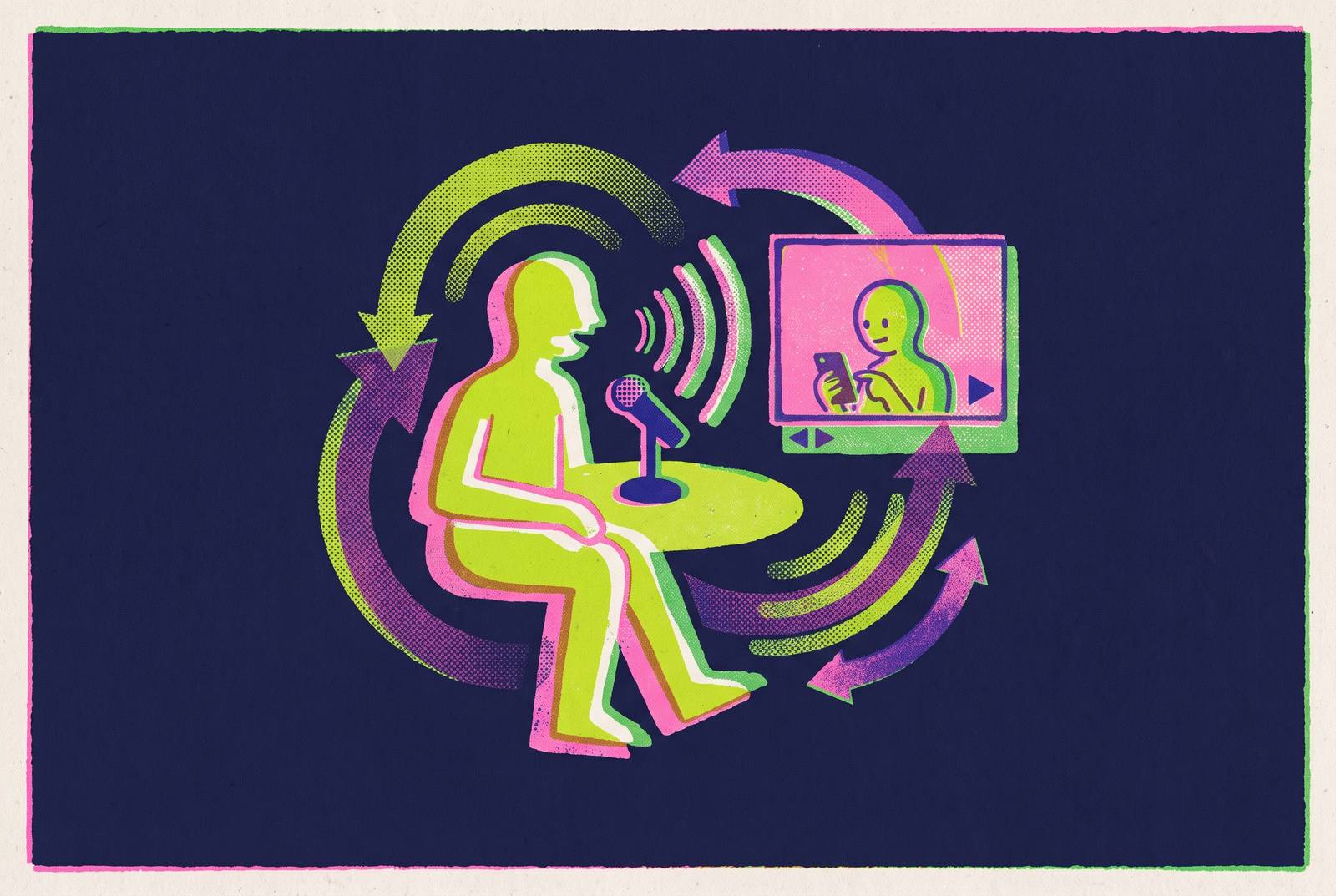
Nobody hears their own voice the way other people do, and that mismatch is why most people never fix the habits making them sound worse than they think. This piece looks at what happens when you close that gap: what recording and reviewing your own speech does to habits sitting below conscious awareness, what actually works, and where AI tools help versus where they just bolt a dashboard onto a problem that was never about data. Discomfort with your own recorded voice is a sign the feedback loop just switched on for the first time in your life. It's a sign the feedback loop just switched on for the first time in your life.
Your body has a built-in sense for where your limbs sit in space, even with your eyes closed, called proprioception. Close your eyes and try to touch your nose. You'll land close, because your nervous system tracks limb position constantly, correcting in real time without asking permission first. Speech never gets that luxury. Nothing in your head flags the fourth "like" in a single sentence, or catches your voice going flat the second you start talking about your own qualifications in an interview. The brain that produces speech and the brain that judges it are not, functionally, on speaking terms, and that gap is the entire reason this piece exists.
The same handful of habits keep hiding from the same handful of speakers, and Med School Insiders names the usual suspects: filler words ("um," "like," "actually"), pacing that speeds up under nerves, posture that collapses inward, eyes drifting to the ceiling instead of the room, a flat pitch that flattens otherwise good content along with it. None of these register from the inside, because attention during speech is fully spent on remembering what comes next. That's precisely why something other than your own judgment has to catch them.
The distortion runs both directions, too. Plenty of people underrate what they're doing well just as often as they overrate what's going wrong, and that cuts both ways badly enough that self-assessment alone is close to useless. An outside record exists to settle the argument. It just shows what happened, with no opinion attached, no flattery, no punishment.
The scale here is bigger than most people assume. Research published in Frontiers in Human Neuroscience put public speaking anxiety at around 63% of the general population at some level, a supermajority, not some rare phobia confined to a nervous few. If hitting play on a recording of your own voice makes your stomach drop, that's not a personal failing. That's just what being the median human sounds like.
These invisible habits carry a real cost, and "go practice your speaking" sounds like homework right up until you look at what skipping it actually does to a career.
The real cost of uncorrected speech habits in school, work, and social life
Public speaking anxiety doesn't confine itself to weddings and eulogies. Data cited by teleprompter.com puts the share of people worldwide who fear public speaking at around 75%, so three out of every four people walking into a meeting or a classroom presentation are carrying some version of dread before anyone says a word.
The career cost has numbers attached, not just vibes. Data from speakwiseapp.com shows speaking-related anxiety has led 45% of workers to turn down a promotion or skip applying for a job they wanted, and it's been linked to a 15% reduction in leadership advancement across a career. Those are raises that never got offered and titles that went to someone else in the room, someone who happened to speak up when it counted.
Almost nobody gets help for it, either. Only 8% of people who report public speaking fear ever seek professional support for it. Everyone else white-knuckles through client calls and Zoom all-hands, hoping nobody clocks the shaking hands or the sentence that trails off into nothing.
And here's where most people get the diagnosis backwards: they treat the anxiety itself as the disease, something to medicate or will away, when 90% of pre-presentation anxiety comes down to a lack of practice rather than some fixed trait baked into personality. That single number reframes the whole problem. The dread in the fifteen minutes before a talk is really just a measurement of how much rehearsal happened beforehand, and rehearsal happens to be the one variable anyone can actually control.
The stakes don't stay confined to the boardroom. The Elocution Coach holds that how something gets said carries nearly as much weight as what gets said, and a strong answer delivered in a flat voice with a wandering gaze loses to a mediocre answer delivered with confidence more often than most people want to admit. That plays out in job interviews, first dates, seminar rooms, pitch meetings. Calling speech clarity a corporate soft skill undersells it badly. It functions closer to a universal edge, available in every room where a decision gets made inside a few spoken minutes.
What the research shows about recording yourself
Skip the slow build and go straight to the number: a study published in the Journal of Quality in Education found a 6.43% difference in speaking skill development directly attributable to self-video recording as a training method. That's not a rounding error, and it isn't a one-off finding either. Several independent studies are in the same neighborhood, and that convergence means something.
Research tracking students who recorded practice presentations before delivering the real thing in class has found the recorded group showed up more confident, better prepared, and less nervous when it counted. Reviewing their own footage raised awareness of presentation habits without spiking anxiety, which cuts directly against the intuitive fear that watching yourself back only makes things worse.
A study of 65 students at Universitas Tidar found a consistent positive trend, across both questionnaire responses and interviews, in self-confidence tied to self-video recording practice. Research has found that students who repeatedly watched and rated their own recordings grew more confident, more motivated, more self-directed. They started catching specific problems, body language quirks, flat intonation, mistimed pauses, weak vocal emphasis, that they hadn't been able to name before seeing themselves on camera. A recording turns a vague sense that something's off into a specific, fixable target, which is the whole mechanism this piece keeps circling back to.
A 2024 literature review in the International Journal of AI in Language Education confirmed the pattern: video recording builds fluency, pronunciation, and self-confidence. It also flagged that the method stays underused, particularly in Vietnam, where instruction leans heavily on written grammar over communicative practice, and where limited access to technology and gaps in teacher training make recording-based methods harder to scale.
None of that works if the recording just sits there unwatched, though. A study on arXiv by Fourati et al., built on 16 semi-structured interviews and two focus groups with public speaking experts, found that feedback only changes behavior when it's personalized, clearly explained, and narrowed to a manageable set of points. Handing someone a transcript with forty flagged filler words and a pacing graph doesn't move the needle much on its own. Interpretation makes the data usable, which raises the obvious next question: how do you turn a recording into something you can act on?
How to review a recording so it changes your behavior
A recording without a structured review is just an uncomfortable home movie. The footage teaches nothing by itself. The review is where the loop actually closes, and most people skip straight past it to the cringing part and mistake the cringe for the lesson.
A workable structure runs three separate passes, each isolating one sense at a time. Mute the audio first and watch only the body: posture, hand placement, eye contact, facial expression, noted without editorializing yet. Then close your eyes and just listen: pace, filler word frequency, whether pitch varies or sits flat, where pauses land and how long they run. Finally watch the whole thing together, sound and picture, and see if the physical delivery matches what the words are trying to do. Does "I'm confident about this" land as confident, or do slouched shoulders and a mumbled cadence quietly undercut the sentence sitting right on top of them?
Restraint beats thoroughness here, and that's the part almost everyone gets wrong on the first try. Expert guidance consistently caps a review at two or three specific targets per session, and that ceiling is doing real work. Trying to fix filler words, posture, pacing, and eye contact in the same pass leads to zero problems solved instead of two. Attention split six ways lands somewhere close to attention paid to nothing.
The distinction between deliberate and routine practice earns its keep here, and it's the one distinction most self-taught speakers never draw. The distinction is between deliberate practice, which is structured, targeted, and feedback-driven, and routine practice, which just runs through familiar motions with no specific target attached. Giving the same rehearsed speech to an empty room for the tenth time is routine practice, full stop. Watching that recording back and hunting for one specific thing to fix is what makes the eleventh attempt deliberate.
Some concrete methods put numbers behind this. The 4/3/2 strategy has speakers repeat the same content three times with the time limit shrinking each round: four minutes, then three, then two. The compression forces faster, more efficient language processing and has been shown to build fluency. Similarly, vlogging-style tasks, recording yourself talking to a camera as if addressing a real audience, encourage genuine engagement rather than memorized recitation.
Listen closely to someone who speaks well, note their intonation and rhythm, record yourself attempting to mimic it, then compare the two. Call it tracing over a drawing to learn the line weight before trying the same lines freehand.
None of this pays off in one sitting. Fluency and confidence gains become visible only across a string of recordings viewed side by side, not in the gap between one take and the very next one, which is the whole argument for treating this as a running log instead of a single correction.
What AI tools add to the self-recording loop
AI earns its place here on a fairly narrow basis. No human reviewer, however sharp, counts filler words or tracks pacing drift across twenty sessions with the consistency of software built to do exactly that and nothing else. Analysis from umevo.ai makes the case that automated tracking replaces "did that get better or does it just feel better" with an actual count.
The experts interviewed for that same 2025 arXiv study were careful about where the usefulness ends, though. Their read: AI handles the repetitive technical layer well, tallying "um"s, flagging pace spikes, freeing a human coach's time for the higher-order work like tone, framing, reading a room. Current tools still fall short on making feedback personalized and appropriately narrowed rather than just comprehensive for its own sake, which sounds like a small gap until it's forty flagged instances of "actually" sitting in one transcript. The conclusion those researchers landed on was a hybrid model: software for the counting, a human for the judgment calls. That split matters more than any single feature list, because the judgment calls are what none of these tools claim to make.
None of the handful of named tools active as of 2026 make the judgment call. They're all counters and trackers dressed up with different features.
Yoodli tracks recorded or live speech across six dimensions: filler words, pacing, eye contact, vocabulary diversity, talk-to-listen ratio, and conciseness. It plugs into Zoom, Teams, and Google Meet, and as of 2025 added customizable roleplay scenarios with AI-generated skeptical audiences and tough interviewers, with multi-persona panel simulations expanding further in 2026. Pricing runs $8 a month for Pro and $20 a month for Advanced, both billed annually.
Articulate, built for iPhone and Android, offers nine recorded drills covering delivery, content, and presence, including modules named Filler Eliminator, Freestyle, Speed Breakdown, Debate Yourself, Scenario Practice, and Voice Type. Each attempt gets scored across six categories: clarity, fluency, structure, vocabulary, confidence, engagement.
Speech Companion, a tool built by speech coaches, focuses on real-time detection of "um," "uh," and "like" delivered through haptic alerts, alongside progress tracking and Apple Watch heart-rate monitoring during live presentations, tying physiological stress data directly to delivery data.
Speakio takes the broadest multi-metric approach, measuring words per minute, filler word frequency, tone, clarity, energy level, detected emotion, and pause length, aiming for a full picture instead of a single score.
Real user feedback gathered via umevo.ai gives a sense of what this looks like in practice. One user didn't realize they said "actually" every time pricing came up until they read the transcript back cold. Another ran a speech through an AI review tool several times before a club meeting and said that by the time they hit the stage, the "ums" were gone, freeing attention for eye contact instead.
Still, the research stays consistent about where the ceiling sits. AI tools don't gauge emotional impact on a live audience, and they don't replace the layered, situational coaching a human brings to one specific speaker's specific weaknesses. Treat AI here as a very good stopwatch paired with a very patient counter: precise, tireless, genuinely useful for the technical layer, nowhere close to being the whole coach. Anyone expecting otherwise is going to be disappointed by version 2.0 same as version 1.0.
Building the habit: why daily short-form recording beats occasional marathon sessions
Research from Frontiers in Education found a real correlation between hours spent actively practicing speech and gains in fluency. The emphasis sits on active, structured output, not passive exposure like listening to podcasts about public speaking without ever opening a microphone yourself. Passive exposure feels like progress and produces almost none, which is the trap most people fall into first.
The psychological case for consistency has real backing. A meta-analysis covering 26 studies and 2,253 participants found that structured psychological interventions, practice among them, produced large reductions in public speaking anxiety symptoms. That's a solid evidence base for a fix that costs nothing beyond a phone camera and five spare minutes.
Short daily reps beat rare marathon sessions for a fairly mechanical reason: a skill practiced in small, frequent doses stays active in working memory, letting small corrections stack on top of each other instead of getting forgotten across the three weeks between sessions. It's the same logic behind why athletic training runs in daily cycles instead of one exhausting session a month. Nobody trains an athlete by cramming everything into a single Saturday, and speech is a motor skill before it's anything else.
A small pilot called SpeakAR, presented at PCSC in 2025 by researchers at De La Salle University, tested this with just five participants across six speaking tasks each, using augmented reality exposure. Even at that scale, brief and structured practice sessions raised confidence, reinforcing the broader point: low-stakes, repeated exposure adds up, even when no single session looks impressive sitting on its own.
The habit itself doesn't need to be complicated, and overbuilding it is probably the fastest way to abandon it inside two weeks. One prompt, one short recording, one structured review pass, run daily, beats a single all-day workshop attended once a quarter. The tracking matters as much as the reps: comparing multiple recordings side by side over time turns "I think I'm getting better" into a trend line with an actual score attached, something to point at instead of just a feeling to trust.
The blind spots from the start of this piece, the filler words, the flat pitch, the wandering eyes, only stay blind for as long as nobody makes a record. Every recording is a rep. Every reviewed rep moves you one step further from just talking and one step closer to actually communicating on purpose.
Sources
- Speak with Confidence: Designing an Augmented Reality Training Tool for Public Speaking
- How to Improve Your Public Speaking as a Student | Med School Insiders
- Probing Experts' Perspectives on AI-Assisted Public Speaking Training
- Thirty years of public speaking anxiety research: topic modeling and semantic trend forecasting using LDA�Word2Vec integration
- researchgate.net
- researchgate.net
- teleprompter.com
- insight7.io