Spaced Repetition for Retaining Verbal Habits
Drilling verbal habits in spaced intervals builds fluency far better than cramming or workshops.

Memory science explains why some people sound composed on command while others freeze mid-sentence, and talent has almost nothing to do with it. Spaced repetition, the same mechanism that makes flashcards stick, applies just as directly to verbal habits: filler-word control, pausing, storytelling, the way someone opens a point under pressure. Most people apply the science to vocabulary lists and never once to their own mouths, which is a little like owning a weight rack and only ever using it to hold towels. If verbal confidence is trainable through spacing, then most of what passes for "communication skills" coaching, the weekend bootcamp, the binge of watching recorded talks online, is aimed at the wrong mechanism entirely.
Hermann Ebbinghaus mapped the underlying decay pattern back in 1885 with his forgetting curve. Without review, memory fades on a fairly predictable schedule, and each spaced review does not just top the memory back up. It consolidates the information into longer-term storage and flattens the future decay rate. That's the whole engine spaced repetition apps run on. Cramming produces something that feels like fluency but isn't, since massed practice loops information through short-term memory without ever forcing reconstruction, so the fluency is real for about six hours and gone by morning. Brown, Roediger, and McDaniel describe the alternative in their research on learning and memory: effortful retrieval after a gap makes the memory pliable again, open to updating, and that friction is when it actually strengthens. Qadir and Imran (cited at justinmath.com) compare it to lifting weights, where a single long gym session gives a pump that deflates by dinner, and real growth comes from spaced effort and rest cycles, not one heroic session. Timing decides the outcome either way: timing the review matters: too soon or too late, and the consolidation benefit is diminished or lost. A study in Academic Medicine confirmed spaced repetition beats repeated study for long-term retention, though the field still hasn't nailed down ideal spacing intervals.
Why memory of a fact and ability to use it in speech are two different things
Standard spaced repetition is excellent at one narrow job: keeping discrete items alive in memory. Vocabulary, dates, chemical formulas, whatever fits on a card. Recalling a word is not the same skill as using it correctly at conversational speed, though, and an analysis on arxiv.org of spaced repetition systems in language learning found exactly that gap. Someone can nail a flashcard for "nonetheless" and still never insert it naturally into a sentence when it counts, which is its own small tragedy of wasted vocabulary.
That gap appears in the outcomes research too, and the numbers look great right up until they don't. Mahdi's 2018 meta-analysis found a medium effect (g ≈ 0.67) favoring spaced-repetition apps over paper flashcards for pure retention, and Mihaylova et al. (2022) found a bigger gap still (g = 0.88) for mobile-assisted learning against traditional study. Sounds like a clean win for the apps. Once researchers looked past retention and checked actual use, though, the advantage shrank or disappeared entirely: Li and Hafner (2022) found no significant difference in productive vocabulary use between app users and traditional learners, and Gou (2023) found the same pattern for writing and speaking tasks, where app users didn't reliably outperform anyone once the test required output instead of recognition. Recognition and production are different muscles. Most apps only train one of them, and that is the design flaw this whole piece keeps circling back to.
The fix is not a better app for recognition. It's a different unit of practice altogether: not a word sitting alone on a card, but a whole sentence-opening gambit, a transitional phrase, a storytelling structure, a pivot move for getting out of a conversational corner. Chen and Yang's research (cited at lgpress.clemson.edu) points to why: elaborative encoding, meaning items tied to real context and real use rather than isolated on a card, gets remembered more vividly across repeated exposures. Memorizing a phrase is not the same as embedding it, and the apps built for the former have very little to say about the latter.
What verbal fluency and eloquence consist of, and why they are trainable
Eloquence gets treated like a trait people are either born with or aren't, the verbal equivalent of being tall. That framing is backwards, and it's worth saying so directly instead of hedging around it. Eloquence can be broken down into component skills that combine, and the research backs the claim that anyone willing to slow down and choose words with intention can build them. Fluency in a live discussion, the appearance of effortless response, usually comes from familiarity and preparation stacked up over time, not from some native gift. Research on spoken communication backs this directly: preparing speech in advance consistently produces more fluent delivery, and listeners pick up on that fluency and judge the speaker more favorably for it.
The trainable pieces are specific and unglamorous. Cutting filler words. Pausing on purpose instead of filling silence with "um." Controlling pace, varying vocal tone, choosing words instead of grabbing the first one available, listening actively rather than just waiting for a turn to talk. The pause is the most counterintuitive one on the list: a deliberate silence reads as composure rather than hesitation, and it buys the speaker a half-second to pick the right word instead of the nearest one. That only becomes usable under pressure once it's drilled to the point of automatic, the same way a free-throw shooter doesn't think about elbow angle mid-game.
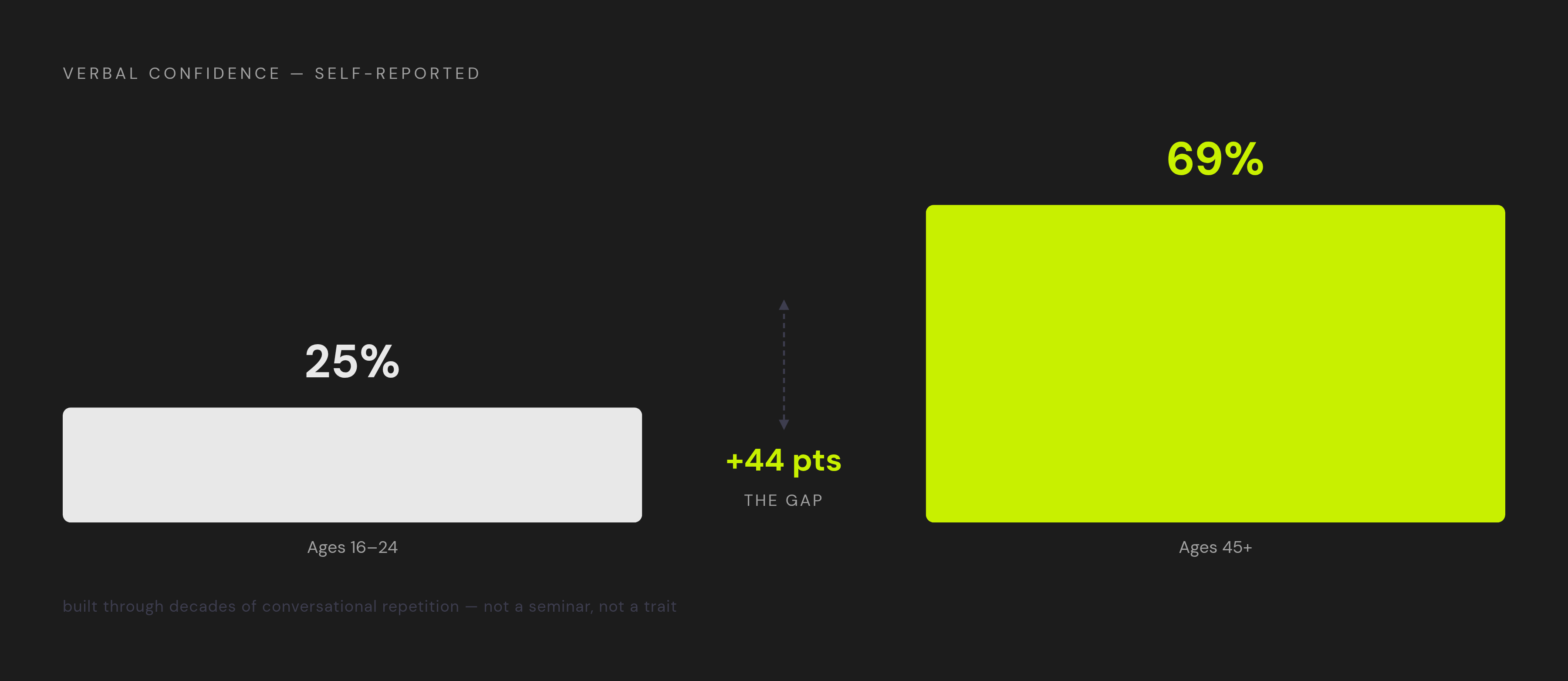
One number says more than any theory here. Cross River Therapy's data put confidence at 69% among people 45 and older, against just 25% of 16 to 24 year olds. That's a 44-point gap, and it did not come from one generation attending a better seminar. It came from decades more repetition, confidence accumulated the unglamorous way, one conversation at a time.
How public speaking anxiety confirms that confidence is a repetition problem, not a talent problem
About 75% of the population reports some level of speaking anxiety, and roughly 15 million people live with glossophobia, fear of public speaking, as a daily condition (Cross River Therapy). That's not a niche fear reserved for people forced onto a stage. It's close to a universal experience, and that fact alone is the clue that talent isn't the deciding variable here. Talent would predict that fear clusters among people who are objectively bad at speaking, but it occurs in skilled speakers and unskilled ones alike, which points toward a mechanism everyone shares rather than a trait some people simply lack.
The stakes touch nearly every workday for most working adults, too, since around 70% of jobs require some form of presenting, according to one industry vendor. Data from Novoresume, cited by that same vendor, found that speaking anxiety has led 45% of workers to turn down a promotion or skip applying for a job outright, and it cuts wage potential by roughly 10% and leadership advancement by about 15% over a career. That's a tax on income and advancement, paid quietly by nearly half the workforce, and paid in silence because nobody puts "afraid of Q&A" on a performance review.
It responds to treatment, not to bravery, which should reframe the whole fear. Research on psychological interventions has found they can produce meaningful reductions in public speaking anxiety symptoms. Research on performance anxiety notes that it typically spikes right at the start of a talk and settles within minutes, so the worst moment is also, conveniently, the shortest one. That's a pattern spaced exposure is built to exploit: repeated, brief encounters with the scary moment, spaced apart, teach the nervous system that the spike passes and doesn't kill anyone. Confidence gets built piece by piece before anyone ever stands up to speak, and that work happens nowhere near a podium.
Applying spaced repetition logic to verbal habits: what the practice units look like
Standard spaced repetition draws its power from free recall: producing the answer cold, from memory, before flipping the card to check. Recognizing the right answer on a multiple-choice quiz barely counts, and this is exactly where most language apps quietly cheat the difficulty down. The verbal equivalent is speaking a full response out loud, unscripted, not just having the right word float through someone's head and calling that fluency.
What deserves the flashcard treatment is behavioral chunks: sentence-opening gambits, the phrases that get a point started when the room goes quiet and expects someone to talk. It's behavioral chunks: sentence-opening gambits, the phrases that get a point started when the room goes quiet and expects someone to talk. Transitional phrases that signal to a listener where the structure is headed. Storytelling beats, setup, tension, resolution, rehearsed as a repeatable sequence rather than reinvented every time. Pivot phrases for redirecting a conversation that's gone sideways, and pause habits deliberately built to replace the "um" and "like" that fill dead air by reflex.
An arxiv.org analysis of conversation-based learning tools found that recommendations drawn straight from a conversation can trigger short, targeted review sessions, with mastery checks afterward confirming whether the review actually worked. That's the feedback loop spaced repetition depends on. Without knowing whether a retrieval succeeded, the review schedule has nothing to adjust against, and it just keeps recycling the same interval blindly.
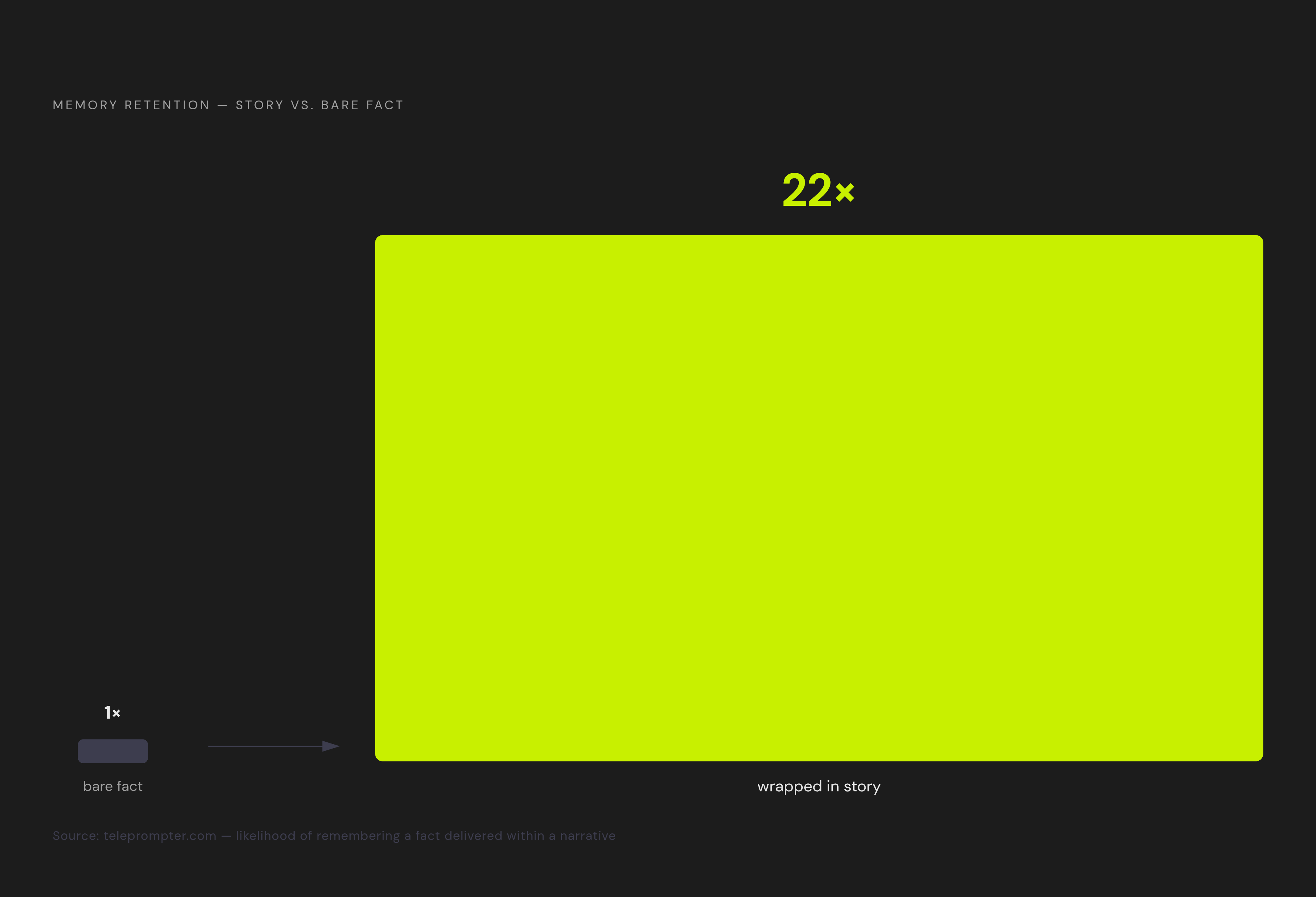
Storytelling deserves more attention than the other four categories combined, and this is the one place where the research isn't subtle about it. According to teleprompter.com, people are up to 22 times more likely to remember a fact when it's wrapped in a story compared to the fact presented on its own. Research into storytelling practice among students has found measurable gains in verbal fluency generally, not just better recall of the stories themselves. Storytelling structure operates as a force multiplier that makes everything else stickier, outranking any single item on a drill list sitting next to the others. It's a force multiplier that makes everything else stickier, and a practice system that treats it as equal to, say, filler-word counting is underweighting the highest-leverage input available.
Cognitive psychology research adds one more wrinkle: contextual diversity matters. The surrounding context, meaning who's listening, where the conversation happens, what's at stake, shifts naturally over time. Practicing a phrase across varied situations builds a wider set of retrieval cues than practicing it the same way every single time. A daily format built around one prompt, one recorded response, one review, functions as the verbal version of a flashcard session. The constraint of speaking out loud, on the spot, is what forces free recall instead of the passive recognition that quietly accomplishes nothing.
What consistent short daily sessions produce that occasional marathon prep cannot
Most people using spaced repetition systems see real gains in retention within two to four weeks of showing up daily, and by six months of consistent use, a typical user has built durable recall across hundreds or even thousands of items that would otherwise have faded. That's not a fast payoff. It's a compounding one, and the distinction matters more than it sounds.
The mechanism producing the compounding is simple. Each successful review at the right interval pushes the next review further into the future, so a verbal habit that needed daily reinforcement in week one might only need a check-in every few weeks by month three, eventually running on autopilot with just an occasional refresh. Compare that to the person who rehearses for three hours the night before a big presentation, cue cards in hand, coffee going cold. Brown, Roediger, and McDaniel's research explains exactly why that late-night cram feels so productive and does so little: it loops through short-term memory, producing a warm sense of mastery that evaporates by the time the meeting actually starts. Ten minutes a day for a month beats the three-hour cram session, and it isn't close.
Structured, repetition-based confidence programs back this up outside the lab, too. Studies on structured public speaking programs have found significant gains in students' self-confidence, alongside a real drop in anxiety, once they'd completed a program built on repeated exposure. Hours logged wasn't the variable that mattered. Structure and spacing were, full stop, and that's a genuinely inconvenient finding for anyone hoping a single weekend bootcamp will fix a decade of avoidance.
There's a useful parallel buried in Brown, Roediger, and McDaniel's work on essay drafting. A first draft is usually loose and imprecise, and setting it aside before returning later sharpens both argument and language, almost without conscious effort. Verbal habits reconsolidate the same way. Each practice session doesn't start from zero, it refines whatever the last session left a little rough around the edges.
Tools that support spaced verbal practice, and what to look for in each
The market has noticed the demand, even if most of it is still solving the wrong half of the problem. The global language learning app market sat around $6.3 billion in 2024 and is projected to grow several times over by 2033, according to polychatapp.com. That's a lot of capital chasing the assumption that people want to get better at communicating. Most of those tools, though, are tuned for vocabulary retention, not for the harder work of getting a phrase to come out of someone's mouth correctly while a clock runs and a room waits.
It helps to know what each tool actually optimizes for, because they are not interchangeable and treating them as such is the first mistake most people make when they pick one. Anki sits at the open-source, fully customizable end: it can be bent into a system for drilling verbal habits with audio cards, but the user has to build that system by hand, since nothing comes pre-configured for speech. RemNote and Mochi work as combined notes-and-flashcards platforms, useful for building a personal library of verbal frameworks (an opening line, a transition, a pivot phrase) and reviewing them on a set schedule. Duolingo remains the standard for word-level vocabulary retention through spaced repetition, and it's genuinely strong at that specific job, though it runs into the same wall Li and Hafner documented: recognizing a word on a phone screen doesn't guarantee it appears in a live sentence three hours later in a meeting. WordUp leans on audio and video, closer to contextual exposure than pure flashcard drilling. Lingvist adjusts its review intervals automatically through an adaptive algorithm. Chunks, built for humanities-style content without the overhead of manually building decks, launched in 2026 as another entry in the space.
None of these fully solve for scored, free-recall practice under time pressure with feedback on delivery rather than content. That gap, the distance between drilling a phrase quietly at a desk and getting scored on how it comes out live with no script and a clock running, is the actual bottleneck. A daily format built around one speaking challenge, recorded and scored on something like a 0-to-100 scale, closes that gap by forcing real production instead of recognition, creating the feedback loop spaced repetition can't function without. No signal on whether a retrieval succeeded means no way for the schedule to adapt. Research summarized at heklin.com points at the same conclusion from a different angle: the learners who get the best results aren't using one tool in isolation, they're stacking vocabulary drilling, structured contextual input, and something that forces real-time activation of the material. The same stack applies just as well to verbal habits as it does to a second language, and picking just one leg of that stool is why so many fluent-on-paper speakers still freeze in the actual room.
Why Gen Z and young professionals face a compounding disadvantage without deliberate verbal practice
A Censuswide survey of 2,004 workers, reported by Fortune, found that 80% of the 1,002 Gen Z respondents called generational differences in workplace language a real challenge, compared with just 30% of the 1,002 boomers surveyed. That's a 50-point gap on the simple question of whether office language is even parseable.
The same survey found something almost funny, if it weren't also a real professional liability. Only 22% of Gen Z respondents knew what "boil the ocean" meant, and only 25% recognized "blue-sky thinking." Office idiom is its own dialect, and nobody hands out a phrasebook on day one. It gets picked up through exposure, which raises the obvious question: what happens to the group getting less of that exposure by design?
Forbes cited career coaches and leadership experts pointing to remote work and remote learning as a specific disadvantage for Gen Z's verbal communication development. The mechanism isn't mysterious. Text-based, asynchronous communication, the default mode for a generation that came up on workplace messaging apps and group chats, doesn't apply retrieval pressure. It doesn't force real-time feedback, and it doesn't carry the social stakes that push a verbal habit from merely understood to fully automatic. A typo gets edited before anyone sees it, but a verbal stumble can't be walked back the same way, and that live, unforgiving pressure is exactly what spaced verbal practice is built to simulate safely, before it happens in a real meeting with a real client on the call.
Layer that onto the earlier anxiety numbers, the ones showing many Gen Z workers reporting real discomfort with formal speaking situations, and it maps directly onto that 45% of all workers who've turned down a promotion because of speaking anxiety. The disadvantage compounds because spaced repetition doesn't scale in a straight line. It scales exponentially, so small, consistent gaps in practice early on turn into wide gaps in ability later, and the widening has nothing to do with who's naturally more gifted. It's math applied to habit formation, plain and a little unforgiving. The same mechanism that makes a flashcard stick after five spaced reviews is what makes a sentence-opening line feel unremarkable and automatic after thirty real conversations. Whether that thirty-conversation threshold gets crossed quickly, slowly, or not at all comes down to one variable: whether someone actually built a system to get there on purpose, instead of hoping repetition would happen by accident.