Glossophobia Prevalence Rates and Who Actually Has It
Rigorous data reveals far fewer people have clinical glossophobia than the viral statistic suggests.
Sorting out the difference between ordinary pre-speech nerves and a genuine clinical fear changes who actually has glossophobia, how severe it gets, and why the real numbers reveal a much smaller affected population than the viral stat suggests.
What the 75% statistic measures
Open a coaching deck, scroll a LinkedIn post about "overcoming your fears," or skim a listicle on public speaking tips, and the 75% figure appears in each one Teleprompter.com. Teleprompter.com's 2025 figure states that 75% of people experience "some level" of anxiety about public speaking, and that phrase, "some level," is quietly carrying the entire argument.
Neither number is fabricated. Neither is really lying to anyone. But "some level of anxiety" describes an experience closer to stage butterflies than to a clinical condition, and that is the sleight of hand baked into the framing. A stat built to describe near-universal nervousness gets read repeatedly as a stat about a diagnosable disorder. The gap between those two readings is where most of the public confusion about glossophobia actually lives.
What's the more useful thing to ask buried under the viral one? The better question is where nervousness ends and phobia begins, and that requires actually defining glossophobia in clinical terms rather than repeating a percentage. Crown Counseling, in a report updated September 26, 2026, puts the figure at 77%, reflecting similar methodology and similar definitional looseness as found in Crown Counseling and Teleprompter.com / Mehrabian.
What glossophobia is, clinically
Glossophobia is not just nerves with a fancier name. Clinically, it sits under the umbrella of Social Anxiety Disorder (SAD), classified either as its own situational specific phobia or as one manifestation of a broader anxiety condition. The mechanism matters here more than the label: SAD involves a cognitive predisposition to expect harsh judgment from other people, and that expectation kicks in well before anyone opens their mouth. The mind runs its own preview reel of humiliation, stumbling, and public failure, and that reel plays on a loop regardless of whether the actual audience is hostile, friendly, or half-asleep on their phones.
This separates ordinary nerves from clinical fear. Nerves respond to the actual room. Glossophobia responds to an imagined one, constructed in advance, and often bears little resemblance to what's really about to happen.
There's a physical signature to this too, and it is not subtle. Layer cortisol on top of that, and something almost darkly comic happens: the stress hormone that's supposed to help the body cope actually impairs working memory and verbal fluency, sabotaging the exact skill it's afraid of failing at.
Fear tends to peak in the moments right before speaking starts, which is precisely where clinical glossophobia diverges most sharply from garden-variety nerves. Ordinary anticipatory anxiety is adaptive; it sharpens focus and can genuinely improve delivery. Clinical glossophobia does the opposite: it drives avoidance, degrades performance, and, left unaddressed, reinforces itself every time the anticipated disaster fails to materialize but the fear doesn't update accordingly.
The rigorous survey data behind the viral stat
Here's where the numbers start to diverge from the version everyone's seen on a slide deck. The Chapman University Survey of American Fears takes a more careful approach, asking a nationally representative sample to rate their fear using specific categories: "Very afraid," "Afraid," "Slightly afraid," and "Not afraid," with the headline figure usually reported as the share who land in "afraid or very afraid," not anyone who reports feeling anything at all.
Under that stricter framing, the numbers drop substantially. Voxbooster.com reports that public speaking was feared by 33.7% of Americans in 2025, placing it 46th out of more than 65 fears surveyed. In 2024, the same kind of measurement put the figure at 29.0%, ranking public speaking below the fear of sharks (34.6%), heights (34.7%), and even dying (31.6%) ZipDo. That last comparison directly undercuts one of the most repeated claims in public speaking coaching culture: that people fear public speaking more than death itself. Under rigorous measurement, they don't. Not even close.
So which number is right, 75% or 29% Crown Counseling ZipDo? Both, technically, because they're not measuring the same thing. The gap between them is the gap between "have you ever felt nervous" and "are you genuinely afraid," and treating those as interchangeable is where most of the public confusion originates Crown Counseling ZipDo. One is a near-universal human experience. The other is a meaningfully smaller subset of the population with a real, measurable fear response.
That raises an obvious follow-up: if the population isn't a clean binary of "afraid" and "not afraid," what does the actual distribution look like?
The severity spectrum: from nerves to genuine phobia
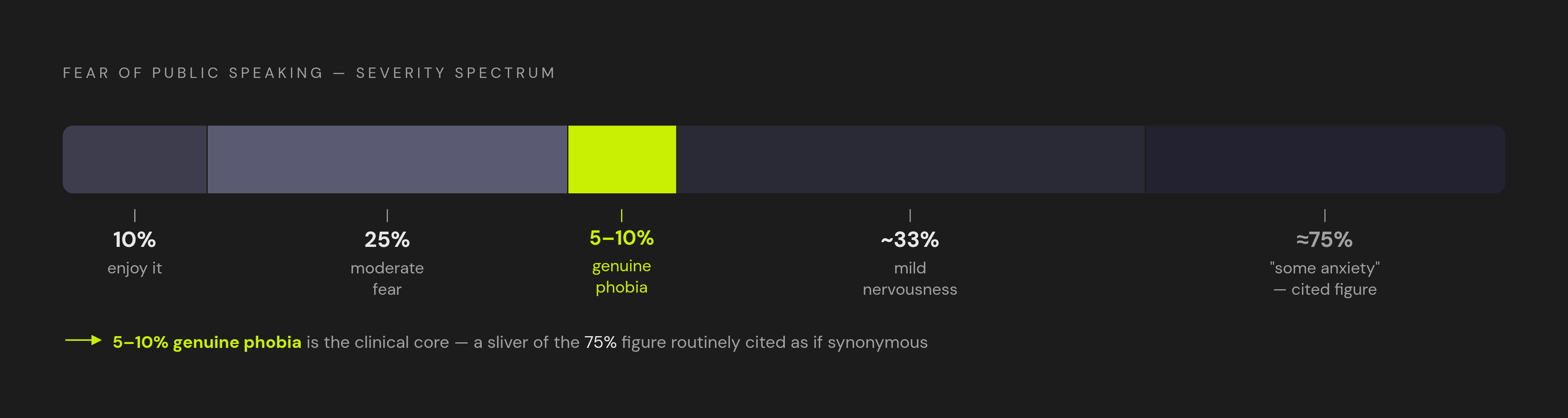
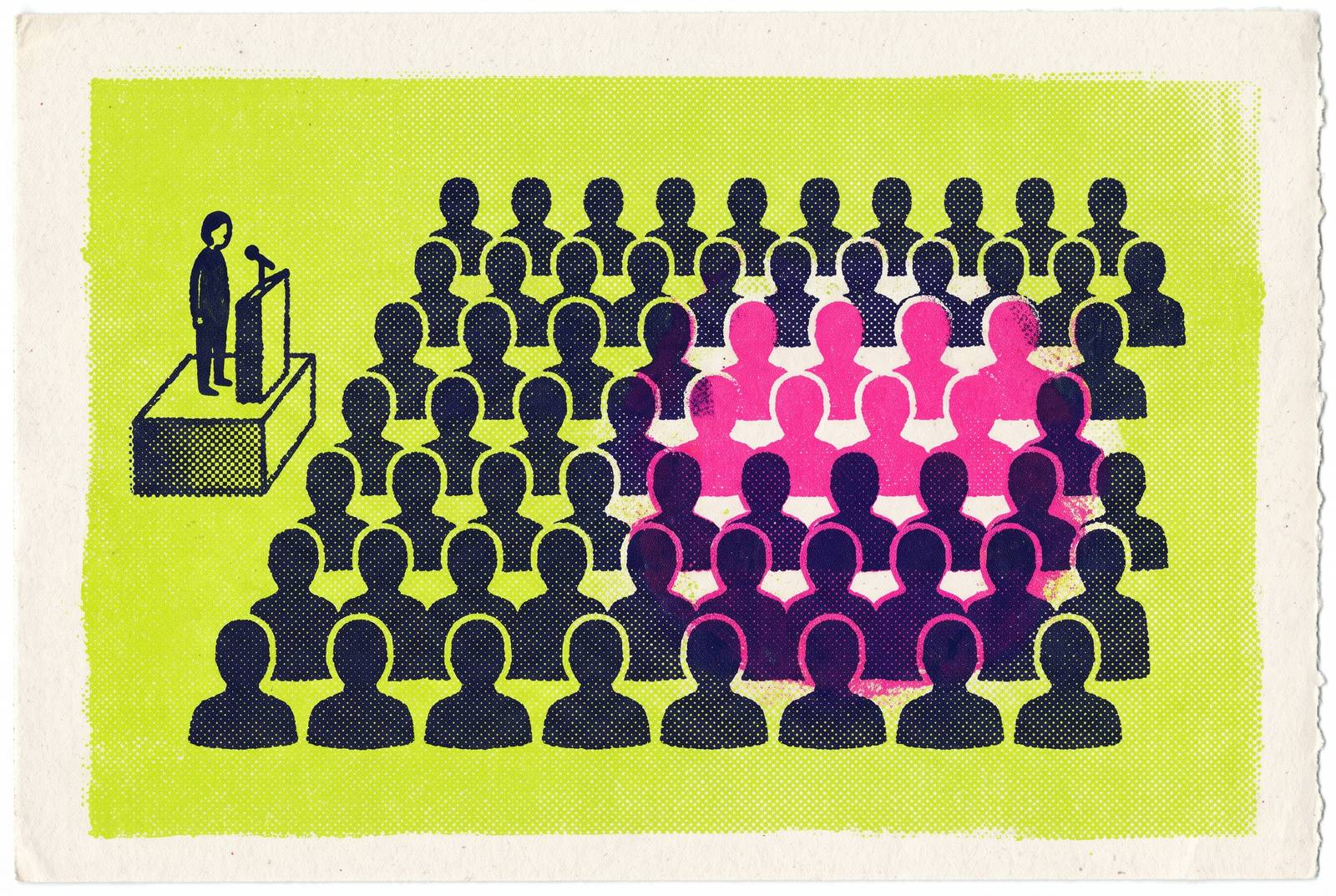
Picture it less as a light switch and more as a dimmer. On one end, roughly 10% of people report actively enjoying public speaking; on the other, about 10% are genuinely terrified, and the remaining 80% occupy the wide, unglamorous middle ground of mild-to-moderate discomfort Ambitions ABA. Severe glossophobia, the kind that produces real avoidance and real impairment, affects an estimated 5% to 10% of the population Supportive Care ABA Ambitions ABA. Moderate fear touches roughly another 25% Supportive Care ABA.
Then there's the clinical floor underneath all of this. NIMH data cited via voxbooster.com shows Social Anxiety Disorder affects 7.1% of US adults in any given year and 12.1% over a lifetime, and glossophobia as a clinical phobia sits as a subset of that broader disorder, not as its own separate epidemic. Among people already diagnosed with SAD, somewhere between 40% and 60% experience glossophobia specifically, with the range depending on how severe the underlying disorder is ZipDo. Crown Counseling's 2026 figures push that even further within the diagnosed population: 89.4% of social anxiety disorder patients report a specific fear of public speaking. That's a striking number, but it describes people who already carry a diagnosis, not the general public wandering around at a dinner party.
Put the 75% figure back on this map and it becomes clear what it's actually capturing: the outer band, everyone who has ever felt a flutter of nerves before a toast or a work presentation. The clinical core, the population for whom this is a genuine, functionally impairing phobia, is a fraction of that outer ring. The nervous and the phobic groups are distinct populations, each documented at different rates in the data. They're just not the same group, and conflating them is how a statistic about common discomfort gets mistaken for an epidemic of diagnosable fear.
Who is disproportionately affected: age, gender, education, and income
Fear of public speaking is not evenly distributed, and the pattern says something about where confidence comes from.
Gender shows one of the sharpest splits in the data. Women are roughly twice as likely as men to report specific phobias including glossophobia, at 12.2% versus 5.8% Crown Counseling. The sources don't fully resolve why, pointing to some combination of hormonal, social, and cultural factors without settling on a single driver, which is a fair, if slightly unsatisfying, place to leave it.
Education tells a more intuitive story. Among people with a high school education or less, 52% report a fear of public speaking, compared to 24% of those with a college degree. That's not really a story about intelligence or temperament. College, whatever else it is, forces a lot of standing up in front of rooms full of people, semester after semester, and repeated exposure appears to wear the fear down over time.
Income produces maybe the starkest number in the whole data set, and one of the least discussed. In communities earning under $50,000 a year, 86% report intense fear of public speaking Passive Secrets. That's an enormous figure, and it raises a genuinely open question about causality: does financial precarity heighten social anxiety, does limited access to practice and coaching leave the fear untreated, or is something else entirely driving that number? The data flags the correlation clearly; it doesn't settle the mechanism, and neither should anyone repeating it. At a national level, roughly 40 million American adults live with some form of public speaking anxiety. According to Crown Counseling (2026), young adults aged 18–25 show higher prevalence, while confidence in public speaking increases measurably with age. Approximately 72% of college students report nervousness about presentations, with roughly 25% experiencing severe anxiety (zipdo.co), a figure that reflects a population-within-population framing rather than a general prevalence claim, as noted by Supportive Care ABA.
The Gen Z dimension: how digital upbringing is reshaping the numbers
Something distinct appears to be happening with the generation that grew up texting before it learned to make small talk. Between 2019 and 2024, the Rowan Center for Behavioral Medicine recorded a 908% increase in calls from Gen Z individuals seeking treatment for social anxiety. That number needs context rather than just repeating, because a percentage that large is as much a story about awareness and willingness to seek help as it is about underlying prevalence rising in lockstep.
Still, the surrounding data points in a consistent direction. NIMH figures from 2023 show 31% of adolescents experience an anxiety disorder severe enough to interfere with daily functioning. The Social Anxiety Association, in 2021, found a strong correlation between heavy social media use and elevated anxiety symptoms among digital natives. Clinicians describe many Gen Z clients as feeling caught "stuck between two worlds," wanting real connection but fearing the vulnerability that comes with it, with nervous systems shaped by constant digital overstimulation defaulting to withdrawal the moment stress occurs.
Under the "some fear" methodology, 74% of Gen Z respondents report fearing public speaking, which is the high end even of that looser measurement. That's not a throwaway detail. It suggests glossophobia, at least for younger cohorts, is tangled up with a broader identity anxiety about how one is perceived.
The pandemic complicates the picture further. The 2020 to 2025 stretch pushed a huge amount of speaking into virtual settings, and many people report less anxiety talking to a screen than a room. For Gen Z, then, the line between "everyone gets nervous" and "this is a genuine problem" may be harder to locate, precisely because their baseline exposure to live, unmediated public performance is thinner than any generation before them. Under the "fear of cringe" framing, Yahoo Lifestyle reports that millennials (now 30–44) fear cringe far less than Gen Z does, a culturally resonant frame that connects glossophobia to broader identity anxiety, not just performance anxiety.
What the fear costs, in careers, income, and opportunity
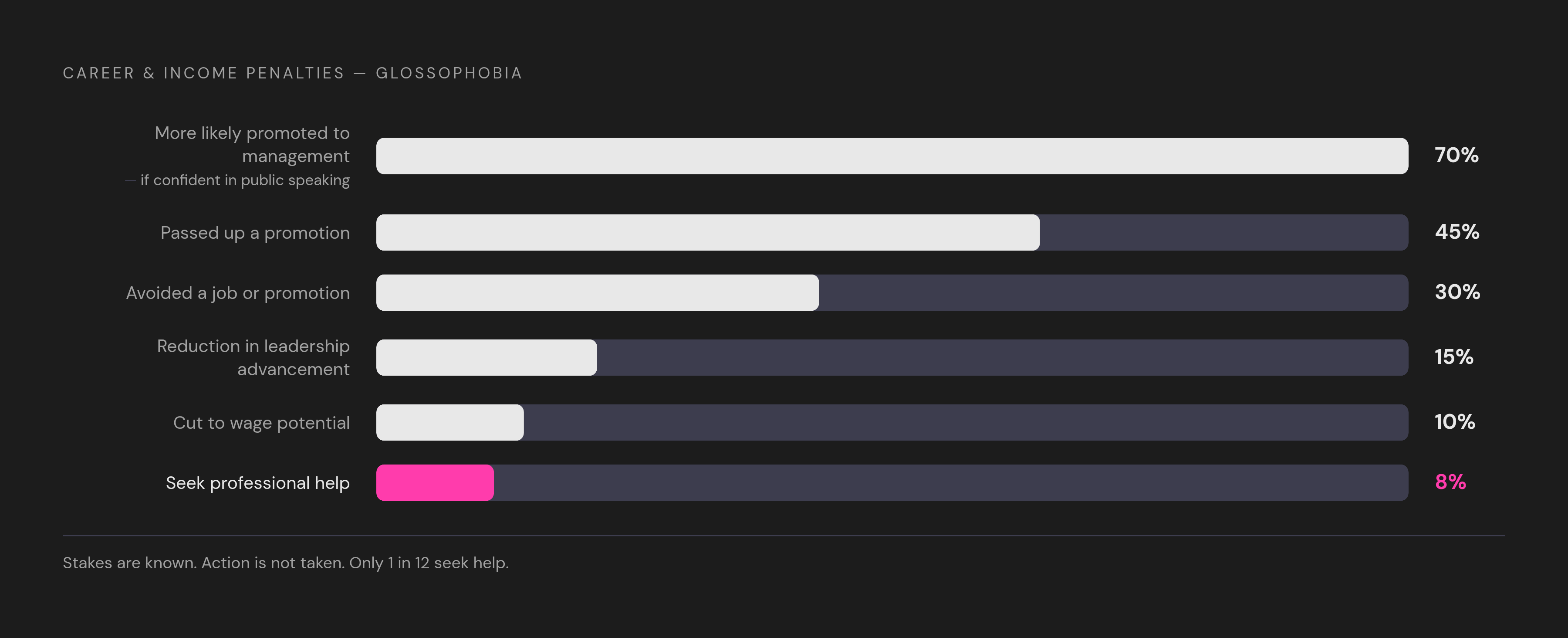
None of this stays confined to sweaty palms before a quarterly review. It affects paychecks and job titles. Roughly 30% of people report having avoided pursuing a job or a promotion specifically to sidestep public speaking duties, and 45% say they've passed up a promotion because of the fear outright. Over a career, public speaking anxiety is associated with a 10% cut to wage potential and a 15% reduction in leadership advancement Ambitions ABA.
Employees who report confidence in public speaking are 70% more likely to be promoted into management roles. It's not a small effect. And 92% of surveyed respondents agree that strong presentation skills are crucial to career success, which suggests most people already know the stakes even if they haven't done anything about their own fear Passive Secrets.
That stake is arguably rising, not falling. Forbes reported in 2025 that LinkedIn named communication the single most in-demand skill for a second consecutive year, and the logic tracks: as AI absorbs more of the technical grunt work, the ability to stand up and explain, persuade, or pitch becomes one of the few differentiators left that a machine can't quietly do instead. Which makes the next section's numbers sting a little more.
The evidence on what works for the few who seek help
Given all of that, wage drag, stalled promotions, a skill market that increasingly rewards exactly the thing being avoided, someone might expect people to be lining up for help. They are not lining up for help. Only about 8% of people with public speaking anxiety ever seek professional help, and that's true even with the career and wage consequences fully documented. Most people simply avoid the triggering situations, or grit through them silently, year after year, without ever treating the underlying fear as something addressable.
That's a shame, because the treatment evidence is genuinely solid. A 2025 meta-analysis covering 26 studies and 2,253 participants, published in The Journal of Psychology, found that psychological interventions produced large reductions in symptoms. Another meta-analysis, pooling 30 randomized trials and 1,355 participants, found a moderate effect right at the end of treatment that grew into a large effect at follow-up, meaning cognitive and behavioral approaches seem to keep working after the sessions stop, a kind of sleeper effect that's rare enough in mental health treatment to be worth noting on its own.
There's a quieter argument in the education data from earlier, too. If 52% of people with only a high school education fear public speaking, compared to 24% of college graduates, exposure itself looks like a form of treatment. Repeated, low-stakes practice appears to erode fear roughly the way water erodes stone: slowly, unglamorously, but reliably, given enough repetitions.
All of which circles back to why the distinction this piece opened with determines how people should actually respond to public speaking fear, beyond just correcting a viral number. The right response to public speaking fear depends entirely on which part of the spectrum someone's standing on. Blanket reassurance is the right answer for the roughly 75% who feel some flicker of nerves and nothing more. Targeted, evidence-based intervention is what the 5% to 10% with genuine clinical impairment actually need Supportive Care ABA Ambitions ABA. And for everyone else in that wide, unglamorous middle, the answer looks a lot less dramatic than either extreme: just more reps, more low-stakes rooms, more chances to find out that the imagined disaster and the actual room rarely look anything alike.
Sources
- Public Speaking Statistics 2025: Global Fear & Trends
- 30+ Revealing Fear of Public Speaking Statistics for 2026
- 49 Fear Of Public Speaking Statistics (Prevalence)
- Glossophobia Statistics Statistics: ZipDo Education Reports 2025
- 35 Interesting Fear of Public Speaking Statistics & Fun Facts
- 49 Fear Of Public Speaking Statistics (Prevalence)
- Public Speaking Statistics (2026): 40+ Data Points on Glossophobia, Career Impact, and the Speaking Economy — VoxBooster
- The Gen Z Stare: Social Anxiety and New Communication Styles