Virtual Reality Exposure for Public Speaking Fear
VR exposure therapy treats the fear mechanism directly instead of coaching around it.
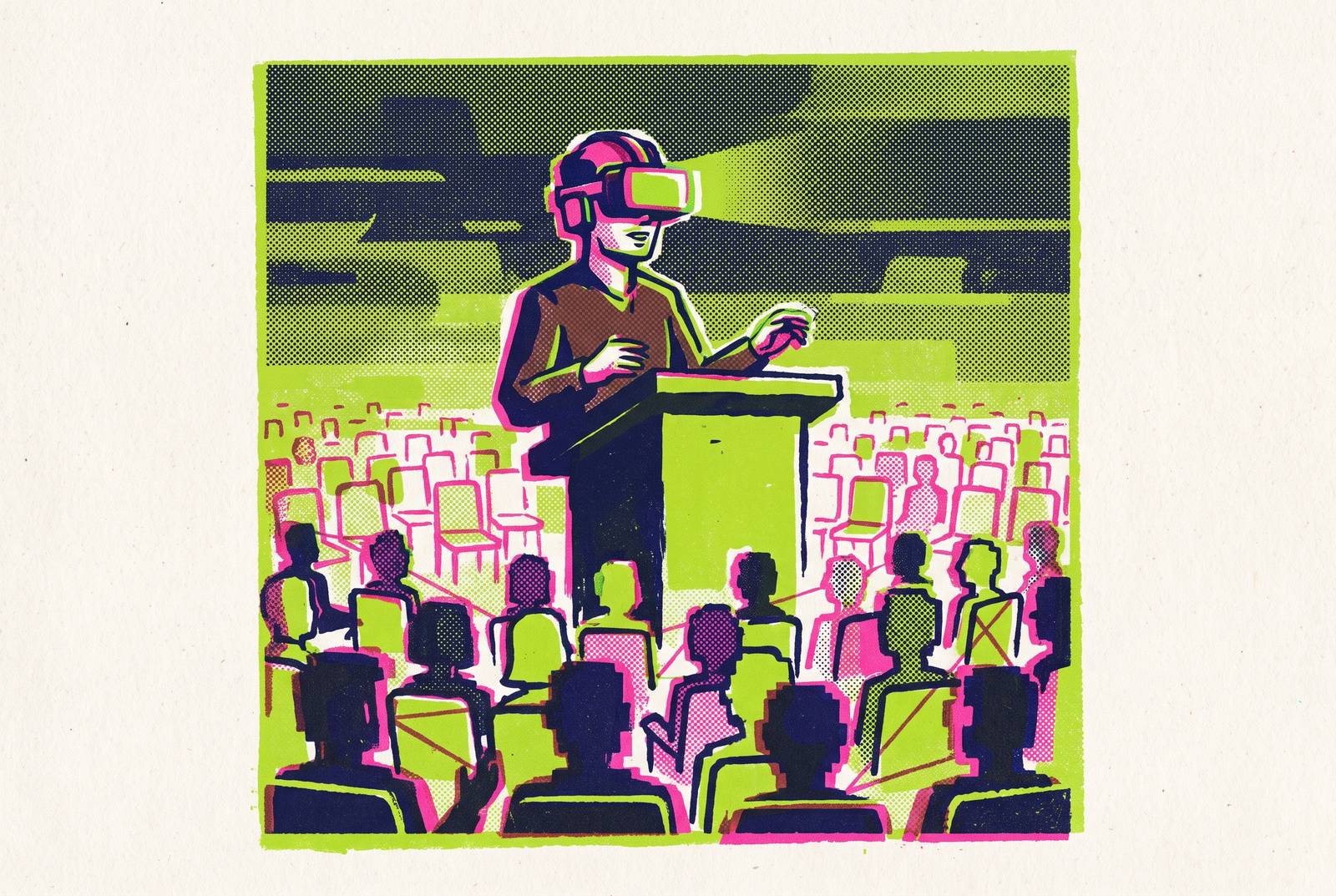
Public speaking fear hits about three out of four people to some degree, and the standard advice for dealing with it (practice more, breathe deeper, strike a power pose) largely ignores where the fear actually lives. Virtual reality exposure therapy, VRET for short, treats the fear mechanism directly instead of coaching around it, and the 2025 to 2026 research explains both why the fear takes hold the way it does and why a headset does something a pep talk cannot.
Prevalence of public speaking fear and who it hits hardest
Roughly 77% of the general population reports some degree of fear about public speaking. That is not a small phobia tucked next to fear of buttons or the number 13. That is most people in the room, including, statistically, whoever is standing at the podium pretending otherwise.
Severity is where the real story sits, and lumping "some nerves" in with "can't function" flattens a distinction clinicians care about. About 75% of people report mild to moderate fear, but only 5 to 10% experience the debilitating version, clinical glossophobia rather than garden variety butterflies. That's roughly a tenfold gap in severity hiding inside one popular statistic, and it's why "everyone gets nervous" and "this person needs treatment" get talked about as the same problem when they are not.
The claim that public speaking ranks above death on the list of human fears has repeated so often it passes for folk wisdom now. Chapman University's Survey of American Fears for 2025 does not support it: public speaking ranked 46th out of more than 65 fears, with 33.7% of Americans reporting it. Not the top slot, nowhere close. But 46th place with a third of the population still affected says something, since this fear sits directly across the path of job interviews, client pitches, and graduate seminars in a way that fear of clowns does not.
Age is where the confidence gap becomes visible: only 25% of people aged 16 to 24 report feeling confident speaking to an audience, compared to 69% of adults over 45. Only 25% of people aged 16 to 24 report feeling confident speaking to an audience, compared to 69% of adults over 45, nearly a threefold gap between a fresh graduate and someone who has spent two decades giving quarterly updates. Whether that's experience doing the work, or something generational going on with how confidence gets built and self-reported, remains genuinely unclear. That gap is exactly where VRET research has pointed its cameras.
Limits of the standard fix of practicing more
Get out there and do it more sounds reasonable until you check when the fear actually peaks. Up to 85% of speakers report their anxiety spiking in the moments right before they start, not during the speech itself. The dread lives in anticipation, in the mental rehearsal of everything going wrong, so practice aimed at the on-stage moment targets the wrong phase for a lot of people. It treats the symptom that shows up under the lights while ignoring the catastrophizing that happens backstage, which is a bit like fixing a flat tire by polishing the hubcaps.
Avoidance compounds this in a fairly mechanical way. Around 57% of people with public speaking anxiety avoid the situation outright, and every skipped presentation confirms to the nervous system that the podium really is dangerous. That's how avoidance loops work: no contradicting evidence ever arrives, so the threat signal never updates. Telling someone to practice more only helps the subset of people already willing to practice, which is a bit like recommending swimming lessons to someone who has just explained they won't go near the pool.
Traditional exposure-based CBT is the first-line, evidence-backed treatment here, and it works. Access to it does not. A full course can run over 20 weeks, and cost keeps a lot of otherwise willing people out. Stigma and logistical friction pile on top of that, especially among younger people, and the result is that something like 92% of people with this fear never seek help. A treatment with a 90-plus percent effect size and a single-digit reach rate has not solved anything at the population level, no matter how clean its numbers look in a journal.
What VR exposure therapy does to the fear response
VRET runs on the same principle as standard exposure therapy: repeated contact with the feared thing, in a setting where the catastrophic outcome never actually lands, wears the threat response down over time. Extinction, in the clinical sense, not the dinosaur one. The delivery mechanism is what changes, and that difference does more work than it gets credit for.
Virtual environments generate what researchers call presence: the sense that a simulated audience is real enough for the brain to treat it as an actual threat instead of an obvious fake. That's why heart rate climbs when someone steps in front of a room of avatars staring back at them. The nervous system reacts to social threat cues the same way it would in a real conference room, regardless of the crowd being made of pixels. A measurable drop in heart rate over repeated VRET sessions counts as a genuine clinical signal, not a training-wheels version of progress, since elevated heart rate is a core marker of social anxiety. If VR practice brings that number down, the fear circuit is updating.
The exposure itself is graded, which is the entire design philosophy compressed into one word. Sessions escalate along several axes at once, including audience size, the tenor of audience reaction (bored, hostile, engaged), the number of prompts a person has to handle, and how visible or "on stage" they feel inside the space. Adjustments happen at 4-minute intervals, turning what used to be a single terrifying live event into a string of small, controllable doses. Less walk into the lion's den, more meet one slightly judgmental lion, then two, then an entire pride that is, weirdly, checking its phones.
Clinical trial results on how well it works
A meta-analysis covering 11 studies and 508 participants found VRET produced a large, statistically significant reduction in public speaking anxiety, with an effect size of -1.39. In-vivo exposure, the real-room, real-audience version, came in at -1.41. Technically VRET trails by a hair. Clinically, that gap is close enough to be rounding error, and for anyone weighing sitting in a room with strangers against putting on a headset, the two options land in roughly the same place.
A broader meta-analysis on social anxiety disorder backs this up with Hedges' g values ranging from -0.86 to -1.14, holding steady across follow-up periods stretching to 12 months. Narrow the focus to public speaking anxiety specifically and the effect sizes climb further, from -1.39 to -1.46. In the language of psychological research, that's a large effect.
Durability is where the newer data earns its keep. A 2026 one-year follow-up randomized controlled trial by Hauge and colleagues, a four-arm design across 100 adolescents, found that groups who went through VRET held onto their gains a full year out. One arm, combining online psychoeducation with exposure, kept improving even after the active intervention stopped. This is currently the longest-running published dataset on VRET in adolescents specifically, which matters given how thin the youth evidence base has been until now.
The authors flag their own limits, including a small sample, a four-arm design that dilutes statistical power, and a call for replication before anyone treats this as settled. Encouraging isn't the same as proven, and to their credit, the paper doesn't pretend otherwise.
The open questions researchers are trying to answer right now
Dosage is the question nobody has pinned down yet. A trial registered with JMIR Research Protocols is running a straightforward comparison: one session of VRET against three. As of November 2025, 101 participants had completed initial screening, with results targeted for submission in March 2026. If one session captures most of the benefit, that reshapes how any platform, clinical or consumer, should build its intervention. If three sessions meaningfully outperform one, that changes the entire pricing and time-commitment conversation on the other side of the ledger.
Audience behavior is the second open thread. A trial registered in November 2025 and published through Trials/Springer Nature is testing whether VRET works better when the virtual audience actually reacts (an avatar interviewer with graded social and emotional responses) against the more static, automated version most tools currently ship. The study tracks heart rate variability and electrodermal activity alongside self-reported anxiety, physiological measures that don't depend on someone accurately narrating their own internal state. If the reactive avatar wins, that becomes a real design constraint for every VR speaking tool built after this point, not a footnote.
A third protocol, published through BMC Psychology, pairs immersive VR with exposure and response prevention and acceptance and commitment therapy modules, layered on top of standard university counseling rather than replacing it. That's a different question from does VR beat nothing. It asks whether VR adds anything once a student already has access to a counselor, which is the more honest question for any university deciding whether to actually fund this.
The adolescent gap keeps resurfacing across all of it. Adult VRET evidence is solid at this point. Adolescent long-term evidence is thinner, and the Hauge 2026 paper is described by its own authors as an early indication rather than proof. Even the most optimistic long-term dataset available comes with explicit cautions about over-interpreting its findings.
The tools available for VR-based speaking practice in 2026
Skip the ones selling immersion as the whole product. Immersion is a feature, not the mechanism doing the clinical work; the tools available in 2026 range from headset-required clinical-grade platforms down to free browser-based practice that has no immersion component. Which one makes sense depends on how severe the fear actually is, not on which demo looks flashiest.
VirtualSpeech sits on the clinical, feature-dense end. It's an AI-powered soft skills platform running on web and VR headsets (Meta Quest, Pico, HTC Vive Focus/XR Elite), with 650,000 users across more than 125 countries. By September 2026, learners had logged over 350,000 completed exercises on the platform. Its Roleplay Studio picked up an "Easy Generate" feature in 2026 for building custom enterprise scenarios, priced at $45. The full experience wants a headset to deliver the immersion it's built around, which puts it more comfortably in enterprise and education budgets than in casual solo practice.
The Cambridge AI-VR Platform takes the opposite approach on cost. Launched free on March 15, 2025, World Speech Day, and built by Cambridge researcher Dr. Chris Macdonald, it hosted more than 50,000 practice presentations from remote beta users during development. Beta participants reported reductions in speaking anxiety, and access remains free. The launch drew notable interest, which is either proof of how badly people want this or a slightly ironic way to demo a tool meant to help people fear crowds less.
For a narrower use case, live-meeting coaching, there's a tool that pushes real-time prompts during Zoom calls instead of running pre-recorded VR scenarios, priced from $8 a month on an annual Pro plan up to $20 a month for an Advanced tier. Call it a co-pilot for the narrower fear of freezing up mid-call rather than a general anxiety treatment.
Using daily verbal practice to get what clinical exposure therapy gets at
Headset marketing obscures a simple detail: the active ingredient in VRET is repeated, graded exposure paired with feedback. The headset is an effective delivery mechanism for making a fear response feel real enough to extinguish, but it remains a delivery mechanism, nothing more mystical than that. So if presence and feedback are what actually work, does the exposure need to happen in VR, or could another delivery method work too?
Not necessarily. The graded structure translates fairly directly into headset-free daily practice. Start with recordings that carry close to zero stakes: a phone camera, an empty room, nobody watching. Then raise the stakes on purpose over time. Record in a public space. Send the clip to someone whose opinion actually matters. Set a hard time limit and stick to it. Close the loop with feedback: a score, a full replay, or another person's honest reaction. That's the same logic behind the 4-minute escalation intervals used in the clinical protocols, minus the pixels.
Whether frequency matters more than intensity is one of the open questions driving the one-session-versus-three-sessions trial running through JMIR right now. If the trial finds that spreading exposure out over time works as well as compressing it into one long session, short daily practice may not be a watered-down substitute for a real clinical protocol. It might be the actual optimal dose, in which case five minutes a day beats one dramatic hour-long ordeal once a month, good news for anyone whose calendar has no room for dramatic hour-long ordeals.
Vague praise does not move the needle here, and most home practice gets this wrong: telling someone "you did great" extinguishes nothing, because it hands the nervous system no concrete signal to update on. Telling someone "you did great" extinguishes nothing, because it hands the nervous system no concrete signal to update on. The clinical trials lean on validated scales precisely because specific, measurable feedback is what drives the fear response down across repeated exposure. Any home version of exposure therapy trying to approximate that needs some equivalent: a score, a tracked change over weeks, something with more texture than a thumbs up. Skipping that piece makes the practice look like exposure therapy without doing the part of exposure therapy that actually works.
Sources
- Frontiers | Long-term effects of virtual reality exposure therapy for adolescents with public speaking anxiety: a one-year follow-up of a randomised controlled trial
- Virtual reality exposure therapy with graded interviewer reactions for public speaking anxiety in university students: a randomized controlled trial protocol | Trials | Springer Nature Link
- JMIR Preprints #89612: One-Session Versus Three-Sessions of Virtual Reality Exposure Therapy for Public Speaking Anxiety: Study Protocol of a Randomized Controlled Trial
- Immersive virtual reality for reducing public speaking anxiety in students accessing a university psychological counseling service: protocol for a randomized controlled trial | BMC Psychology | Springer Nature Link
- frontiersin.org
- 48 Public Speaking Statistics for 2026
- 30+ Revealing Fear of Public Speaking Statistics for 2026
- Public Speaking Statistics (2026): 40+ Data Points on Glossophobia, Career Impact, and the Speaking Economy — VoxBooster