The Role of Mental Simulation in Preparing for Difficult Conversations
Rehearsing conversations productively requires process focus, not outcome fantasy.
The habit is nearly universal: rehearsing an argument on the walk to work, refining an apology in the shower, drafting the overdue feedback conversation in the shower for the third day running. Most of this rehearsal never becomes a real conversation; it just loops, gets polished, and loops again. It just loops, gets polished, and loops again. Mental simulation, done right, is one of the more useful cognitive tools available for high-stakes talking, but done wrong, it is just worry wearing a blazer.
What separates productive mental simulation from anxious rumination
From the inside, reflecting on a hard conversation and ruminating about one feel almost identical. Same tight chest, same replaying, same imagined faces. The difference appears only in the output. Reflection eventually produces a sentence you'll actually say, a decision about timing, or a recognition that the issue isn't as urgent as it felt at 7 a.m. Rumination arrives nowhere. It just circles the same three minutes of imagined dialogue, sanding down the same phrase for the fortieth time without ever producing a next step.
Why does the imagined version get so sticky? Because it's rigged in your favor. Real conversations are unpredictable: the other person softens when you expected defensiveness, or they change the subject entirely, or they cry and now the script you spent four days writing is useless. The version in your head never does that. It delivers your line exactly when you need it delivered, every single time. That predictability is the trap, not the safety net. Rehearsal that only ever plays out one way is rehearsing for a conversation that doesn't exist.
A 2025 review in Nature Reviews Psychology by Michelle Moulds (UNSW Sydney) and Peter McEvoy (Curtin University) argues that worry and rumination, long treated as separate phenomena because one faces forward and the other faces backward, are better understood as a single overarching process that appears across anxiety, depression, and stress. The direction of the thinking, past or future, isn't what makes it a loop. What makes it a loop is the absence of resolution. Preparing for a conversation that never happens fits that description almost exactly: it's neither past nor future, technically, since the conversation exists in neither tense. It just exists in rehearsal, indefinitely.
How deliberate mental rehearsal physically changes the brain
Mental rehearsal, treated as a discipline rather than a coping mechanism, has well-established use across high-stakes performance domains. Pilots run failure scenarios in a simulator seat before ever touching a yoke under real stress. Surgeons walk through a procedure's steps before making an incision. None of this is idle daydreaming; it's structured cognitive rehearsal of a task, performed without the task itself.
The theoretical scaffolding for why this works draws on how cognition processes language and mental imagery through distinct but complementary channels. Information tends to stick better when both are engaged at once, rather than one alone. That's the operational argument for why vivid, sensory simulation of a conversation, picturing the room, hearing the tone of voice, feeling the pause before you speak, outperforms an abstract bullet-point plan sitting in a notes app.
Neuroscience backs the mechanism further. Repeatedly imagining a task is associated with changes in how the brain represents and anticipates performing it, even without physical execution. That effect is not merely a metaphor for practice but reflects how internal simulation can shape cognitive readiness.
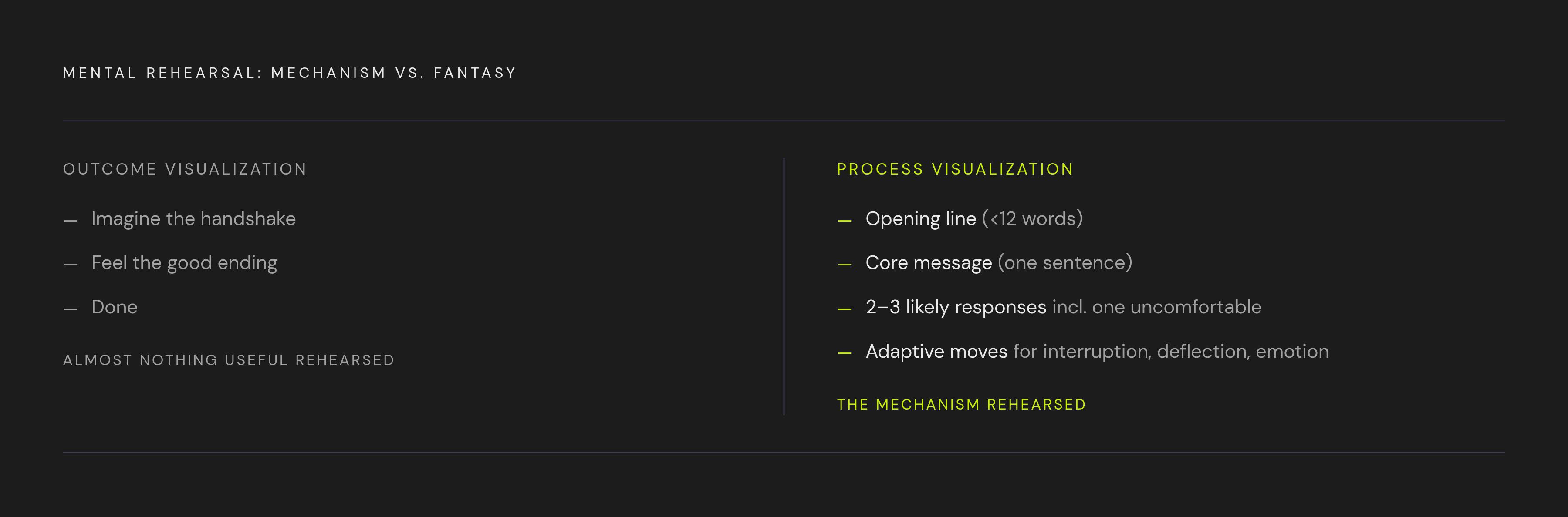
There's a critical fork here that most people miss entirely: outcome visualization versus process visualization. Outcome visualization is imagining the result you want, the tense conversation ending in a handshake, the difficult feedback landing well. It feels good and does almost nothing useful. Process visualization walks through each step required to get there, including the opening line, the pause after you deliver the hard part, and the moment you might get pushback. Performance preparation frameworks tend to favor process visualization as the more effective technique, because it rehearses the mechanism, not the fantasy.
Why over-scripting backfires when real conversations go off-script
Spoken conversation is adaptive by design. Both participants are building their next response while simultaneously decoding what the other person is saying, in real time, with no pause button. That's a genuinely different cognitive task than writing or reading a script, and it's why an over-rehearsed opening line can feel so brittle the moment the other person doesn't say what you expected them to say.
This creates what's essentially a performance gap. The real conversation diverges from the rehearsed one, which it almost always does, and the over-scripted rehearser is left holding a script for a play that stopped being performed the second the other person spoke. Worse, this isn't just an awkward pause. It can visibly derail someone: research on fluency shows that over-monitoring, focusing intently on "getting it right," can actually hinder fluency by producing more hesitation and more self-analysis in the moment, precisely when fluid response is needed most. The over-preparation doesn't just fail to help. It actively works against the goal.
Part of the issue is that oral communication actually asks for two distinct skills stacked on top of each other: fluency in spontaneous conversation, and command of planned, structured speech. These are not the same muscle. One can rehearse a keynote the way an actor rehearses a monologue, because a keynote doesn't talk back. A difficult conversation does talk back, constantly, and rehearsing for spontaneity the way you'd rehearse a monologue is a category error. It's a bit like training for a boxing match by shadowboxing against a mirror that occasionally throws punches you didn't call for.
A structured approach to mental rehearsal that builds readiness without feeding the loop
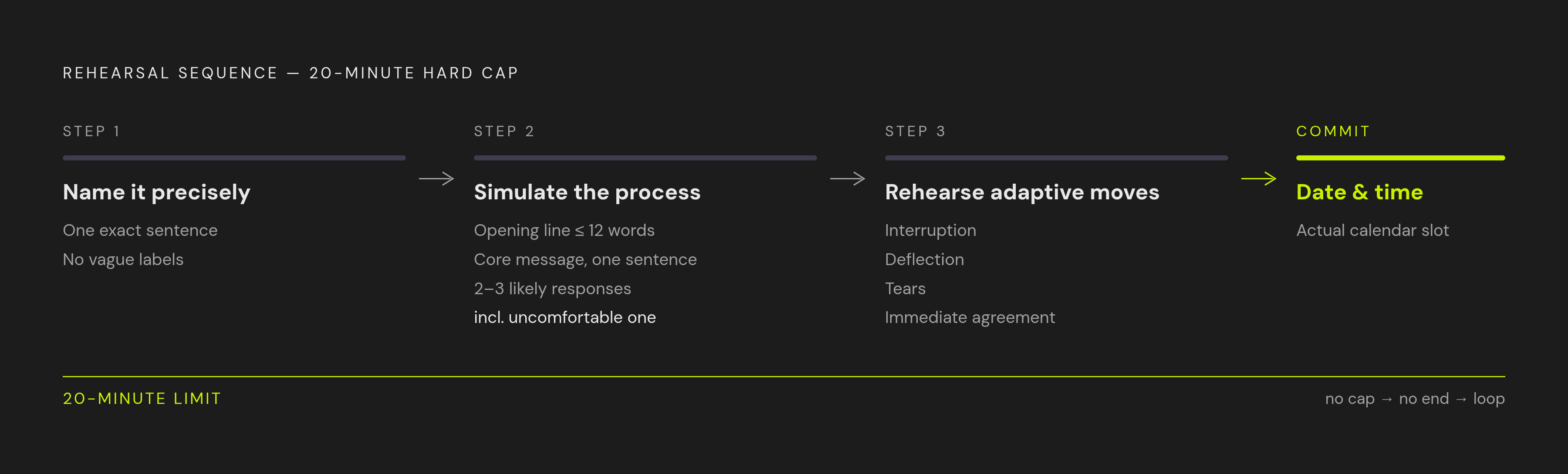
So what does productive rehearsal actually look like, mechanically? One useful discipline is the rehearsal limit: cap preparation at roughly 20 minutes, then commit to an actual date and time to have the conversation. Open-ended rehearsal has no natural stopping point built into it, so it becomes a loop rather than a process. A deadline forces resolution.
Inside that window, three steps do most of the work.
Name the conversation precisely. Not "the situation with my manager," but the actual sentence: "I need to tell my manager that the deadline moved without warning me, and it cost the team two days." Vague rehearsal just rehearses vagueness, over and over, without ever sharpening into something sayable.
Simulate the process, not the outcome. Draft an opening line under 12 words. Identify the core message in one sentence. Then generate two or three likely responses from the other person, including one that's genuinely uncomfortable, the one where they get defensive or dismissive or start crying, not just the version where they nod along and thank you for your honesty.
Rehearse the adaptive moves, not just the lines. What happens if they interrupt? What happens if they deflect to a different topic? If they get emotional? If they agree immediately, before you've even made your case? Practicing responses to these branches is what builds real conversational flexibility. Practicing only the ideal path builds something that looks like confidence but collapses the moment reality deviates from the script, and the section above shows that it will.
What the research on chatbot-assisted preparation reveals about how readiness works
A pre-registered study with 1,371 participants, conducted by Charul Maheshka and Elizabeth Dunn (University of British Columbia) alongside Dunigan Folk (University of Pennsylvania) and published in Social Psychological and Personality Science, offers a data point worth taking seriously. Participants who briefly prepared for a difficult conversation with a chatbot were significantly more likely to actually initiate that conversation in real life over the following week, compared to a control group that didn't prepare this way.
The preparation window was short: 6 to 12 minutes of structured discussion with the chatbot, not an open-ended rumination session. That's roughly the length of a coffee break, which raises a fair question. Why would talking to a chatbot for ten minutes move the needle on something as loaded as a difficult conversation?
The mechanism the researchers point to is expectation. Participants who prepared this way came away anticipating that the real conversation would go better than they'd otherwise have expected, and that shift in anticipation is what changed their behavior enough to actually pick up the phone or start the talk. Structured preparation didn't make people braver in some vague sense. It made the imagined outcome less catastrophic, which lowered the activation energy needed to start.
One more detail matters here, maybe the most reassuring one: the structured preparation participants did with the chatbot got them through the door without appearing to hollow out the real conversation that followed. Readiness didn't cost them authenticity. It just lowered the barrier to starting.
Spoken practice, not mental rehearsal alone, closes the gap between preparation and performance
Mental rehearsal, even done well, tops out at some point. Fluency is the speed, automaticity, and ease with which someone can express a thought under pressure, and it develops through repeated spontaneous speaking. It doesn't develop through internal rehearsal alone, no matter how vivid the imagery or how disciplined the 20-minute window.
This is where role-play and micro-teaching earn their keep as verbal training tools. Structured practice that includes micro-teaching, role-playing scenarios, and peer evaluation has been shown to build confidence in spoken communication, a pairing that a difficult real conversation demands. You can't fake your way to spontaneity by thinking harder about it in advance. It has to get practiced out loud, with another person, who is allowed to surprise you.
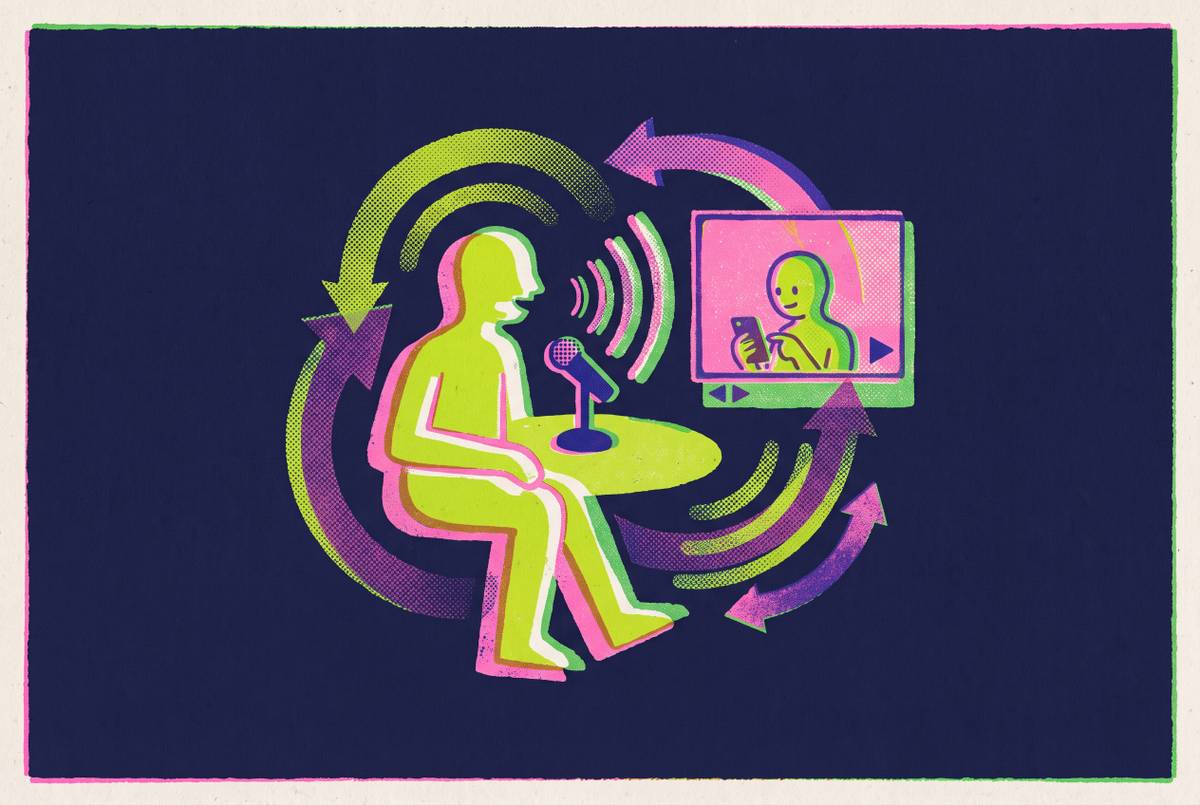
Reflective practice supplies the feedback loop that closes the whole system. Identifying weaknesses and tracking progress requires self-assessment after speaking. The full cycle is prepare, speak, review, adjust, then prepare again for the next one, informed by what actually happened last time rather than what was imagined.
There's a broader pattern here in communication development more generally: practice that prioritizes actually speaking over continued internal preparation tends to build stronger real-world readiness than over-preparation alone. The same logic transfers cleanly to high-stakes communication of any kind, in any language. Preparation gets you to the starting line. Repetition, the unglamorous, unscripted kind, is what actually gets you good at running.
The generational stakes: why this skill is becoming rarer exactly when it matters most
The pattern turns into something closer to a structural problem, not just an individual one. Among a large sample of Hinge daters surveyed worldwide, Gen Z daters reported being notably more hesitant than millennials to start a deep conversation on a first date, even though many report actively wanting new ways to build deeper connections. That gap, wanting depth and being unwilling to initiate it, is the entire article compressed into a dating app statistic.
It doesn't stop at dating. Surveys of Gen Zers and millennials suggest the rehearsal habit described at the top of this piece isn't a quirk, it's close to a norm. And among those who avoid spoken conversation altogether, many report the avoidance has cost them money or opportunities they otherwise would have had. The avoidance described at the top of this piece costs real money and real opportunities. That's rent.
Layered onto this is what Dr. Michael Robb of Common Sense Media calls "social offloading": a growing share of teens report preferring AI companions over humans for serious conversations. Offloading isn't inherently bad, the chatbot-assisted preparation study above is a form of it, and it worked. Offloading the entire conversation, rather than just the preparation for one, is a different move. One builds the skill. The other quietly replaces the need to build it.
And the stakes aren't just personal. Constructive disagreement, the kind built on divergent perspectives, tends to spark creativity, catch costly mistakes early, and produce better decisions than forced harmony does. Clarity in how people talk to each other predicts trust more reliably than surface-level agreement does; how people translate their intentions into actual spoken exchanges shapes whether they disagree well or just avoid disagreeing. As spoken, spontaneous, difficult conversation becomes something people practice less and defer more, the ability to actually initiate and carry one is turning into a differentiator, not a given. Which raises a fair question: if the rehearsal keeps getting more sophisticated while the actual conversation keeps getting rarer, is the muscle being built, or just the excuse for not using it?