How Long It Takes to Build a New Speaking Habit
Most speaking habits take 59 to 154 days to form, not the mythical 21.
Speaking confidently in front of other people is a habit, in the strict neurological sense of the word, and it forms the same way flossing or running does: slowly, unevenly, and nowhere close to the fabled 21 days everyone keeps quoting. That number comes from Maxwell Maltz, a plastic surgeon writing in the 1960s, who noticed patients took about three weeks to adjust to their new faces after surgery. Self-help culture picked it up and ran, mostly because three weeks sounds achievable, especially in January. Ben Singh at the University of South Australia actually ran the numbers in a paper published in Healthcare, and the real median for habit formation is between 59 and 66 days, with a full range of 4 to 335 days depending on the behavior and the person. Averaged out, most habits take somewhere between 106 and 154 days to lock in, which is not three weeks under any reading of the calendar.
This piece walks through what that timeline means specifically for speaking, why speaking sits on the harder end of the habit-formation spectrum, and what actually speeds the process up without pretending the process can be skipped.
How the brain locks in a habit: cue, reward, and the basal ganglia
Habits aren't decisions, even though they feel like ones from the inside. A decision runs through the prefrontal cortex, the part of the brain doing conscious, effortful weighing of options. A habit runs through the basal ganglia, a cluster of structures buried deeper in the brain that also handles emotion and memory storage. Once a behavior gets filed there, it stops requiring the kind of mental energy a decision does. That's the whole point of a habit: it's a behavior the brain has decided is safe to run on autopilot.
That filing process runs on what researchers call the habit loop. A certain time of day, a specific room, or a feeling like nervousness or boredom triggers a cue, the cue produces a craving, the craving drives a response, and the response delivers a reward. That reward is what glues the cue to the action. Every time the loop completes, the connection between trigger and behavior gets a little stronger, a little faster, a little less conscious.
Neuroplasticity, the brain's capacity to physically rewire itself based on repeated patterns of attention and behavior, produces all of that. Firing a neural pathway enough times makes it easier to fire again, the same way a footpath through a field gets easier to walk the more people use it. Something like 65% of everyday behavior runs on this kind of automatic pilot rather than conscious choice. Building a habit is really just an exercise in moving a behavior from the smaller portion that requires thought into the majority that doesn't.
Why speaking is a harder habit to form than most
Not all habits are created equal, and complexity is the main reason some take root in three weeks while others take the better part of a year. Drinking a glass of water first thing in the morning is a single-step action: reach, drink, done. Speaking is nothing like that.
Talking in real time asks the brain to do several jobs at once. It has to retrieve vocabulary on the fly, apply grammar automatically instead of consciously, read the audience's reactions, manage whatever emotional static is running in the background (nerves, excitement, the mild dread of public exposure), and coordinate the physical mechanics of breath, posture, and voice. All of that eventually has to run in parallel, below conscious attention, the same way an experienced driver doesn't think about the clutch. Speaking fluency is a genuine cognitive skill, and it's trainable precisely because it isn't fixed.
The stumbles, filler words, and restarts that make speech sound halting reflect underlying sub-skills, things like word retrieval and sentence construction, that haven't yet automated. Those are the actual sub-habits that need wiring. Fluency isn't one skill, it's a bundle of smaller automated processes stacked on top of each other, and each one needs its own repetitions before the whole system runs smoothly.
The real-world cost of not building this habit
The career math on this is not subtle. Workers who feel confident speaking publicly are 70% more likely to land promotions into management roles, which puts a fairly hard number on something that often gets waved off as a soft skill. On the flip side, public speaking anxiety has led 45% of workers to turn down a promotion outright or skip applying for a job they wanted, and over a career, that anxiety can cut wage potential by 10% and leadership advancement by 15%.
Communication has ranked as the single most in-demand skill on LinkedIn for a second year running, and employers consistently rank it among the most critical traits when hiring. Yet only 25% of people aged 16 to 24 feel confident speaking in front of an audience, compared to 69% of adults over 45. That's a wide confidence gap sitting right at the point in a career when foundations get built, promotions get decided, and reputations start to calcify. Waiting until 45 to build this habit is a bit like waiting until retirement to start saving.
Why this problem lands hardest on Gen Z and younger millennials
Gen Z grew up talking through screens, often several at once, in a culture that prizes being authentic over being formal. Structured, in-person verbal communication, the kind a meeting or a client pitch demands, usually doesn't develop until college or a first job, arriving late relative to everything else and colliding with workplace expectations that assume it was already there.
The data shows the avoidance patterns pretty clearly. 42% of Gen Zers and millennials say they never answer their phones, and 58% admit to scripting or rehearsing what they're going to say before making a call. Neither behavior fixes the underlying discomfort; both just delay the moment the brain has to practice the skill, and this avoidance keeps anxiety fed instead of starved. Small talk tells a similar story: 86% of this group engage in small talk, but only 34% would start a conversation themselves. Break that down further and the gap widens: only 23% of Gen Zers would initiate, versus 37% of millennials, a meaningful split even within a generation often treated as one bloc.
Layer onto that the disconnect between constant digital connection and the real social ease that in-person conversation requires. Building verbal confidence, in that light, is a response to a kind of social hunger that texting and other messaging tools don't seem to satisfy, no matter how many messages get sent in a day. It's also a response to a kind of social hunger that texting and other messaging tools don't seem to satisfy, no matter how many messages get sent in a day.
What the habit structure looks like for speaking specifically
The standard three-stage model of habit formation maps onto speaking without much modification. The first stage consists of the conscious decision and the plan: deciding to practice, picking a method, setting a schedule. Stage two is consistent repetition inside a stable context, doing the practice enough times, in similar enough conditions, that the brain starts recognizing the pattern. Stage three is automaticity, where delivery, pacing and structure start running without deliberate thought, freeing up mental bandwidth for the audience and the actual content instead of the mechanics of getting words out.
What matters most happens early. The first repetitions carry outsized weight in carving the neural pathway, even when the practice feels forced and the payoff feels invisible. Timing and context matter here too: attaching practice to a fixed point in the morning routine, same time, same place, builds a sharper, more reliable cue than practicing whenever it happens to come to mind. That's the logic behind habit stacking, tacking the new behavior onto something already automatic (right after the morning coffee, say), so the friction of remembering to start disappears because the trigger is already firing for something else.
The three phases of the timeline
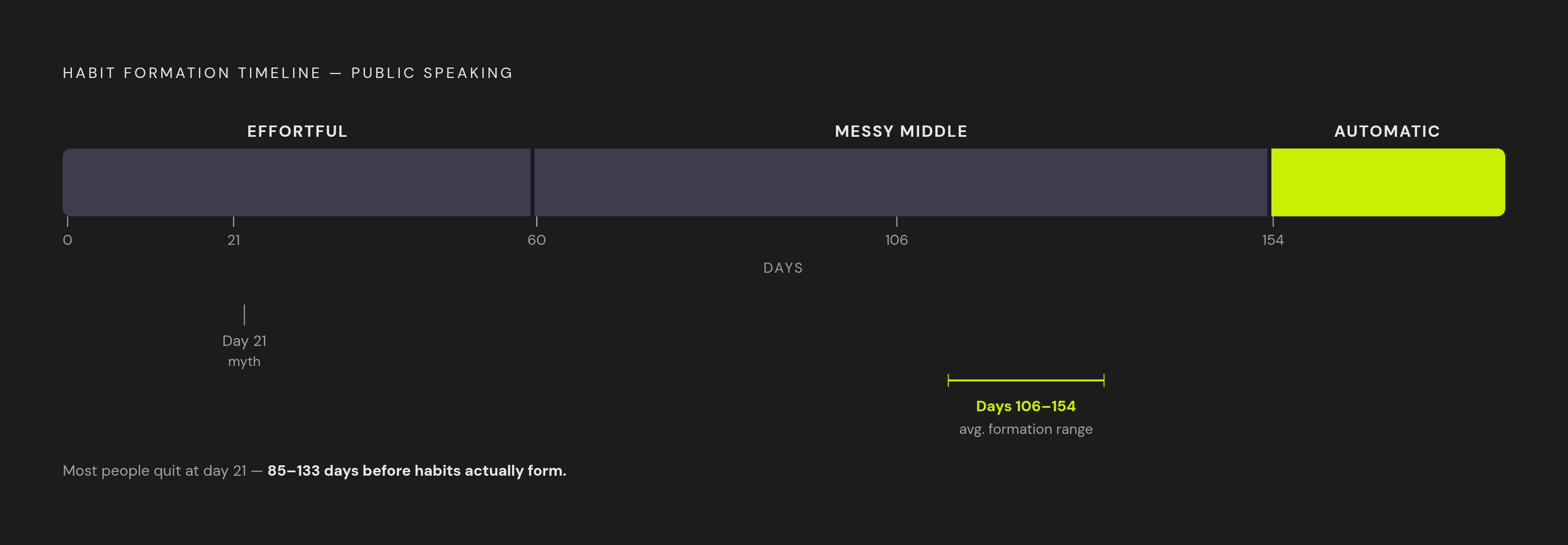
Phase 1, the effortful phase, runs roughly through the first two months. Every repetition is conscious. Delivery feels stiff, maybe even a little embarrassing. The cue-reward loop is being laid down, brick by brick, but it hasn't automated yet, and this is exactly where most people quit, mistaking the effort itself for a sign the whole thing isn't working. 21 days in, the novelty has worn off, the habit clearly hasn't formed yet, and the 21-day myth is whispering that it should have by now. That mismatch between expectation and biology is probably responsible for more abandoned habits than any actual lack of discipline.
Phase 2, the messy middle, covers roughly months two through five. Some parts of the skill start feeling easier (maybe filler words drop off first), while others stay stubbornly effortful (maybe structuring an argument on the fly still feels like work). Progress stops being linear here, which is disorienting if nobody warned it would happen. The evidence that average habit formation runs from 106 to 154 days maps squarely onto this stretch, where most people are technically still building the habit, even if it doesn't feel like building anything.
Phase 3, automaticity, is the payoff. Pacing, structure, and presence start running below conscious thought, and attention finally frees up to focus on the audience and the message rather than on not tripping over a sentence. This is what fluency actually feels like from the inside: not perfect, just no longer effortful.
How to accelerate formation without shortcutting the timeline
Frequency beats duration here, consistently. A short daily practice session builds the pathway faster than one long weekly session, because each repetition, however brief, adds another layer as the cue fires, the response runs, and the reward lands, once a day, every day, rather than once a week in a single larger dose. Skipping days doesn't just pause progress, it lets the cue-response link go slack.
Fixing the cue matters just as much as the repetition itself. Attaching practice to a consistent time and setting (right after the morning workout, during the commute, whatever already happens on a fixed schedule) means the trigger becomes automatic before the speaking behavior does, which gives the whole loop a running start. And making the reward tangible speeds up the dopamine side of the equation: a streak counter, a score, some kind of visible marker of progress gives the brain an immediate payoff to attach to the cue, rather than a vague, deferred sense that this is probably good for the career eventually.
Finally, aim the practice at the actual bottlenecks instead of general "getting more comfortable" vibes. Since disfluency traces mainly to lexical retrieval and grammatical automaticity, prompts that push into unfamiliar vocabulary or less comfortable topics train the specific muscle that needs it. None of this shortens the underlying timeline. The basal ganglia doesn't take rush orders. But it does mean the 4 to 335 days get spent building something real instead of getting stuck in phase one, quitting at day 21, and blaming the wrong number for the wrong reason.