Feedback Specificity and Communication Skill Gains
Specific feedback tied to observable moments drives measurable gains in communication skills.
Vague feedback like "good job" or "be more confident" produces almost no measurable improvement in how someone communicates. What moves the needle is specific, behavioral feedback tied to an observable moment in a performance, and most managers get this exactly backwards: they manage the listener's feelings instead of naming the behavior. That instinct is kind. That same instinct is also why so much workplace feedback changes nothing.
What specific, behavioral feedback means
Feedback that works names a moment. It describes a behavior with precision, then ties that behavior to a standard or outcome the speaker can measure against. That rules out most of what passes for feedback in daily conversation, which runs on adjectives like "weak," "flat," or "unconvincing" instead of anything a person could act on tomorrow.
Feedback and debriefing get lumped together constantly, and the mix-up is doing real damage. A 2026 scoping review by Brodowski and colleagues, referenced in the MCW Teaching Toolbox, defines feedback as giving specific information about a learner's performance measured against an established standard. It is evaluative. Debriefing is guided reflection after some kind of experiential learning, reflective rather than evaluative. Conflating the two is part of why so much feedback ends up mushy: people think they are being evaluative when they are actually just musing out loud, and musing out loud rarely changes what anyone does next.
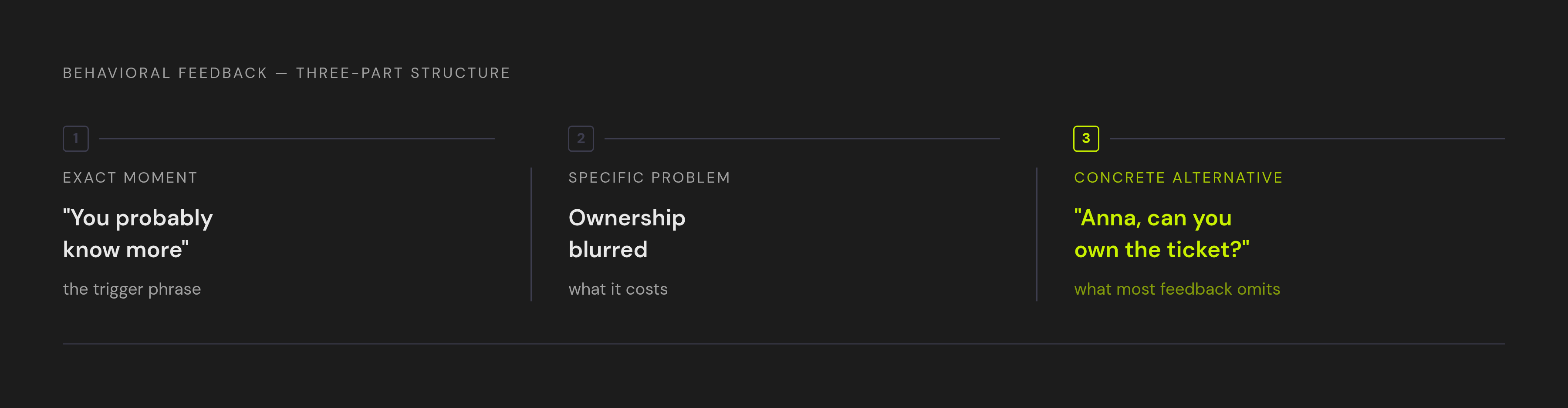
Behavioral anchoring looks like this in practice. Not "your ownership was weak," which hands the listener nothing to grab, but something closer to what an AI coaching platform demonstrates in its own materials: "When you said 'you probably know more,' ownership blurred. Next time, try: 'Anna, can you own the ticket?'" One sentence, three parts: the exact moment, the specific problem, a concrete alternative. That compression is the whole mechanism.
A couple of frameworks exist specifically to force that kind of precision. The Situation-Behavior-Impact model, known as SBI, and the BOOST framework are both designed to convert critique into something usable, anchoring every comment to an observable behavior instead of a general impression. The MCW Teaching Toolbox lists the traits that make feedback usable: timeliness, specificity, actionability, sensitive delivery, regularity, and the credibility of whoever is giving it. Specificity is one pillar out of six, and skipping the other five will still make a perfectly specific comment land wrong.
Specific does not mean harsh, and that distinction gets lost more than it should. The EBSCO research starter on constructive feedback stresses staying objective, opening with what went right, giving concrete examples, and showing empathy for how the feedback lands emotionally. The sharpest feedback anyone gets is often the least cruel one, precisely because it never has to guess at someone's character. It just points at the tape and lets the tape do the talking.
The research case: what happens when you swap vague for specific
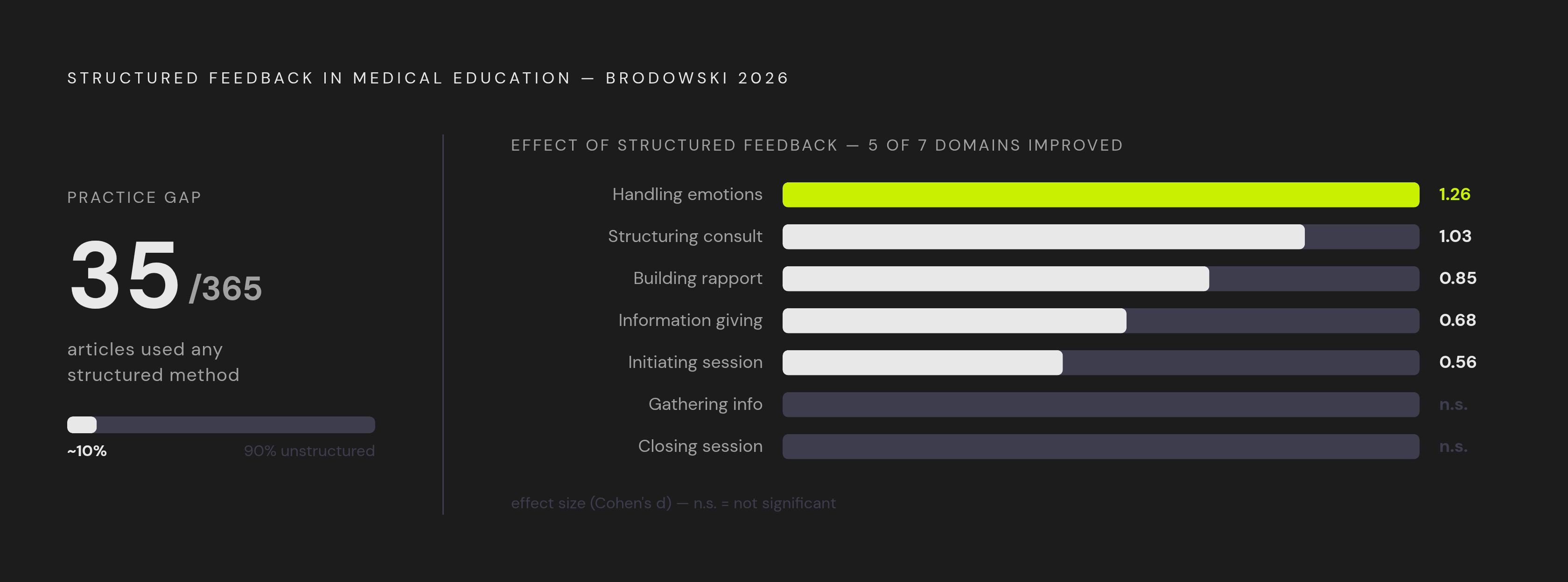
The clearest evidence comes from a randomized controlled trial of undergraduate medical students, comparing specific, structured, behavioral feedback against general, experience-oriented feedback during communication skills training. Five of seven communication skill domains improved significantly in the group getting specific feedback, with three domains showing large effects and two showing medium ones.
The standout number is handling emotions, where the effect size hit 1.26. That counts as a large effect by any conventional statistical yardstick, a shift visible clearly and consistently across raters rather than something that might be noise. The behavior changed enough that independent observers could see it and score it consistently, without every student turning into a bedside-manner virtuoso overnight.
What makes that trial land harder is the context sitting around it. The same Brodowski review, published in the Journal of Medical Education and Curriculum Development, looked across 365 articles on feedback in medical education and found that only about 10%, or 35 articles, reported using any structured feedback method or model. So the gap is not between people who know feedback matters and people who do not. Nearly everyone agrees feedback matters, in the abstract, the way everyone agrees flossing matters, but few act on it in practice. The real split sits between agreeing with that in principle and actually running the specific, structured version of it instead of the vague, comfortable one. That split explains most of the bad feedback anyone has ever received.
That trial lived inside medical education, and claiming the exact numbers transfer cleanly to a sales call or a wedding toast would be a stretch too far. But the underlying mechanism, behavioral anchoring leading to self-correction leading to skill that sticks, has no obvious reason to stop working the moment you leave a hospital. Communication under observation is communication under observation, whether the observer is a standardized patient actor or somebody on a Tuesday afternoon video call.
Why the brain responds to behavioral specificity and not to vague praise
Talking out loud, in real time, asks a lot of the brain at once. Lexical retrieval, sentence construction, and executive control all fire together while someone is mid-sentence, a well-documented feature of real-time verbal performance. Against that backdrop, "just be more confident" is close to useless as an instruction delivered mid-performance, since there is no gear in that sentence for the brain to grab onto.
Specific feedback works because it points at one gear instead of the whole engine. Rather than asking the entire system to somehow run better all at once, it isolates which sub-system slipped: a named moment, a named behavior, one variable instead of everything. That is what makes the correction tractable instead of overwhelming, and it is the same reason a mechanic asks which noise the car makes and when, instead of just being told the car is broken.
There is a self-reflection piece to this too. The MCW Teaching Toolbox notes that feedback and debriefing help learners build their own capacity for self-reflection and lock in what they have learned during hands-on practice. Vague praise skips that step, because there is nothing concrete left to reflect on. "You did great" closes a conversation instead of opening one, and that is often the outcome the person delivering it wanted.
Specific feedback also tends to lower the threat response, if only because a single, bounded behavior feels a lot less like an attack on someone's identity than a broad verdict like "you lack confidence." One is a note about a sentence. The other is a note about a person, and nobody enjoys being told they are the problem rather than that they mistimed a pause.
Consider the craft-level version of this. A skilled speaker uses pauses and shifts in tempo as deliberate tools, not accidents. Those are discrete, learnable moves, and specific feedback tells a speaker which move they missed and exactly where in the sentence they missed it.
Why most people never get this kind of feedback, and what fills the gap instead
The gap between knowing feedback works and actually delivering it is well documented. Brodowski and colleagues found a clear split between the theoretical case for structured feedback and how rarely it appears in actual practice. Standardized models are gaining ground, but slowly and unevenly across settings, which points to a barrier that has nothing to do with awareness. Call it habit instead.
Who delivers the feedback is part of the problem too, and most organizations avoid looking at this directly. A source from an AI coaching platform notes that only about 25% of managers are considered highly effective at delivering coaching and feedback; when those conversations land poorly, teams quietly check out, and when they land well, teams stay engaged. Three out of four managers are running the wrong version of the conversation, and most of them have no idea.
So what fills the space where specific feedback should sit? Encouragement, mostly, alongside vibe-based reactions and general impressions. Saying "great job" costs nothing in the moment and nothing later either, which is exactly the problem. It is socially frictionless in a way that "at the two-minute mark, your pace dropped and you lost the room" will never be, even though the second sentence is the one that actually helps someone.
Frequency compounds all of it. The pattern seen broadly across feedback research is that teams running structured, frequent feedback cycles tend to outperform teams stuck on quarterly reviews, and the gap between high and low performers rarely traces back to training content. It traces back to how often, and how precisely, feedback actually happens.
There is a generational wrinkle layered on top of that. A 2025 Forbes Coaches Council piece describes what it calls "Feedback Friction": Millennials and Gen Z often expect feedback framed positively or collaboratively, while older colleagues tend to deliver it more bluntly. The result is that feedback gets softened past the point of usefulness, or avoided altogether because nobody wants to sit through the awkward five minutes.
Occasional feedback from a mentor or a well-meaning peer, however precise in the moment, cannot substitute for something running on a loop. The mechanism does not just need quality. It needs regularity, and regularity is the part almost nobody sets up on purpose, mostly because it means signing up for the awkward conversation more than once.
How to build a feedback loop that produces improvement over time
The basic structure is not complicated: perform under observation, get specific behavioral feedback, pick one correction, try it again under low stakes, then check whether it actually changed. Repeat. That loop, run consistently, is the entire engine behind measurable improvement, and everything else in this section is just commentary on how to keep it turning over.
Recording yourself is the cheapest way into that loop when no human observer happens to be around. A communication guide from Medium describes recording the attempt, going back over the notes, then practicing again somewhere low-risk. It manufactures the observation condition artificially, which turns out to work almost as well as having someone actually watching.
"Practice makes perfect" is true and also close to meaningless without a timescale attached to it. Consistent practice tends to produce early improvements within weeks, with more substantial change arriving over several months. Those windows shrink when feedback comes more often, which is the whole argument for building the loop deliberately instead of waiting around for an annual review to do it for you.
A handful of tools now exist specifically to widen access to that loop. A university research team's coaching tool, covered in February 2026, was built by a military officer serving as program lead alongside Assistant Professor Eugenia Rho, now at Emory University. It simulates difficult conversations and adjusts its feedback to whatever a user tends to struggle with, whether that is listening or reading emotional cues, across repeated sessions. The stated goal is helping people notice their own habits, try alternatives, and build their own style, under conditions where nothing is actually at stake.
Pearson launched a tool called Communication Coach on November 18, 2025, built in partnership with Microsoft and folded into Microsoft 365. It gives real-time notes on grammar, vocabulary, tone, clarity, and how someone comes across in professional exchanges, aimed at both native and non-native English speakers. It was previewed at Microsoft Ignite 2025, with pilots and wider availability planned through 2026.
A 2026 roundup from vocalimage.app names several other apps working this territory, including Vocal Image, PatterAI, and Tonen, alongside BetterUp as a premium option in the human coaching space. Poised, once a well-known real-time meeting feedback tool, announced it was shutting down on October 8, 2026, a reminder that this category is still young enough to lose players.
The tightest version of this loop is visible in apps built around a daily prompt and a numeric score, often on a 0 to 100 scale. One attempt, one score, one behavioral note, every day. It is the same structure as athletic training applied to speaking, and the comparison holds up better than it has any right to: nobody gets better at deadlifts by being told "nice lift," and speaking does not seem to work differently once you look at it that closely.
Research from IMD on coaching tools powered by one model found that 55% of the feedback these tools generated fell into what researchers called the "zone of learning," meaning it was both surprising to the user and genuinely useful, not just a restatement of something they already suspected. Participants specifically valued how granular the feedback got, down to tone of voice within individual sentences.
None of that guarantees consistent use, and this is the part left out of the pitch deck. A 2025 study tracking AI coaching adoption across 50 mid-market companies found 67% of employees used the platforms only sporadically after the first month, and just 18% used the tools to work through anything substantive. The tool can supply precision. Discipline stays with the user, which is a slightly deflating fact and also the actual reason most coaching software churns.
Frequency itself appears to be doing real work independent of the tool. Research on public speaking confidence suggests that simply increasing how often someone presents, more reps per week rather than fewer, speeds up how quickly evidence of improvement accumulates and shortens the timeline to feeling confident. Nothing about that logic suggests it stops applying once you leave the subject of public speaking behind.
What communicators who improve fast do differently
The overrated belief here is that fast improvement comes down to talent, or charisma, or some innate comfort in front of a room. The overrated belief here is that fast improvement comes down to talent, or charisma, or some innate comfort in front of a room, but the evidence contradicts that belief. The pattern among people who improve quickly is duller and more mechanical than that: they stop waiting around for someone to hand them feedback and start manufacturing the conditions for it themselves. Recording sessions, structured practice, tools that score one discrete behavior at a time instead of handing out a thumbs-up.
They also lean on frameworks instead of feelings, and naming the spec before speaking changes what the feedback actually says. SBI, BOOST, and a model called ARCH-SPIKES, described in an MCW faculty development piece from August 2026, share the same underlying trick. Each one forces whoever is giving feedback to name the specific moment instead of describing the vibe in the room.
There is a shift, too, in how these people treat a score. A number on a 0 to 100 scale functions as training data, and watching that number move over six or eight weeks counts as evidence in a way "you're getting better" never quite manages. Vague encouragement leaves nothing behind to compare against next time, so there is nothing to point to when someone asks what actually changed.
Storytelling turns out to be a specific, trainable move rather than some trait a person either has or lacks. A Forbes piece from July 2026 on the science of storytelling argues that connecting a technical detail to a clear, human consequence is what turns a flat explanation into something people actually remember. That is a craft skill, and craft skills respond to the same kind of pointed feedback as everything else covered here.
Confidence closes the loop, in a way that is easy to miss if you treat it as a personality trait instead of an output. A public speaking resource from SMU Academy notes that fear of speaking is common and driven by real psychological and biological responses, and that it eases with practice and repeated exposure rather than raw talent. Confidence comes from preparation, real practice, and feedback loops, and specific feedback speeds that process up precisely because it hands someone actual evidence that something changed, rather than just a feeling that it probably did.
A real dividing line causes this, separating people who keep getting better at communicating past their twenties from people who plateau there and stay put. People who keep getting better at communicating past their twenties, and people who plateau there and stay put, are separated by whether they ever built, or stumbled into, a feedback loop specific enough to tell them what to fix. Specific enough, later, to tell them when they had actually fixed it too.
Sources
- Feedback and Debriefing in Healthcare Education to Improve Communication Skills: A Large Scoping Review - PubMed
- Feedback and Debriefing in Healthcare Education to Improve Communication Skills: A Large Scoping Review - PMC
- Mastering Communication Skills in 2026: A Complete Guide to Personal and Professional Success | by EEM | Medium
- The Feedback Loop | Teaching Toolbox | Medical College of Wisconsin
- Critical Skills: Giving Constructive Feedback | Communication and Mass Media | Research Starters | EBSCOhost
- Giving feedback: Be empathic, specific, and watch your body language - I by IMD