Exposure Therapy Protocols for Public Speaking Anxiety
Systematic gradual exposure to speaking situations rewires fear responses through repeated evidence.
Somewhere around 75% of people worldwide report some fear of public speaking, which makes it one of the most common social fears on record. Only 10% say they actually enjoy it, and 57% say they'd do almost anything to dodge a speech in front of a large audience. The split by gender runs fairly even (44% of women, 37% of men), and that's the tell: it's a shared design flaw in how humans process social risk, not a niche neurosis some people happen to have. It's a shared design flaw in how humans process social risk. What follows is a breakdown of the actual clinical mechanism for fixing it, exposure therapy, and how its logic maps onto something a person can run alone with a phone camera and a spreadsheet.
What the anxiety response is, and why avoidance makes it worse
Public speaking anxiety runs on three layers stacked on top of each other. The cognitive layer carries the catastrophic beliefs ("everyone will notice my hands shaking," "I'll forget everything and stand there like a mannequin") paired with intense self-focused attention, where a speaker burns more processing power monitoring their own voice than actually delivering content. The behavioral layer is avoidance itself: skipping the meeting, ghost-writing an email instead of raising a hand, letting a coworker "just take this one." The physiological layer is the familiar fight-or-flight package: elevated heart rate, sweating, tremor.
One mechanism drives all three: a conditioned fear response. An audience, a neutral stimulus on its own, gets linked to something aversive (social rejection, embarrassment) and that pairing produces fear on sight, the same way a bell once produced drool in Pavlov's dogs. Most people get avoidance backwards. It feels like the fix, but it's the fuel. Skipping the presentation drops distress in the short term, sure, but it also confirms the brain's suspicion that the audience really was dangerous, since nothing ever happened to prove otherwise. Each dodge adds another line to the file marked "audiences are threats." Compound interest, but for fear.
Self-efficacy, the belief in one's own capacity to actually pull off the performance, moves opposite anxiety. As self-efficacy rises, anxiety tends to fall, and the two track each other closely enough that confidence and competence start to look like the same variable measured from two angles. That relationship matters later, because it's the entire engine behind why exposure works and avoidance doesn't.
The core logic of exposure therapy: extinction learning and habituation through repetition
Exposure therapy runs on extinction learning. A person faces the feared stimulus repeatedly, without the feared outcome ever showing up, and the original fear association weakens over time. Weakens does not mean erased. The old link between audience and threat stays in memory; a new, competing "safe" association gets built next to it, and with enough repetition, the safe one starts winning more often than the old one fires.
That's why a single pep talk, one dazzling speech, or a weekend workshop rarely produces change that sticks. Extinction is cumulative. It needs volume, plain and simple. Clinical cognitive behavioral therapy for social anxiety typically runs 14 to 16 weekly sessions across roughly three to four months, though shorter formats exist for milder cases.
Clinicians build this in two phases, and the order is not interchangeable. Cognitive restructuring comes first: naming the automatic, catastrophic thought (the script that says "I will blank" or "they will laugh") and turning it into something testable. Graduated behavioral exposure comes second, where the person actually steps into speaking situations and checks the revised belief against what happens in reality. Restructuring without exposure is just talk therapy about talking. Exposure without restructuring is repeated punishment with no framework to learn from. Together, the two let a person form a hypothesis, then test it against real evidence.
Building a fear hierarchy: the graduated protocol that makes exposure safe and progressive
A fear hierarchy ranks speaking situations from mildly uncomfortable to genuinely dreaded, and it works as the map for graduated exposure. No rung on the ladder should feel like an impossible leap. That's the whole design principle: difficulty rises in increments small enough that the nervous system never floods past the point where it can still learn something.
A reward-focused exposure trial at Philipps University Marburg lays out a version of this hierarchy in concrete steps. Session one, 60 minutes, walks participants through the cognitive-behavioral model of social anxiety, the "here's what's happening in your head and why" briefing. Sessions two through five, 90 minutes each, escalate through impromptu speeches delivered first to group members, then to confederates (people planted to react in specific, scripted ways), then to a video camera. After each exposure, participants watch the recording back and compare what they predicted beforehand against what the footage actually shows.
That video-review step is where the real work happens. Someone walks in believing "I will blank completely" or "they will see me shaking so badly it'll be obvious." The footage plays, and more often than not, The catastrophic prediction runs into recorded reality and loses. That's cognitive restructuring by evidence, not by someone telling you to think positive.
A separate VR exposure trial for adolescents shows how fine-grained this hierarchy gets once a controlled setting allows for it. Audience size ranged from 1 to 14 classmates. Task duration ranged from 30 seconds to two minutes. Task type ranged from reading text aloud to delivering a full presentation. Three axes of difficulty, each adjustable on its own, without touching the other two. A researcher, or a self-directed practitioner working alone, can turn one dial without disturbing the rest.
VR exposure research on dosing: one long session vs. several short ones
Virtual reality exposure therapy, VRET for short, is the busiest corner of PSA research heading into 2025 and 2026, mostly because it lets researchers control the feared stimulus with a precision live audiences never allow. Audience size, crowd reactions, the room itself: all of it can be dialed up or down without rounding up actual strangers to sit and stare at someone.
A Lithuanian randomized controlled trial asks a genuinely useful dosing question: does one long VR exposure session produce different outcomes than three shorter sessions containing the same total number of exposure tasks, when both groups also get four weeks of online follow-up afterward? As of the interim report, 37 participants met inclusion criteria and were randomized, against a target enrollment of 86 higher education students. Small numbers so far. As of the interim report, 37 participants met inclusion criteria and were randomized, against a target enrollment of 86 higher education students, and the design matters: small numbers so far.
Spacing matters because it changes how the fear reduction holds up over time. Prior meta-analyses on in-vivo exposure for specific phobias (spiders, needles, heights) generally found no meaningful difference between massed and spaced schedules. VR's precision might change that calculus, since it can hold every variable constant except the one being tested, something a live phobia session can rarely manage. If spacing turns out not to matter even under VR's tight controls, that's a fairly strong signal that dosing schedule is a red herring for this particular fear, not the lever people assume it is.
A second protocol, published through Springer Trials in 2026 and targeting 92 Korean university students under 1:1 randomization stacks another variable on top of dosing: graded interviewer reactions. In the active condition, the virtual audience's responses escalate in difficulty across three sessions; the control condition runs automated prompts only, with no escalation. Assessments happen at baseline, right after each session, and again at 6 and 12 weeks out. That follow-up window is the whole point: it tests whether the fear reduction holds once the novelty of strapping on a headset wears off.
The clinical structure that informal repetition alone cannot provide
Community speaking clubs and general coaching build comfort through sheer repetition, and that part genuinely works. Standing up regularly, in front of other people, does something real. What's missing is distress monitoring, hierarchy-based pacing, and any mechanism for adjusting the next session based on how the last one actually felt. A clinical protocol adapts to the person doing the exposure. Informal repetition asks the person to adapt to whatever the club's agenda happens to be that week.
The gap comes down to calibration, or the lack of it. Without tracking whether anxiety actually drops session over session, a speaker can grind through dozens of talks and still circle well below their own ceiling: the specific situations that would trigger peak distress (hostile questions, zero prep, a genuinely large room) never get touched. Volume without a hierarchy just means getting comfortable with the easy half of the problem and calling it finished.
The EXOPAT trial's "reward-focused" add-on gets at a related question: does a reward-focused approach to exposure produce different outcomes than standard cognitive restructuring? Results haven't published as of this writing, but the fact that researchers are running the trial at all says something. Motivation is a variable that shapes how repetition works, not an afterthought bolted onto it. It's a variable serious enough to test on its own.
Building a self-directed exposure protocol: the same three axes that clinical trials use
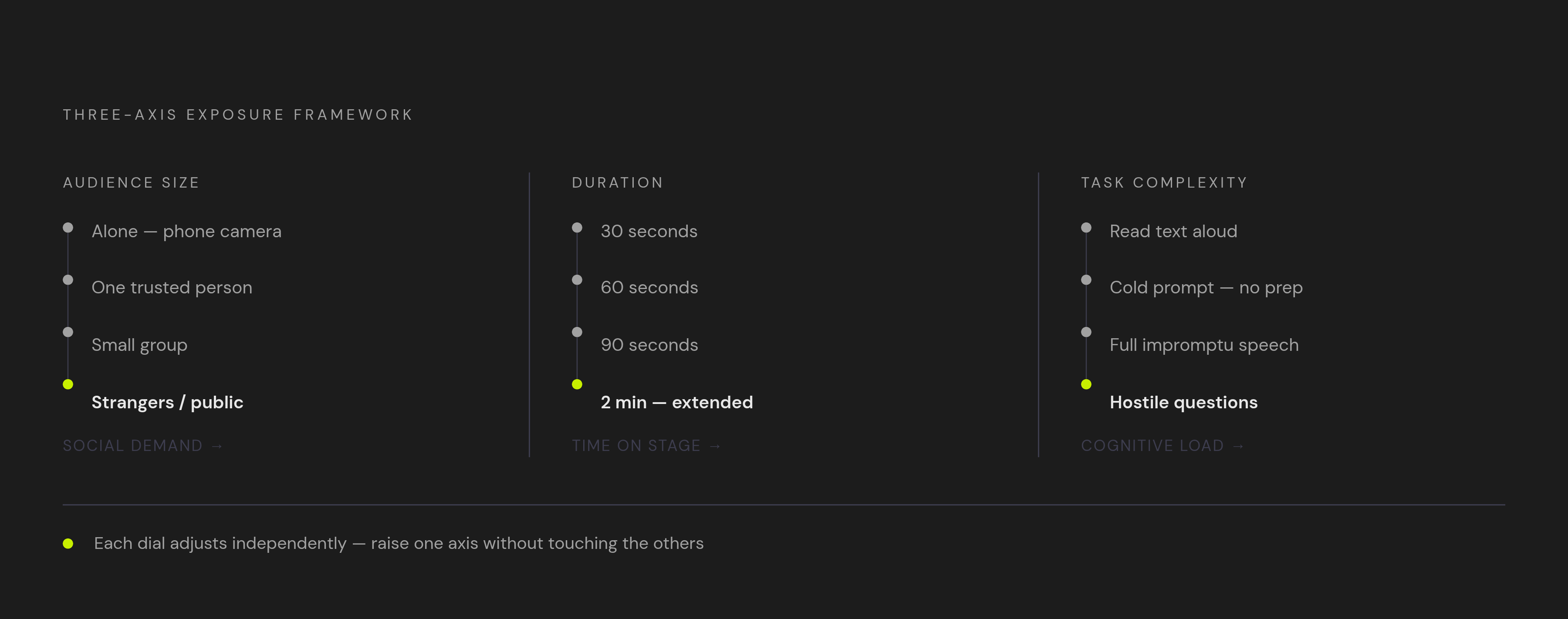
Nobody needs a VR headset or a research grant to borrow this structure. The same three axes that appear across these trials translate directly into a solo practice routine, and each one adjusts independently, mirroring the multi-axis structure seen in the adolescent VRET study.
Audience size is the first axis. Start alone, phone camera running, zero live observers. Move to one trusted person. Then a small group. Then strangers, or some genuinely public setting like a farmers market crowd or an open mic. Duration is the second axis, and the adolescent trial's 30-second-to-2-minute range is a reasonable model to copy: begin with short, timed responses and stretch the clock as tolerance builds. Task complexity is the third axis. Reading text aloud is the easy end, then answering a prompt cold with no prep, then a full impromptu speech on a topic pulled at random, then fielding pushback or hostile questions at the hard end.
The daily structure ties back to the clinical video-review step. Use the identical prompt on day one and day fourteen, then play both recordings back to back. That side-by-side comparison mirrors the video-review logic in clinical exposure protocols: catastrophic predictions from two weeks ago line up against actual footage and, in most cases, quietly fall apart.
The fear of looking bad is trainable: the self-efficacy feedback loop
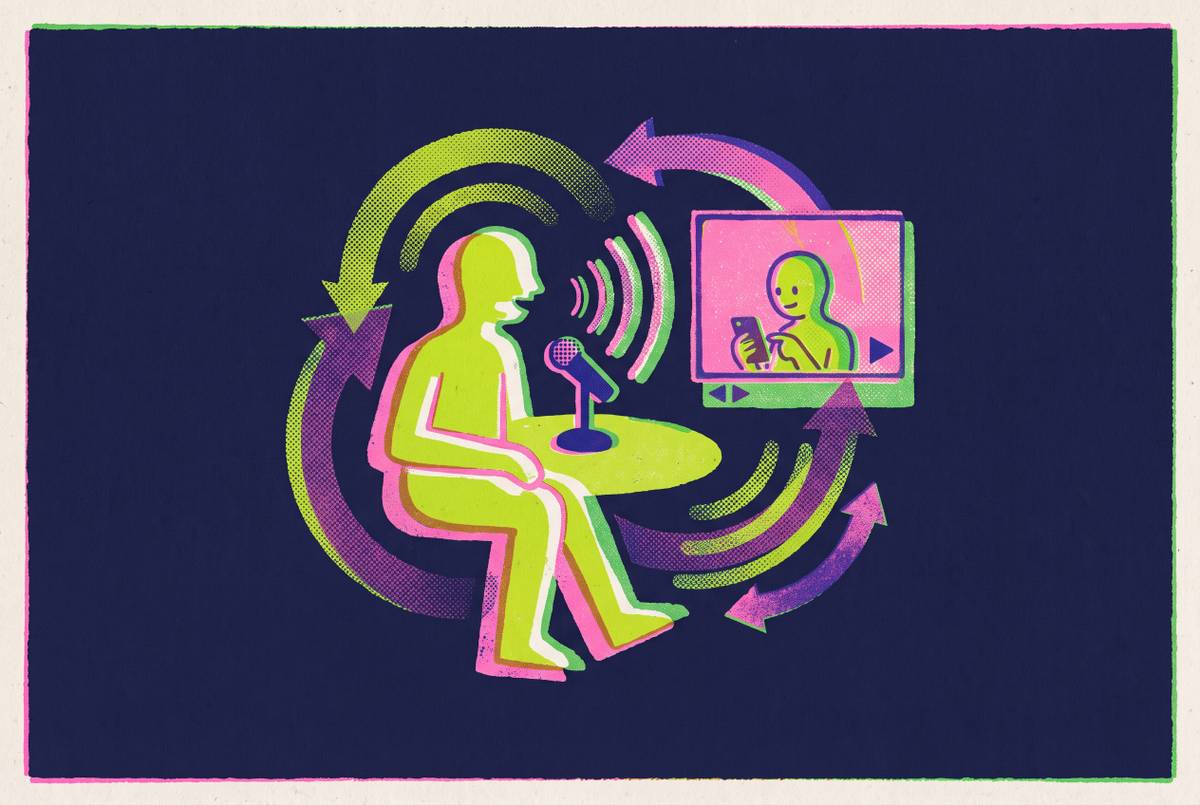
Self-efficacy and anxiety move in opposite directions, and that relationship is the engine under all of this. As belief in one's own capacity to perform climbs, anxiety drops, and that belief gets built through stacked, survived exposures, not pep talks, mantras, or someone telling you to visualize success.
The mechanism is the same prediction-versus-reality loop from earlier, just running on repeat. Each time catastrophe fails to occur, the catastrophic belief takes a small hit. Do that enough times and the baseline fear response drops, because the brain has quietly updated its threat model based on accumulated evidence rather than reassurance. That's a different kind of change than feeling temporarily pumped up before a talk, and it's the kind that survives contact with a bad night's sleep or a hostile question.
The physical signals shift too, once arousal comes down. Posture steadies. Eye contact holds instead of skittering to the floor. The voice projects instead of collapsing into a mumble. Public speaking research often points to a roughly 27-second first-impression window, and lower physiological arousal is what lets that window start working for a speaker instead of against them.
Eloquence itself isn't some separate gift, walled off from confidence, handed to a lucky few at birth. Research on oral storytelling frames the craft as a set of learnable components that can be developed and practiced. Each one trains on its own, the same way audience size, duration, and task complexity train independently in a fear hierarchy. None of it is fixed personality. It's reps, tracked properly, on the right axis.
Sources
- One-Session Versus Three-Sessions of Virtual Reality Exposure Therapy for Public Speaking Anxiety: Protocol of a Randomized Controlled Trial
- Virtual reality exposure therapy with graded interviewer reactions for public speaking anxiety in university students: a randomized controlled trial protocol | Trials | Springer Nature Link
- Frontiers | Long-term effects of virtual reality exposure therapy for adolescents with public speaking anxiety: a one-year follow-up of a randomised controlled trial
- teleprompter.com