Cortisol and Testosterone Before High-Stakes Speaking
Elevated cortisol impairs the verbal fluency needed for high-stakes speaking.
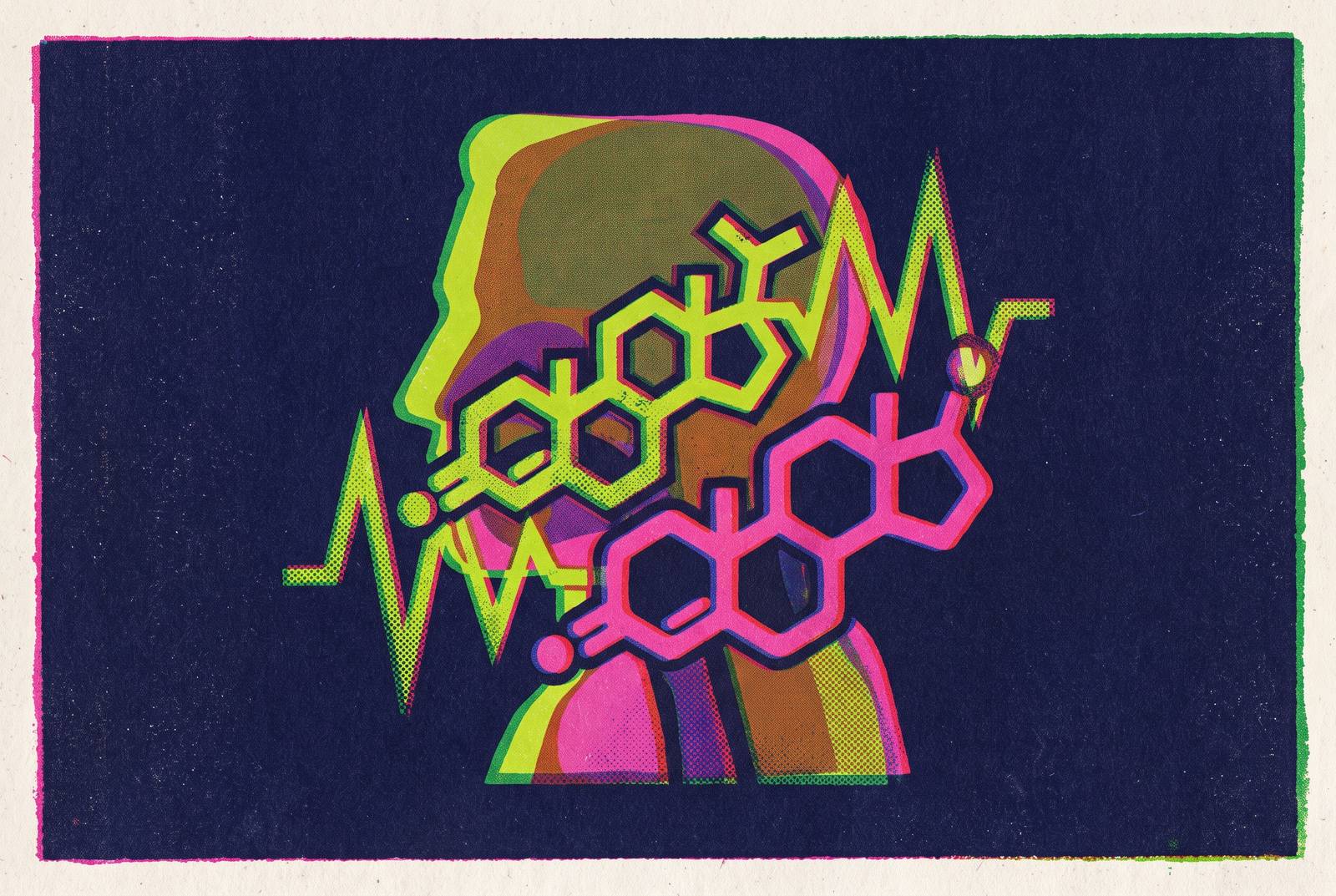
Testosterone builds. Cortisol breaks down. That's the whole cellular argument in one sentence: testosterone is predominantly anabolic, cortisol predominantly catabolic, and the two operate as antagonists at the tissue level. The testosterone-cortisol ratio, or TCR, is just a number that tries to capture which of those two forces has the upper hand at a given moment, and a 2025 narrative review in the Indian Journal of Endocrinology and Metabolism frames it as a surrogate marker for whether the body is leaning toward building or toward breaking down [5].
Sports scientists have used it for years to predict overtraining, time an athlete's competitive peak, track psychological stress, and even flag cardiovascular risk. But nothing about the ratio is sport-specific. It's a dial, not a stopwatch. Anywhere the body faces a demand that could go either way, toward growth or toward depletion, the same dial moves.
A July 2026 narrative review in the Journal of Education, Health and Sport (Grębosz et al.) reinforces that the testosterone-cortisol ratio is responsive to acute and chronic stress, competition demands, and recovery status, but interpretation is shaped by exercise type, circadian rhythm, and individual variability. So the ratio functions as a lens rather than a diagnosis. It's a lens, and a genuinely useful one, but only when read over time and next to other signals, not as a single number that settles anything on its own.
Why a speaking stage triggers the same hormonal storm as a competition
Anyone who has stood at a podium and felt their mouth go dry, their heart start pounding, or their voice crack on the first sentence has already met this hormonal system firsthand, they just didn't know its name. Public speaking flips the amygdala's threat switch the same way a physical danger would, and adrenaline and cortisol start flooding the system within seconds, which is also roughly how long it takes for the prefrontal cortex, the part of the brain responsible for fluent, organized speech, to start losing bandwidth. That's the biological story behind "going blank." It isn't a character flaw. It's a resource-allocation decision your nervous system made without asking permission.
The data backs this up in a way that's hard to wave off. A Psychoneuroendocrinology study followed 95 university students delivering speeches that counted toward their final grade, and measured salivary cortisol, alpha amylase, and interleukin-1 beta before and after. The more interesting detail sits one layer down: students who scored higher on communication anxiety and social interaction anxiety showed greater cortisol reactivity independently of each other, and when both types of anxiety showed up in the same person, the hormonal and inflammatory response compounded further. In other words, the fear of being watched and the fear of fumbling your words aren't the same fear, and having both is measurably worse than having either alone.
A more recent study reinforces the point with a different population. The physical symptoms trace directly back to elevated heart rate, dry mouth, and the tightening around the larynx that turns a normal voice into something squeaky or cracked mid-sentence. None of that is random. It's the same adrenaline-cortisol cocktail an athlete gets before a race, just delivered by a slide deck instead of a starting gun. A 2024 study published in Medicine Science measured salivary cortisol in 104 university students aged 18–20 and found a positive, statistically significant relationship between cortisol levels and public speaking anxiety (p=0.001).
How elevated cortisol breaks verbal fluency in real time
Everyone knows the sensation: mid-sentence, the word is right there, and then it isn't. A string of "um"s fills the gap while the brain scrambles for a thread it was holding two seconds earlier. That's a cortisol problem. It's a cortisol problem, and it happens whether or not the speaker actually knows the material cold.
High cortisol impairs working memory, raises impulsivity, and undercuts the brain's ability to weigh options accurately in the moment, exactly the machinery live speech depends on to stay organized sentence to sentence. A PLOS One study by Becker, Schade, and Rohleder found that a verbal fluency task on its own, without any audience or evaluation attached, acts as a stressor and produces a measurable cortisol and perceived-stress response. Meaning the act of trying to speak fluently under any pressure at all is enough to trigger the spiral.
The sharper finding from that same research: participants whose cortisol spiked hardest during the Trier Social Stress Test paused more often and produced measurably worse verbal fluency than those with a smaller spike. That's the mechanism, not a correlation living somewhere off to the side. It isn't that people who are already bad at speaking get more nervous and that's why they stumble. Elevated cortisol degrades the cognitive machinery fluent speech runs on, and it does that regardless of how skilled or well-rehearsed the speaker actually is. Talent doesn't buy immunity from this. Nobody's amygdala checks a resume before it fires.
What the pre-competition testosterone response looks like, and its counterintuitive implication for performance
A finding ought to complicate anyone's simple mental model of "more testosterone, better performance."" A study in Frontiers in Sports and Active Living examined 24 master rowers aged 43–57, finding cortisol remained stable from awakening through pre-race, then spiked post-competition, while testosterone rose before the race. Cortisol stayed flat from wake-up through the pre-race window and only spiked after the race ended, while testosterone climbed beforehand, a pattern the researchers read as a marker of competitive, aggressive readiness.
So far that tracks with intuition: testosterone rises, the athlete gets primed, everyone wins. Except that's not what the results showed. Across all 24 rowers, a higher testosterone-to-cortisol ratio measured before the race correlated with a worse podium finish, not a better one. That runs against the entire folk theory of hormonal hype-up culture.
The effect wasn't uniform, either. It reached significance in female rowers but not in male rowers, and the post-race cortisol spike was statistically solid against both pre-race levels and the early-morning baseline. So gender moderates the relationship, and the ratio's predictive power isn't the same dial for everyone who steps onto a starting line.
What does this actually mean? Probably that hormonal activation isn't a straight line where more equals better. A ratio pushed too far toward testosterone might reflect an athlete who's over-aroused, running hot on competitive aggression rather than settled readiness, and that's a different physiological state than composed confidence, even though both can look similar from the outside. The same likely applies to a speaker. Someone who walks on stage flooded with adrenaline and swagger isn't automatically in a better spot than someone quietly composed. The target seems to be a productive middle window, not a maximum reading on the dial.
The scale of speaking anxiety and the cost of chronic cortisol exposure over time
The old claim that public speaking is Americans' number one fear, ahead of death itself, doesn't hold up against the current data. It's overstated: only a minority of Americans report being afraid or very afraid of public speaking, and the fear ranked well outside the top tier in the Chapman University Survey of American Fears 2025. But dismissing the topic on that basis would miss the real number that produces this undercount. Subclinical communication apprehension, the everyday nervousness that doesn't rise to a clinical phobia, appears every time someone has to speak in front of others, and it sits far higher: roughly 70% of students report some level of it. So the headline fear stat is smaller than legend suggests, and the actual footprint of the problem is bigger.
Where this actually bites is career trajectory. SpeakWise data show that a meaningful number of workers have turned down a promotion or skipped applying for a job specifically because of speaking anxiety, and the wage and leadership-advancement cost compounds over a career. That's not a one-time discomfort. It's a recurring tax charged every time an opportunity requires standing up and talking, and it adds up the same way compound interest does, just in reverse.
The chronic health angle deserves its own mention, because it changes the calculus from "unpleasant" to "worth addressing." The Auer et al. research suggests that people with elevated trait communication anxiety and social interaction anxiety may end up habituating their HPA axis to fire more readily over time, meaning repeated high-cortisol speaking events are not just acutely unpleasant but may carry long-term health consequences. And yet only about 8% of people with speaking anxiety ever seek professional help, despite a 2025 meta-analysis of 26 studies showing psychological interventions produce a large reduction in symptoms. The treatment exists. Almost nobody's picking it up.
What shifts the ratio before a high-stakes moment
Start with the idea everyone's already heard of, because it's the fastest way to establish who's being honest here. Power posing, the notion that standing like a superhero for two minutes rewires your hormones, came from a 2010 study by Carney, Cuddy, and Yap claiming expansive posture raised testosterone and lowered cortisol.
It didn't hold up. Large meta-analyses and repeated replication attempts have failed to find reliable evidence that expansive posture changes hormone levels or shifts real-world behavior like risk tolerance in negotiation. A replication in BMC Psychology, with 92 young adults, found no replication of the original testosterone effect and no replication of the subjective feeling-of-power effect either. There was one partial signal buried in the null result: among people assigned to high-power poses, a drop in cortisol did track with higher risk tolerance, which suggests something is happening, just not the something the original study claimed. A separate study of 247 male participants found that winners who adopted a high-power pose saw a small relative testosterone bump compared to winners who didn't, but for losers, the same pose produced no benefit and possibly made things worse. Posture, in other words, doesn't hand you a hormone. It amplifies whatever emotional state you already walked in with. If that's disappointing, the upside is that posing still reliably nudges subjective confidence upward, even without the hormonal magic, which makes it a fine thing to do in a green room. Just don't expect biochemistry to salute.
The intervention with the strongest psychological backing is a two-word swap. Alison Wood Brooks, at Harvard Business School, ran a 2014 study published in the Journal of Experimental Psychology showing that people who said "I am excited" out loud before a high-stakes task outperformed both those who tried to calm themselves down and those who said nothing at all. The mechanism makes sense once it's spelled out: telling yourself to calm down means fighting an already-activated nervous system, which is neurologically expensive, while relabeling that same arousal as excitement just redirects the signal instead of suppressing it. A 2025 pre-registered randomized controlled trial, run with 221 third-year medical students, tested this exact reframe, framing stress arousal as a resource rather than a threat, on high-stakes communication tasks, adding clinical weight to what had been a clever psychology-lab finding.
Breathing is the fastest lever on this entire list, and it isn't close. Box breathing, a 4-4-4-4 count, and the 4-7-8 method both lower cortisol and slow heart rate in under two minutes by kicking the parasympathetic nervous system into gear. Nothing else here works that quickly. Detailed visualization, mentally rehearsing the specific beats of a successful talk rather than just vaguely "picturing success," taps the same neural circuitry as the live performance itself, and a brisk pre-speech walk or a few minutes of stretching releases endorphins and brings cortisol down through simple physical exertion.
A 2024 Medicine Science study of those same 104 university students found a significant negative correlation between public speaking anxiety and cortisol after inhaling thyme essential oil, and reported the practice as safe for people with high glossophobia. Call this an emerging, niche finding rather than a settled protocol. It earns a mention because it's sourced and specific, not because it belongs on the same shelf as breathwork or cognitive reframing just yet.
Why 90% of pre-speech anxiety is a preparation problem
Roughly 90% of pre-presentation anxiety traces back to inadequate preparation, which is either the most obvious sentence in this entire piece or the most useful one, depending on how honestly a reader answers the next question: when's the last time you actually rehearsed a talk out loud, more than once, with someone giving you real feedback?
That's the practical hinge the whole hormonal argument swings on. The July 2026 review notes the TCR earns its keep as a longitudinal marker, tracked over repeated measurement and consistent training load, rather than as a single reading taken once and treated as gospel. Athletes don't show up to competition hoping their hormones cooperate that day. They train for months specifically to shift their baseline profile before the starting gun ever fires. There's no reason to assume speaking works differently, and every reason from the research above to think it doesn't.
What does repeated practice actually change? Structurally, it seems to lower the amygdala's threat-tagging of speaking situations over time, which gradually pulls down the cortisol baseline that gets triggered by being evaluated. The body stops treating a microphone like a threat once it's stood in front of enough of them and survived. The format of that practice affects how much the cortisol baseline drops, more than the raw hours logged do. The 2025 meta-analysis of 26 studies found structured, repeated exposure with feedback outperformed unstructured experience at reducing public speaking anxiety. Athletes track training load for a reason. Speakers rarely apply the same discipline to their own reps, and the data suggests that's exactly the gap to close.
A market case produces the personal-development one, too. Communication has ranked as the most in-demand skill on LinkedIn for a second consecutive year, and treating verbal fluency as a trainable daily practice is not just self-improvement optimism but a response to what employers are actually asking for. The hormonal case says the baseline moves with training load. The market case says the training's worth doing regardless. Between the two, the instruction for anyone dreading their next talk is less mysterious than the neuroscience makes it sound: practice more, practice with feedback, and let the ratio catch up.
Sources
- Testosterone–Cortisol Ratio as a Marker of Training Load and Recovery in Athletes: A Narrative Review | Journal of Education, Health and Sport
- Communication and social interaction anxiety enhance interleukin-1 beta and cortisol reactivity during high-stakes public speaking - ScienceDirect
- Frontiers | Testosterone/cortisol ratio: gender effect and prediction of podium results in beach sprint master rowers
- The Testosterone: Cortisol Ratio - A Tool with Practical... : Indian Journal of Endocrinology and Metabolism
- PLOS ONE | https://doi.org/10.1371/journal.pone.0319426 February 25, 2025
- Activation of the hypothalamic-pituitary adrenal axis in response to a verbal fluency task and associations with task performance | PLOS One
- A randomized controlled study of power posing before public speaking exposure for social anxiety disorder: No evidence for augmentative effects - ScienceDirect
- 30+ Revealing Fear of Public Speaking Statistics for 2026