Vocal Pitch and Perceived Leadership in Speakers
Lower voices trigger snap leadership judgments, whether speakers intend it or not.

If you listen for just a second, pitch tells you whether a speaker deserves to lead. The research on this is specific enough to put numbers on it, and the mechanism behind it is old enough to predate language itself.
Why Listeners Judge Leadership by Sound
Someone starts talking before anyone in the room has decided to pay attention. Within a few syllables, before the sentence even finishes, the room has already formed a rough opinion about whether this person is worth following. Nobody voted on it or thought it through. The voice did the work on its own, and the brain filed an impression under "leader" or "not leader" well before it got around to parsing the actual words.
The likely explanation reaches back further than boardrooms or ballots. For most of human history, a challenge to leadership was a physical one, so a voice that signaled size and strength carried real survival information. A lower voice tends to come from a longer, thicker vocal tract, and that physical setup correlates with higher testosterone and greater physical strength in the person producing it. Listeners who read "low pitch" as "strong and capable of protecting the group" were reading a real signal, not a superstition, and that shortcut stuck around long after leadership stopped requiring anyone to win a fight.
Pitch also tracks something else: age and maturity. Fundamental frequency, the physical measure of how high or low a voice sounds, drops steadily from childhood through middle age. A deeper voice reads as an older, more experienced voice, and listeners tend to associate both experience and readiness with fitness to lead. None of this makes pitch destiny. It makes pitch a signal that gets read whether a speaker intends it or not, and a speaker who never thinks about pitch is not opting out of this judgment. That speaker is just leaving the read up to chance.
Pitch and Leadership Outcomes in the Research
The laboratory evidence turns this mechanism into a measurable pattern, and some of the clearest work comes from Casey Klofstad's "Sounds Like a Winner" research. Klofstad and colleagues recorded men and women saying a single scripted line, "I urge you to vote for me this November," then digitally manipulated each recording to produce a higher-pitched and a lower-pitched version. Participants heard pairs of these recordings and had to pick which speaker they'd vote for. Both male and female listeners picked the lower-pitched version as more capable of leadership, and that held no matter whether the candidate was male or female.
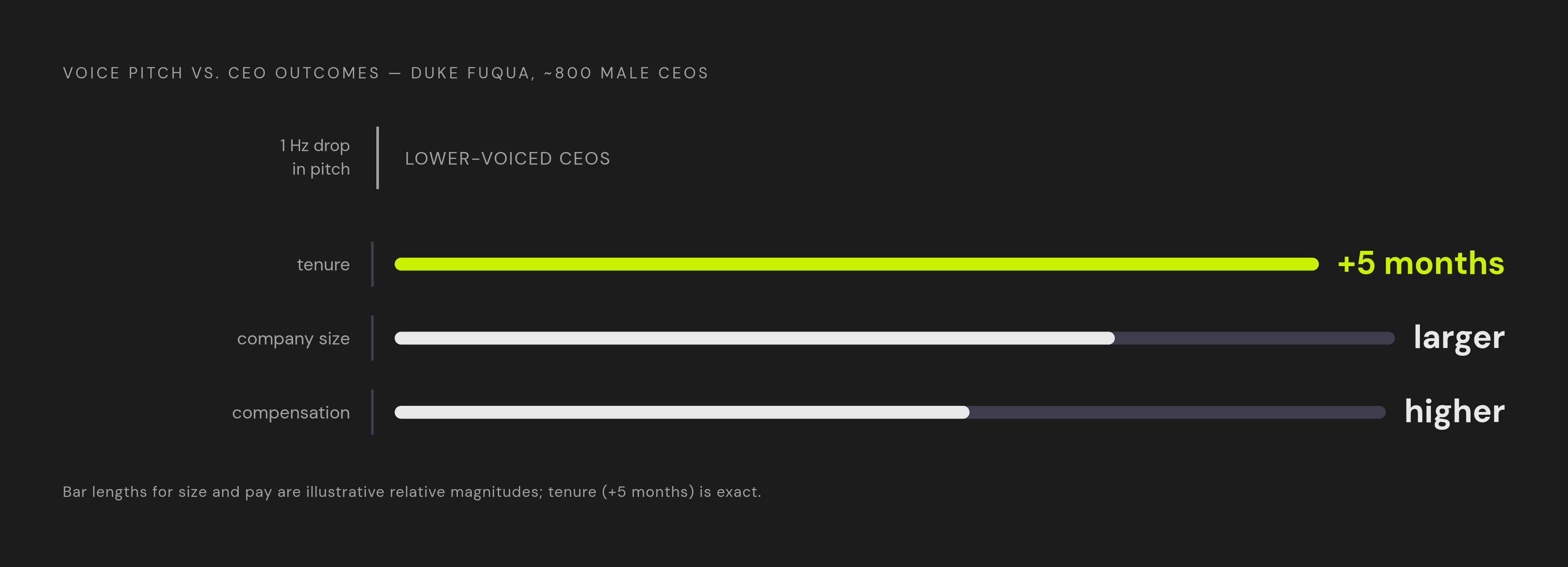
That effect is not confined to elections. A Duke Fuqua School of Business study looked at nearly 800 male CEOs and found that lower vocal pitch tracked with longer time in the job. A specific drop in pitch corresponded to roughly five additional months of CEO tenure, and the CEOs with lower voices also tended to run larger companies and take home higher pay. A few hundred CEOs and a laboratory voting experiment are two very different settings, which makes it notable that they point in the same direction: the market and the ballot box both reward the same acoustic trait.
What makes the pattern more interesting is that pitch is not a static score a listener takes once and files away. Emergent rank is the informal pecking order that forms when a group interacts in real time, and research on it shows that pitch shifts during a conversation predict standing in that group. Speakers who raise their pitch early in an interaction tend to end up lower in the emergent rank, while speakers who deepen their pitch tend to rise. Listeners are tracking pitch as it moves, moment to moment, not averaging it over an entire conversation. That dynamic quality is what makes the next complication so important: if pitch is being read live and in context, then who is speaking, and in what setting, changes what the same pitch shift actually communicates.
Why the pitch–authority link is more complicated for women
The Klofstad and Duke findings describe a pattern that holds for men with unusual consistency. The same logic applied to women produces a messier picture, because gender changes what a lowered pitch is understood to mean. Low pitch reads as dominance, and dominance is a trait audiences expect and reward in men far more readily than they reward it in women.
A researcher studying gender and leadership perception frames the asymmetry directly: "People tend to expect dominant leadership from men and communal leadership from women. A man who lowers his pitch is activating a schema listeners already have ready for him. A woman who does the same thing is often activating a schema that clashes with the expectations she's being measured against, so the dominance signal can land as a mismatch.
Elizabeth Holmes offers the example most people already have in their heads. Kim's research on this point reaches a clear verdict: "you don't have to do that, because it's not going to help your integrity." That's a specific, researched claim about how the pitch-dominance cue functions for women, not a vague gesture at fairness.
A 2025 Leadership Quarterly study by Wilms, Oostrom, and van Garderen adds a layer that changes the practical stakes. The researchers tested small pitch shifts, plus or minus 20 Hz, on perceptions of female leadership candidates and found that these shifts didn't move hirability scores when the candidate also projected a charismatic delivery. In other words, how a woman delivers a message can override what her raw pitch number says. That means a woman chasing a lower register without also building charismatic delivery risks paying twice: the manufactured voice can read as inauthentic, and the dominance cue it's meant to send may not even register as intended.
How context changes what a given pitch signals
Gender is one variable that reshapes what a given pitch communicates. Setting is another, and the research on professional, high-stakes environments makes the point well. A 2025 study in the Journal of Voice looked at how listeners judge pitch in contexts like aviation, where trust and competence carry real operational weight. Lower-pitched voices still came out ahead for trust and professional competence in that setting. But the same study found that emotionally charged scenarios produced far more mixed results, which complicates any assumption that lower pitch simply equals more authority across every situation a speaker might face.
Culture adds another layer. Research on CEO voice pitch and how it interacts with accent found that the usual link, where higher pitch predicts lower perceived trustworthiness, weakens when the CEO being judged has a foreign accent, and strengthens when the listener doing the judging is foreign-born. The cultural frame a listener brings to the interaction changes how the pitch signal gets interpreted, so the same voice can land differently depending on who's in the room.
Gen Z audiences tend to favor less hierarchical models of leadership, extending credibility based on transparency and demonstrated competence. A delivery that sounds too polished, including a pitch drop that comes across as performed rather than natural, can read as less trustworthy to this audience. Pitch functions as one input in a larger vocal impression. A 20 Hz shift that changes outcomes in one audience might go completely unnoticed in another. Treating pitch as a single dial to crank down is a weak strategy on its own.
The two habitual pitch patterns that actively undermine credibility
Context and gender complicate the pitch story, but two specific habits undermine credibility in almost any context, and most speakers do them without noticing.
The first is upspeak: ending a declarative sentence with a rising pitch, the same inflection used for a question, so a statement like "the numbers are solid" comes out sounding like "the numbers are solid?" Listeners read that rising tone as hesitation, and in its more severe forms it can make a speaker sound unsure of the very content they're presenting, no matter how strong that content actually is.
The second is vocal fry: the low, creaky rattle in the voice that often appears at the end of sentences, especially among younger women. A Duke University study on this found that listeners rated speakers using vocal fry as less competent, less educated, less trustworthy, and less likely to be hired, independent of anything about the actual content of what was said. Upspeak sits at one end of the pitch register and vocal fry sits closer to the other, yet they produce the same basic outcome: they pull listener attention away from what's being said and toward the question of whether the speaker sounds confident, which is the last impression a speaker wants to leave in a job interview, a negotiation, a classroom presentation, or a team meeting, where these habits tend to surface most because nerves push the voice into whatever register it's least practiced at controlling.
Both patterns are habits, and habits can be retrained, with evidence for that retraining more specific than a general pep talk about confidence.
Pitch is partially trainable, and the mechanism matters
A reasonable response to everything above might be a shrug: either a speaker has an authoritative voice or they don't, so why bother? The research on vocal training doesn't support that fatalism. Vocal control behaves like a motor skill, so it responds to focused, repeated practice the same way a golf swing or a free throw does.
University of Surrey researchers challenged the assumption that pitch perception and control are fixed traits a person is simply born with. Adult musicians who went through an eight-week focused training program were able to identify pitches with high accuracy by the end of the study. That's a finding about pitch perception and the plasticity of the auditory-motor system in adults, not a direct claim that anyone can lower their speaking voice on command by the same method. But it does push back hard against the idea that pitch ability is locked in early and stays fixed for life.
Participants had to repeatedly complete the final levels of training to lock the skill in. Sporadic practice produced sporadic results. If you want the muscle memory that makes a vocal change durable, rather than something that evaporates the moment attention lapses, you need consistent repetition over time rather than one long session or a single breakthrough afternoon.
On the practitioner side, New York Speech Coaching reports that its most common training path covers preparation, pitch, volume, rate variation, and physical and practical balance, and that clients working through that sequence see real changes in vocal versatility and control. That's a practitioner's reported outcome rather than a controlled study, so it should be read as one data point describing what training in practice tends to look like, not as proof on the order of a peer-reviewed trial. Together, the Surrey findings and this practitioner pattern point toward the same conclusion: pitch and vocal delivery respond to deliberate work, even if nobody should expect an overnight transformation.
What deliberate vocal practice actually looks like day-to-day
Vocal training behaves much like athletic training: short, frequent sessions with real feedback tend to beat occasional long sessions without any feedback at all, because the feedback loop is what actually drives the adaptation, not the raw number of hours logged.
Effective vocal presence work tends to address several things at once: pitch range and stability, pace and the strategic use of pauses, a deliberate downward inflection placed on statements meant to carry authority, volume control, and physical grounding, meaning posture and breath support. These elements interact, so if you fix pitch alone and ignore pace, you can end up with a voice that sounds slow and rehearsed instead of naturally confident. A sentence delivered in a careful monotone with a dramatic pitch drop at the end doesn't sound authoritative. It sounds like a hostage read a ransom note out loud.
The Leadership Quarterly 2025 finding, that charismatic delivery can neutralize pitch bias for female speakers, points to a practical priority worth taking seriously: building expressive range and delivery confidence often does more work than chasing a specific Hz target on a pitch tracking app. Vital Voice Training, founded by theater-trained coaches Casey Erin Clark and Julie Fogh, frames this well through a client who won a pitch competition and described the win as a result of speaking "with my own voice." The goal of serious vocal practice is expanding the control and expressiveness of the voice a speaker already has, not manufacturing a performed version of authority.
Practically, that work tends to come down to something simple enough to do without a coach in the room: record a short answer to a prompt, then listen back specifically for pitch, for inflection patterns, and for moments of upspeak or vocal fry creeping in under stress. That loop, record, listen, adjust, repeat, is unglamorous and slow. It's the same mechanic behind the Surrey study's finding that repetition is what makes a skill stick, and it's a more reliable path to vocal authority than hoping the right voice shows up on its own the day it matters most.
Sources
- (PDF) Sounds like a winner: Voice pitch influences perception of leadership capacity in both men and women
- Contextual Effects of Vocal Pitch on Trust Perception in Aviation Settings - PubMed
- The effects of the charisma signal and voice pitch in female leader selection - ScienceDirect
- Sounds Like a Winner: Voice Pitch Influences Perception of Leadership Capacity
- New study finds a lower voice adds credibility to leadership, depending on gender
- Voice Pitch and Leadership: Moderating Effects of CEO Accentedness and Follower Native Status
- Perceptions of Competence, Strength, and Age Influence Voters to Select Leaders with Lower-Pitched Voices