Eye Contact and Perceived Confidence in Speakers
How speakers lock eyes to calm their nervous system and connect with audiences.

Eye contact shapes both how confident a speaker looks and how confident that speaker feels. Its importance goes beyond body language. By helping the nervous system move away from anxiety and toward connection, it can help a speaker feel the presence that others see. That makes eye contact a trainable lever.
Eye contact triggers a physiological shift in the speaker, not just a signal to the audience
The instinct to look away when anxious runs against the very response that can help a speaker settle. Most speakers think it works the other way around and expect to get their nerves under control before meeting someone’s eyes. The gaze both signals an internal state and helps change that state.
The mechanism involves the SES and a shift from sympathetic to parasympathetic dominance in the nervous system. In ordinary terms, the body moves away from a threat response and toward a state more suited to relating to other people. When the SES is active, the speaker becomes better able to read the room, access their material and think creatively. Those abilities are part of what makes speaking feel possible when attention would otherwise be consumed by anxiety.
This distinction changes what it means to work on presence. If eye contact only advertised confidence, practicing it would amount to improving the packaging. If it also helps produce calm, practicing it reaches into the experience that the audience eventually sees.
That does not turn eye contact into an instant cure for nerves. Waiting to feel ready can postpone the very interaction that helps create readiness. In this account, the eyes are less like a confidence gauge and more like a control the speaker can learn to use.
What the audience actually reads from a speaker's eyes, and why they weight it most
On the audience’s side, visual attention is not distributed democratically across the speaker’s body. The face, and especially the eyes, carries more weight in judgments of confidence than posture or hands. A speaker may think looking away is a small change that only they notice, but the audience is watching the speaker’s eyes.
Yondu Mori and Marc D. Pell’s 2019 production study looked at the visible signs that speakers were confident in what they were saying. Speakers answered general knowledge questions, some harder than others, while their face and upper body were recorded. Observers then watched muted recordings to judge confidence and identify the areas they relied on. Sustained eye contact occurred far more often in high-confidence speech. Low-confidence speech instead involved upward gaze, a thinking face, eyebrow and head movements, and postural movements.
Observers in the same study reported giving the greatest perceptual weight to facial expressions, head movements and eyes. Posture and hands were secondary. Gaze belongs to the cluster of cues people use most heavily to infer uncertainty. Eyes are a fallible but high-stakes source of evidence in the audience’s judgment.
Social expectations reinforce that weighting. Audiences have a deeply embedded association between confidence and a person’s willingness to hold their gaze, and that association can activate within the first seconds of a presentation. As a result, looking away when uncertain can broadcast uncertainty before a speaker has had much opportunity to explain anything. The internal act of managing discomfort becomes an external cue, whether or not the speaker intended to send it.
Why eye contact's effect on confidence is bidirectional — and what that means for the speaker-audience loop
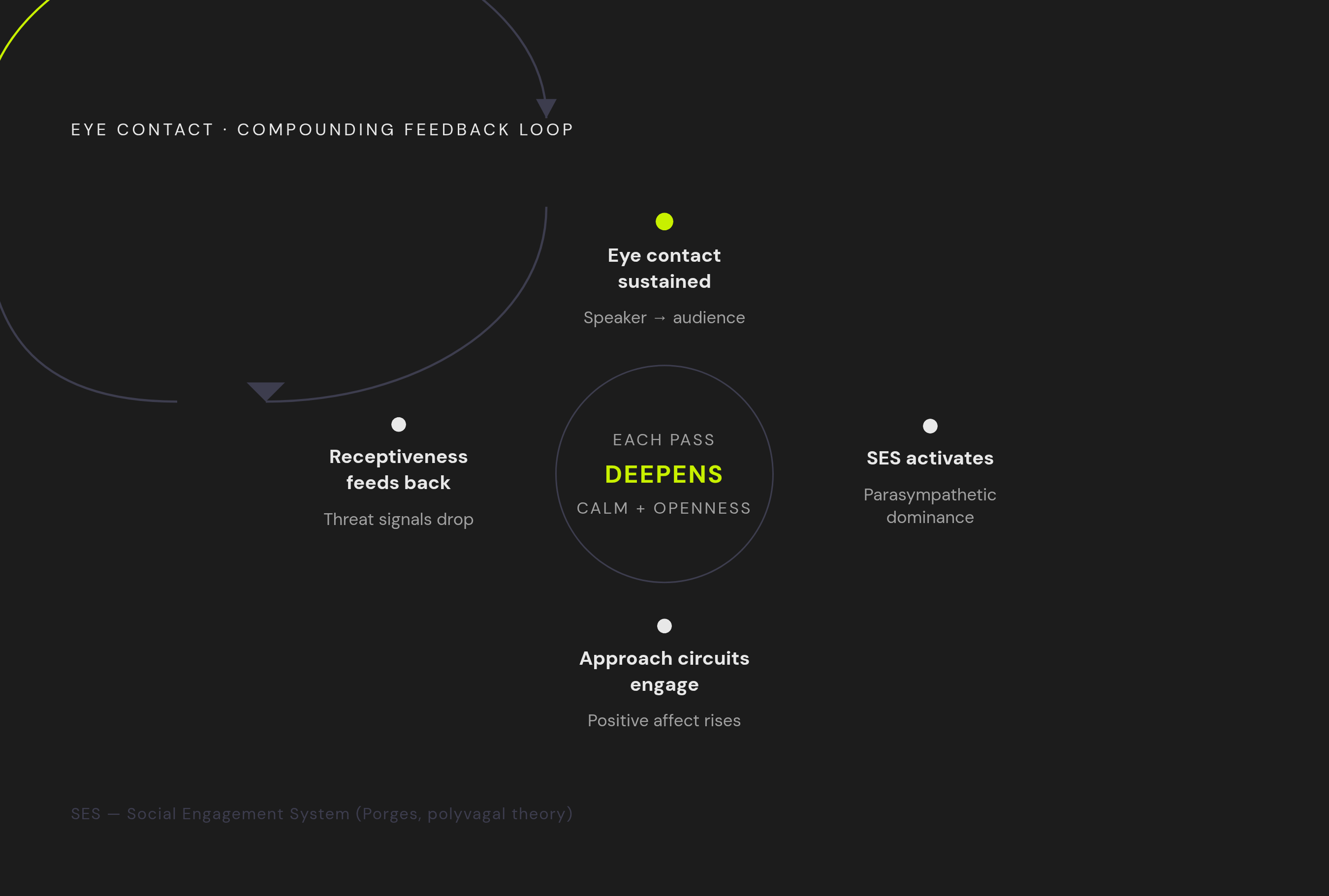
The physiological change in the speaker and the social response in the audience do not have to remain separate effects. They can reinforce one another. When the speaker’s SES is active, the speaker can better pick up nonverbal cues and move beyond just putting up with being watched. That matters because an audience’s receptiveness can only help if the speaker is able to notice it.
A 2025 study in PLOS ONE found that receiving direct gaze produces automatic positive affective reactions in the perceiver. Brain systems associated with approach motivation become active, making the listener more willing to take in new information. Eye contact therefore does more than make the speaker look composed. In a receptive exchange, it also helps create the social openness that makes composure easier to sustain.
The loop closes when that openness feeds back to the speaker. A calmer speaker engages with the audience, and a more receptive audience presents fewer threat signals to the speaker. The speaker can then settle further and become more available to the room. This is a compounding interaction rather than a fixed amount of confidence transferred through a glance.
The speaker does not need to wait passively for the room to become reassuring. A soft-focused gaze toward individual audience members for roughly 3–4 seconds, followed by moving on, gives the interaction time to register “not a threat” without becoming a stare.
The rhythm also keeps the technique tied to actual people rather than to the abstract task of appearing confident. Eye contact works here as an exchange. Practicing that exchange means learning to start the loop and respond to the audience as it unfolds. But responsiveness also requires noticing when the same behavior produces a different result.
Where eye contact fails: the skeptical-listener paradox and the video-call structural problem
A listener who already disagrees with the speaker presents the clearest limit to the idea that more eye contact is always better. Frances Chen of the University of British Columbia and Harvard Kennedy School’s Julia Minson found that participants who spent more time looking at a speaker’s eyes while watching video were less persuaded. Their study in Psychological Science showed resistant listeners becoming more entrenched.
This finding separates two outcomes that are easy to confuse, namely perceived confidence and persuasion. A speaker’s willingness to meet someone’s gaze does not mean that person will accept the argument. With a receptive audience, eye contact can support rapport and the calming loop. With someone who already holds a contrary view, it can backfire. Skilled use therefore means modulating eye contact.
A screen introduces a different problem because it interferes with the exchange itself. Standard webcam setups place the camera above or to the side of the screen, so looking at the other person’s face means looking away from the lens. Looking into the camera, meanwhile, means losing sight of that person’s reactions. Alice Gao and colleagues’ 2025 study in Journal of Vision found that looking approximately 2° below the camera lens better optimized perceived eye contact than looking directly into it.
The consequences for virtual interviews are less settled. Hiroshima University’s 2024 research in Scientific Reports found that scores were significantly lower when people looked away from the camera. A 2025 CHI Conference study with a larger sample found too little evidence to say that eye contact significantly changed how well people did in virtual interviews. These conflicting findings do not support a universal claim about the career value of camera gaze. Instead, they sharpen the distinction between live mutual attention and its imperfect screen-mediated substitute.
Gen Z is entering high-stakes situations with a specific eye-contact deficit, and the career cost is concrete
For many younger speakers, the challenge begins before any deliberate attempt to refine presentation skills. During formative social years, pandemic conditions replaced in-person interaction with video calls and removed physical proximity. That disrupted the ordinary accumulation of face-to-face practice. A habit that can seem effortless to an observer may therefore be underpracticed in the person being observed.
The Rowan Center for Behavioral Medicine recorded a sharp rise in calls from Gen Z individuals seeking treatment for social anxiety between 2019 and 2024. These findings provide context for the difficulty some younger people face in social situations. They do not make every awkward gaze a symptom of a disorder, or every member of a generation equally anxious.
The “Gen Z Stare,” a viral cultural phenomenon on TikTok, captures the visible side of the perception gap. A blank, deadpan expression can read to older colleagues and interviewers as disengagement or low confidence. Yet the expression does not necessarily mean what those observers think it means. Many Gen Z individuals also choose to reject emotional labor, including changing their facial expressions to meet other people’s social expectations. So people who have had less practice and people who resist acting warm can look much the same to others, for different reasons.
The expression can still hurt someone’s career, whatever they intend it to mean. A CareerBuilder survey found poor eye contact among the most common nonverbal mistakes hiring managers cite, with a significant fraction describing avoidance as a major red flag. In that setting, a gap in practiced behavior can be treated as evidence about the candidate. Understanding the mismatch shows why a closable skill gap deserves more attention than a generational caricature, regardless of whether an interviewer’s judgment is warranted.
How the eye-contact loop is actually trained — and why reps matter more than advice
If the obstacle is partly a nervous system that treats being watched as threatening, information alone cannot reliably remove it. Repeated exposure supplies the experience needed to desensitize the threat response and make the behavior habitual. Training must therefore involve the situation itself, whether the audience is real or simulated.
Reeves et al.’s meta-analysis found that virtual reality exposure therapy led to a large drop in public speaking anxiety. The reduction was comparable to, though marginally lower than, that achieved through in-person exposure. This matters because it shows that a virtual audience can support real physiological adaptation. Practice does not become meaningless simply because the people in front of the speaker are simulated. What matters to the training principle is that the speaker encounters and works through the speaking situation.
A 2025 quasi-experimental study in Taiwan used Meta Quest 2 headsets over five sessions with an AI-integrated VR application for training people to speak. It found significant improvements in speaking proficiency and significant reductions in both public speaking and interview anxiety. Those findings support exposure-based practice, though they do not prove that gaze alone caused every gain.
The same principle supports practice with less technology, in which a speaker faces a real or simulated audience and gets feedback on where they look. Recording and reviewing a response to a single timed prompt gives speakers a way to practice briefly each day and get feedback on what they do. Short sessions held often build SES habituation faster than long sessions held now and then because speakers face the situation often and get feedback soon after each try. Reviewing gaze connects the intention to make contact with what the speaker actually does.
Rehearsing the exchange helps make looking toward the audience part of handling a high-stakes moment. Because the skill depends on the setting, practice includes learning a soft rhythm that allows breaks in eye contact. Confidence and eye contact are trained together because practicing eye contact is part of what produces the feeling.