Body Posture Effects on Speaker Confidence
Straightening your posture can rewire how confident you actually feel, not just appear.
Body posture affects speaker confidence in two directions. It shapes how an audience reads the speaker, but it also helps create the confidence the speaker feels. That makes postural awareness more than a lesson in looking composed. It is a concrete, trainable way to build presence and authority, provided it becomes a daily communication habit.
Why posture shapes how a speaker feels, not just how they look
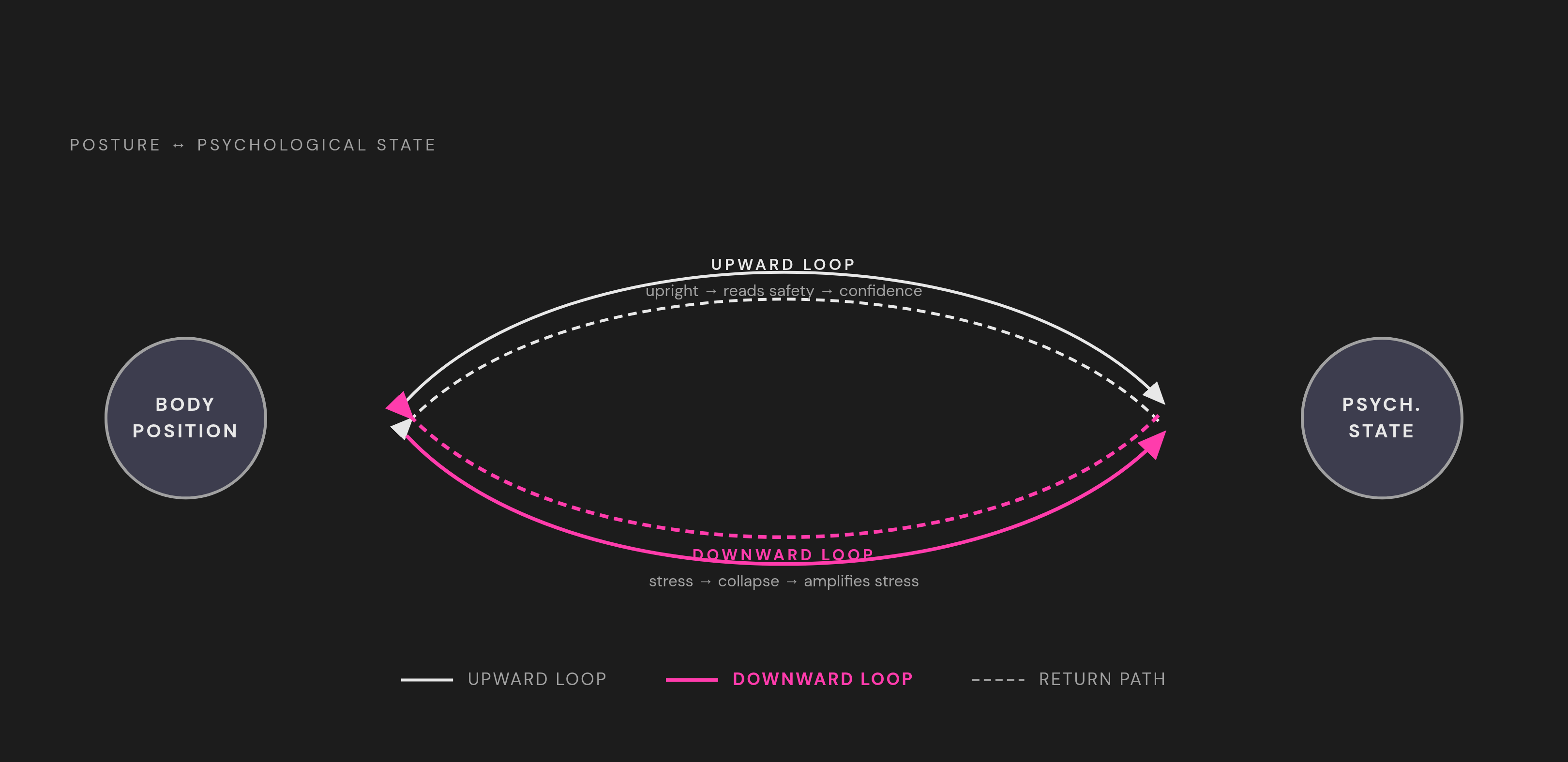
Confidence can start in the body. The familiar account runs the other way, with a confident person standing upright because they already feel capable. But that account leaves out half the loop. Physical position is also an input to psychological state, so a change in posture can help change how ready a person feels to speak.
An upright torso and open chest signal safety and capability to the brain, while a collapsed, rounded posture signals defeat or threat. These are physiological readings the nervous system makes automatically. The speaker therefore receives information from their own stance even while thinking about what to say. Confidence is partly shaped by that information, rather than being settled before the body enters the picture.
That influence can work within minutes, so posture can help just before or during a tough speaking moment. Its value is not that it replaces knowledge of the subject or familiarity with the audience. Instead, it gives the speaker a physical way to influence the state in which that knowledge must be used. Someone can have a well-prepared argument and still need help feeling capable of delivering it.
A speaker who takes a stance just to look impressive uses posture as packaging. Postural awareness treats it as part of the process of speaking itself. That is a stronger claim than advice to look confident, but it also raises a fair question about which effects the research can actually support.
What the research actually shows — and where it stops short
Studies consistently find that people with upright posture report more confidence, feel more alert, and cope better with stress than those in slumped or supine positions. Those outcomes support the body-mind loop, but they are not interchangeable. Feeling more capable, performing better on a task, and producing a different voice each require their own evidence.
Research published in Frontiers in Human Neuroscience found that people did better on problem-solving and working memory tasks in upright than in supine positions. It also reported higher anticipatory anxiety in sitting or standing than in lying-down positions. That second finding matters because being more alert is not necessarily the same as being less anxious. A randomized controlled trial published in Health Psychology found that people who sat upright had a higher speech rate and less self-focus. These findings fit embodied cognition, in which muscular and autonomic states influence emotional responding, without suggesting that upright posture improves every outcome in the same way.
The replication controversy around power posing makes that distinction especially important. Claims about hormonal changes remain unresolved, so they should not carry the argument for speakers. The broader evidence still shows that posture can affect subjective confidence, stress perception, and self-evaluation. Those are meaningful outcomes even without a settled hormonal explanation. The practical distinction is equally useful, with power poses treated as a possible pre-talk intervention rather than a stance to maintain throughout a performance.
The limits become clearer when the question shifts to sound. A 2025 peer-reviewed study in the International Journal of Language & Communication Disorders found no significant differences in voice range profile parameters between sitting and standing in vocally healthy, untrained participants. Effect sizes were very small to small across the board. Posture’s effects on felt confidence and perceived credibility have stronger support than any promise to transform raw vocal acoustics. Standing differently is not a voice transplant, and the case for doing it does not need to pretend otherwise.
How audiences read posture before a speaker says a word
An audience begins forming judgments of competence and trustworthiness in a fraction of a second. Posture is among the first signals available, before listeners can assess voice quality, word choice, or argument structure. That timing gives the body a role in the opening moments of a speech or conversation.
Audiences reliably read open body language, including unfolded arms, visible palms, and an upright torso, as confidence and competence. Closed postures tend to suggest defensiveness, insecurity, or disengagement, regardless of the speaker’s intended message. These audience interpretations can differ from what a person actually knows or feels. Yet that distinction does not make them inconsequential. A capable speaker can still present signals that make their capability harder for others to recognize.
Openness is most effective when it comes with warmth. Both assurance and a willingness to engage can be conveyed by open palms and a slight forward lean, whereas openness without warmth can read as arrogance. Research on mass media presentations found that upright and leaning forward postures received the highest audience ratings for credibility, trustworthiness, engagement, and authority. CNN chief international correspondent Clarissa Ward provides a concrete example of the principle. Her upright, commanding stance during challenging live broadcasts reinforces the credibility of her reporting in real time.
Albert Mehrabian’s limited 1960s studies concerned emotionally loaded messages in which words conflicted with tone and body language, a scope misrepresented by the widely repeated claim that communication is 93% nonverbal. When words and nonverbal signals conflict, audiences tend to trust the body language.
Why the body-mind loop breaks down under pressure — and what gives it away
A speaker may know what confident posture looks like but struggle to hold it naturally under stress. Knowledge of the material and the audience supports an authentic stance because the speaker has something solid beneath the appearance of confidence. Striking a pose without feeling that sure can have the opposite effect. Audiences are sensitive to the mismatch between a rehearsed position and the nervous system underneath it. The body may be saying capable while the performance as a whole says strained.
Posture needs to support the speaker’s state. A peer-reviewed study in BioMed Research International found that stuttering severity differed significantly across postures, with sitting without arm support producing worse outcomes than lying down. The clinical finding shows that posture can shape the physiological conditions of speech as well as its social perception. The issue reaches further than how a speaker looks.
Under pressure, the loop can reinforce the very state the speaker hopes to overcome. Stress instinctively rounds the shoulders, sinks the chest, and shifts weight back. That collapse then feeds the brain signals that increase stress.
The skill is to notice the physical change before the feeling of stress has fully registered. Rounded shoulders or a withdrawn stance can be signs to act, as well as signs that confidence has already gone. This interception can be trained. It also explains why preparation and postural practice are distinct tasks. Knowing the argument prepares the content, while learning to recognize the loop prepares the speaker to deliver it under pressure.
Why Gen Z and millennials face this problem in a sharper form
For Gen Z and millennials, learning this skill takes place in a world where much of how people communicate is shaped by screens. A large portion of Gen Z’s communication learning has happened where body language, facial expression, and physical presence are compressed, flattened, or absent. That changes the feedback available to a developing communicator. A person may get ample practice exchanging messages without getting the same practice reading how a whole body affects an interaction.
In-person interaction provides a setting for calibrating posture against the responses of other people. Screen-based communication weakens that feedback loop when much of the relevant physical information is missing. It does not teach someone how to hold a room, take up space with authority, or read the nonverbal signals coming back from an audience in the same way. Those demands depend on embodied practice.
The generational comparison also resists an easy stereotype. Gen Z prefers face-to-face interaction over digital communication more than millennials do, despite having had fewer formative hours in it to build nonverbal instincts. Wanting to talk in person and feeling at ease in the body while doing so are different things. That distinction matters because it changes the diagnosis from unwillingness to a gap in practice. The desire for connection can be present even where postural calibration needs work.
For these speakers, physical presence becomes more consequential at the same time that opportunities to learn it have been uneven. These speakers need to recognize the limits of what digital fluency teaches. Posture belongs to that missing layer because it affects both the speaker’s state and the audience’s response. Instead of requiring a new personality, it requires repeated experience with a visible, adjustable skill.
How to train postural awareness as a daily communication skill
Useful practice begins by isolating one behavior. Vague advice to stand tall offers an intention, but no clear way to see whether anything changed. Structured practice supplies a feedback loop in which the speaker attempts a behavior, observes it, and adjusts it. This turns communication from a supposed personality trait into something that can be built and measured.
The “freeze and read” exercise makes that distinction tangible. Mid-conversation or mid-practice, a facilitator calls “freeze” and the group holds its current posture. The group then discusses what each person’s position is signaling. A habit that was invisible to its owner becomes available for examination without special equipment. Because the exercise captures a posture already in use, it reveals more than asking everyone to demonstrate their idea of looking confident.
Feet should be shoulder-width apart with weight balanced, while the shoulders sit back and down and the chest stays open. The chin remains level rather than tilted up, which can read as arrogant, or down, which can read as uncertain. Hands stay relaxed, visible, and available for gesture instead of crossed, pocketed, or gripped together. Eye contact stays with each person for three to five seconds before moving to the next. These points guide specific practice while allowing the body to remain flexible.
A recording shows most directly how well those habits hold up while someone speaks. Slouching, arm-crossing, and gaze avoidance may be almost invisible to the speaker in the moment but obvious on video. One executive coaching client tracked filler words per minute, how long her eye contact lasted on average, and how often she adjusted her posture to show confidence. Those granular measures gave her motivating evidence of improvement before others noticed the broader change.
Short daily practice, with one prompt, one recorded response, and one review, lets speakers spot what they do and adjust it soon after. That loop gives speakers repeated chances to spot and correct a habit under mild pressure, which occasional rehearsal cannot offer. Over time, repetition makes posture more automatic rather than another instruction to remember while speaking. Confidence and eloquence compound through that daily-practice model. Posture is a lever for more assured communication, but its value depends on using it consistently.
Sources
- The effect of body posture on cognitive performance: a question of sleep quality
- (PDF) Analyzing the influence of physical posture on audience perception in mass media presentations
- Effects of Body Posture on Voice Range Profile Performance in Untrained Vocally Healthy Individuals
- Effect of Different Body Postures on the Severity of Stuttering in Young Adults with Developmental Stuttering