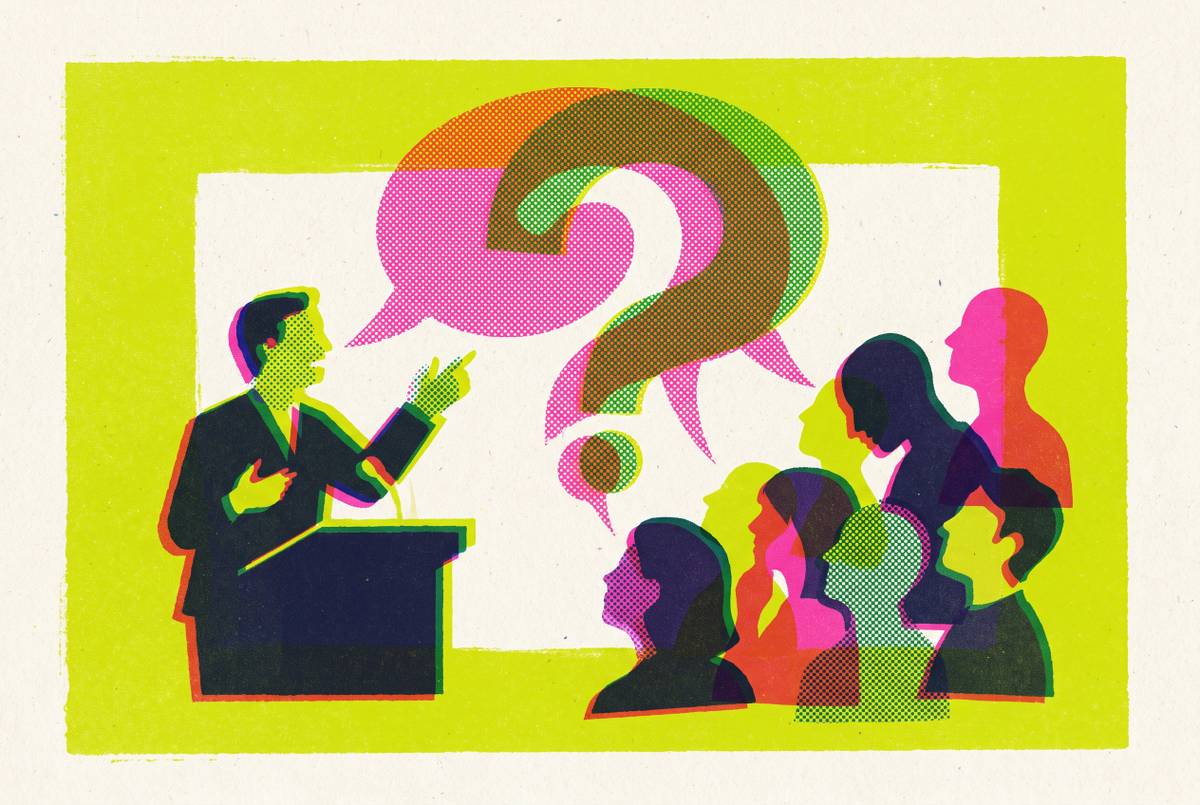
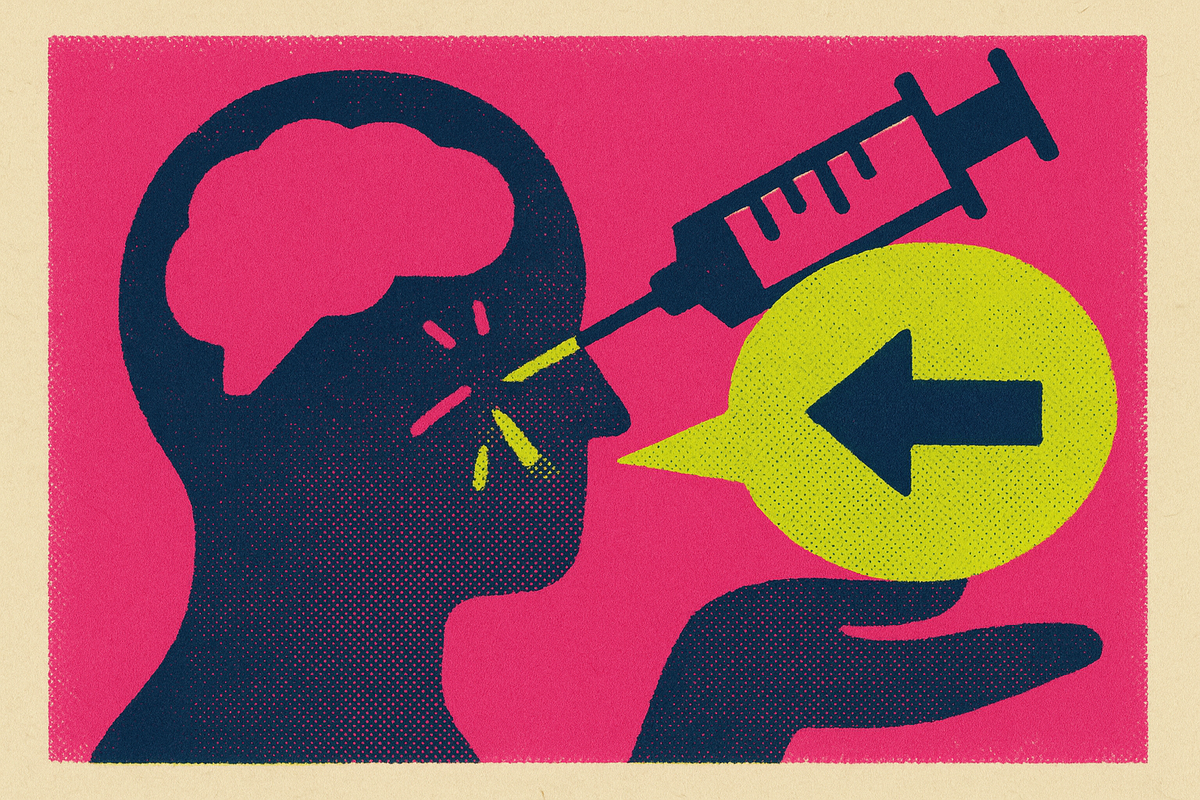
Emotional Contagion Between Speaker and Audience
Speakers unconsciously transmit their emotions to listeners through biology.
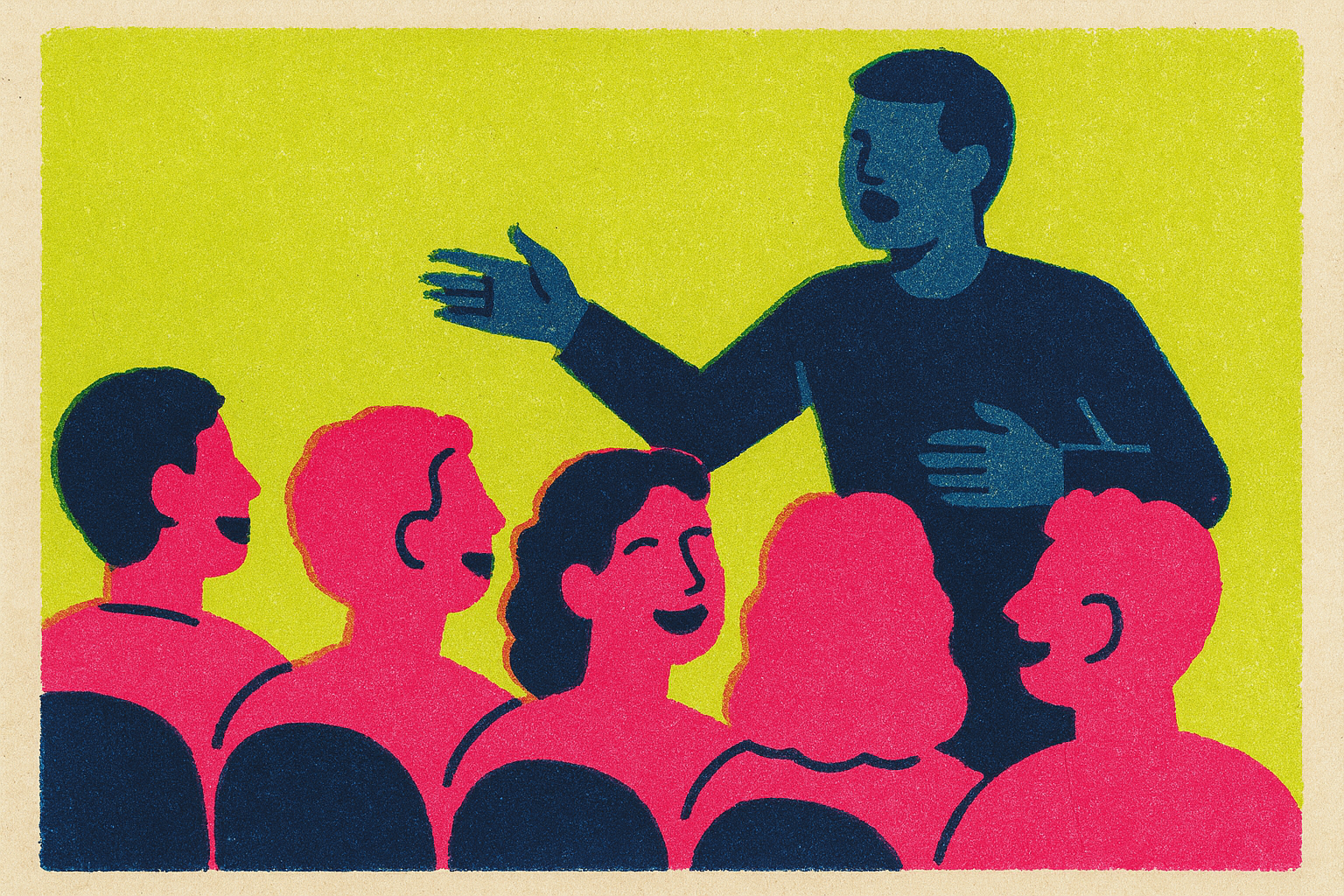
Emotional contagion is a measurable, millisecond-speed biological event in which one person's emotional state gets transmitted to and reproduced inside another person's body, and understanding its mechanics gives a speaker a concrete lever to pull on every single time they open their mouth in front of a room.
The biological process behind emotional contagion
People talk about "infectious energy" the way they talk about catching a cold: loosely, as a nice turn of phrase for something that feels contagious without actually being so. The research says otherwise. Emotional contagion is defined by researchers as the tendency to automatically mimic and synchronize facial expressions, vocalizations, postures, and movements with those of another person, and, as a result, to converge emotionally with them. The operative word is automatically. Nobody decides to do this. The muscles around the eyes and mouth, where a dense cluster of small muscles sits, start adjusting before the conscious brain has finished registering that the person across from it looks upset. EBSCO's research overview on the subject notes these same facial regions are where babies fix their attention when they look at their parents, a detail that suggests this wiring was laid down long before anyone learned to read a room on purpose. And copying someone's expression is not a passive readout of their mood. The feedback loop runs both directions: the muscular state produces the emotional state, so mimicking a frown does not just signal that someone noticed sadness, it manufactures a version of that sadness in the body doing the mimicking. That is the entire mechanism. No metaphor required.
The mirror neuron system and the speaker as emotional anchor
Scale that mechanism up from two people to a hundred, and something specific happens: the speaker becomes the dominant input for every mimicry process running simultaneously in every skull in the room. The biological basis for this is the mirror neuron system, a set of neurons that fire both when a person performs an action and when that person watches someone else perform it. This is what allows a listener's brain to mirror a speaker's internal experience without the listener doing anything active about it. Neuroimaging work has localized the activity to the inferior frontal gyrus, the inferior parietal gyrus, and the precentral gyrus, all of which light up during emotional contagion. Princeton University research on storytelling describes "extensive neural coupling" between speakers and listeners, meaning their brain activity starts to pattern-match in real time. Your brain pattern and theirs start to look alike. A study in Neuroscience of Language found that effective speeches produce interbrain coupling spanning from basic sensory processing all the way up through higher-order language and social cognition. A skilled speaker is not simply holding a room's attention. They are replicating their own mental states inside every listener who is paying attention. And in a crowd gathered for a shared purpose, the unconscious mimicry runs toward the leader at the front of the room, not evenly between audience members. Structurally, the person speaking is the anchor. Everyone else is the needle.
Voice and story: the two fastest channels for triggering contagion
Granted the mechanism, the practical question becomes: which signals actually move it? Two, consistently: vocal delivery and narrative specificity. These are the two channels that most reliably trigger the mimicry-and-coupling process, making them more direct levers than posture, slides, or word choice alone. On the vocal side, audiences infer mood and intention from tone before they've processed a single word of content, happy or sad, friendly or threatening, registered in the ear well ahead of the brain's slower language circuits. Speakers use this constantly, often without naming it: speeding up to signal excitement, slowing down or pausing to make an audience sit with a phrase, dropping to a hush that makes people lean in physically to hear better, leaning hard on a single word to mark it as the one that matters. Tone, story, and truth together form what some practitioners call an emotional signature, the particular way a voice makes a room feel, the real engine of influence underneath the words layered on top of it.
Story carries its own separate weight. Research in Psychological Science shows that narrative detail activates sensory, emotional, and memory regions all at once: describe climbing a mountain, and the listener's motor cortex responds as though they were doing the climbing. Describe fear or joy with enough specificity, and the listener's emotional centers mirror it directly. What audiences carry out of a room is the emotional arc of what they heard, not the supporting statistics. Actors train for this when they look for the "emotional truth" of a line: the same sentence lands as comfort, as challenge, or as persuasion depending on what the speaker's actual intention is behind it. An actor reciting "I'm fine" while playing grief and an actor reciting it while playing rage are saying the identical four words, and audiences read the difference instantly. Speakers are doing the same work, whether they've named it or not.
Why live, in-person delivery amplifies contagion beyond remote formats
Proximity is a causal input, not atmosphere. A 2022 EEG hyperscanning study by Chabin and colleagues, published in Frontiers in Human Neuroscience, recorded audience brain activity during a live concert and found that emotional intensity and physical closeness interacted to boost interbrain synchrony, rather than simply stacking on top of each other additively. That interaction effect means closeness does not just add a small bonus to an already-emotional moment, it multiplies what the emotional content was already doing. It is a biological interaction effect between two measurable variables, visible in brain activity that can be recorded and compared. For a speaker standing in a physical room, that makes eye contact, physical presence, and even movement across the stage something closer to inputs feeding the contagion mechanism than stylistic flourishes layered on top of the actual content.
What happens to emotional contagion when speaking moves online
None of that settles what happens when the room disappears and a webcam takes its place, which is the condition most speakers now operate under at least some of the time. A 2025 study published in Frontiers in Psychology by Marx, Sachs, Frenzel, and Schweizer at LMU Munich tested emotional contagion directly in dyadic video conferences. Self-report data from participants showed contagion of anger, happiness, and sadness all transmitting across the call. Facial expression data appeared in a narrower pattern during the video sessions: joy registered reliably in the facial channel, but anger and sadness did not register there at all, and that split matters. It suggests the subtle muscular microexpressions that typically carry negative emotion get compressed or lost somewhere in the chain between a person's face and the version a webcam and screen resolution deliver to the other side. Happiness survives that compression. Anger and sadness do not, at least not through the face. What that leaves is vocal tone and verbal content carrying more of the emotional load online than they would in person, where the face could be trusted to do a share of the work automatically. A speaker presenting over video who leans entirely on expression, the same way they might in a room, is working with a channel that the LMU Munich data says drops two out of three emotions it was tested on. Vocal variation and the narrative specificity covered earlier stop being nice additions online. They become the whole mechanism.
Is deliberate emotional contagion manipulation or connection?
Granting all of this, a harder question follows close behind: if a speaker can deliberately trigger contagion, is that connection or is it manipulation? The sharpest version of the objection is not about ethics so much as it is about detection. One prominent neuroscientist has challenged the standard mirror neuron account directly, arguing that these neurons may not encode meaning or intention at all, and instead simply reflect associative learning, sensory-motor pairings built up through repeated exposure. If Hickok's read is correct, a speaker manufacturing emotion they don't actually feel is transmitting a signal distinguishable from the real thing, and an audience that values authenticity over polish is positioned to catch it. That risk is not evenly distributed across audiences, either. Gen Z communication runs on unspoken rules that prioritize emotional accuracy over performance, which means the generation most likely to fill a room or sit on a hiring panel is also the generation best equipped to notice daylight between a performed feeling and a real one.
So where does that leave a speaker who wants to use contagion on purpose? Closer to an actor's method than to a con artist's script. The goal was never to fabricate emotion out of nothing and project it convincingly. It is to locate the genuine emotional truth already present in the material, then let the body carry that truth outward without getting in its own way. Vocal variation, specific imagery, deliberate pacing: none of these manufacture emotion from scratch. They clear interference out of the signal's path so a feeling that is already real can transmit without getting garbled on the way out. A speaker who has delivered the same material dozens of times under different conditions has felt which version lands and which doesn't, because repetition wears away the performance layer and leaves whatever is true underneath it exposed.
Culture and diversity in the research
None of this should be mistaken for a universal formula, and the research itself draws the boundary. A 2025 scoping review by Michalec and colleagues in Frontiers in Psychology, surveying emotional contagion studies published between 1992 and 2022, found the field has relied mostly on college-aged, predominantly white participants. That narrows what practitioner advice built on top of this science can claim about audiences outside that demographic window. Cultural context changes how the same delivery lands: a high-energy, visibly passionate style might read as inspiring in one room and as overwhelming or suspect in another, while a quiet, measured tone might project calm authority in one culture and read as hesitation or uncertainty in another. The same vocal technique that triggers contagion reliably with one audience can suppress it with another audience sitting in the identical room. None of that is a reason to distrust the underlying mechanism. It is a reason to treat these findings as a framework a speaker adapts to the room in front of them, rather than a fixed script to run the same way everywhere, every time, for every audience.
Gen Z's confidence gap: social fluency versus deliberate emotional transmission
A CNBC survey found that 47% of Gen Z respondents rate their own social skills as "very confident. That's a striking number against everything else the research says about this generation's wiring for emotional accuracy, and it raises an obvious question: confident at what, exactly? Confidence and emotional intelligence are inputs. Knowing what you feel, and reading what someone else feels, is a different skill from deliberately shaping what a room of strangers feels on command. Gen Z's default communication style, built around brevity, multimodal shorthand, and informality, is tuned for peer bonding and identity signaling among people who already share context. It was never built for sustained, directed emotional transmission aimed at a room of strangers or a panel of interviewers who owe the speaker nothing. The gap this produces is a training gap, and a specific one: the absence of any feedback loop that tells a speaker what their delivery actually produced in the room, against what they meant for it to produce. Social fluency tells someone how to read a room. It does not, by itself, tell them how to move one.
Daily practice with feedback closes the gap between feeling an emotion and transmitting it
Closing that gap starts with a basic physiological fact: anxiety and excitement are nearly identical in the body, elevated heart rate, heightened attention, a surge of adrenaline, and the difference between them is almost entirely the story a speaker tells themselves about what that arousal means. Reframing pre-speech dread as readiness is a real adjustment to what the nervous system sends outward into the room, which the mirror neuron mechanism then picks up and starts replicating in listeners.
Repetition builds the rest, provided it is the right kind of repetition. Running a full talk start to finish, over and over, tends to smooth over the exact moments where delivery breaks down. Layered rehearsal works differently: perfect the opening until it runs on autopilot, then add the next section, then the next, isolating precisely where the emotional transmission drops instead of blurring it across an entire thirty-minute run-through. And none of this works without a feedback signal sharp enough to be useful. Vague encouragement, "that was great," cannot tell a speaker whether a delivery actually moved anything in the audience. A concrete signal can: did people lean in, or did attention drift? Did the room go quiet at the turn, or did it keep shuffling? A daily short-form structure, one situation, one response, one score, builds the same kind of competency that athletes build through repeated, scored drill work. Eventually the adjustment stops requiring conscious thought. At that point it stops reading as technique at all, and starts reading, to everyone sitting in the room, as presence.
Sources
- Emotional contagion
- Frontiers
- A scoping review of emotional contagion research with human subjects: identifying common trends of previous research and potential areas for future research
- Social Cognitive and Affective Neuroscience, 2025, 20(1), nsaf091
- Emotional contagion in dyadic online video conferences—empirical evidence based on self-report and facial expression data