Rhetorical Questions and Audience Engagement in Speeches
Rhetorical questions make audiences generate conclusions that feel like their own.
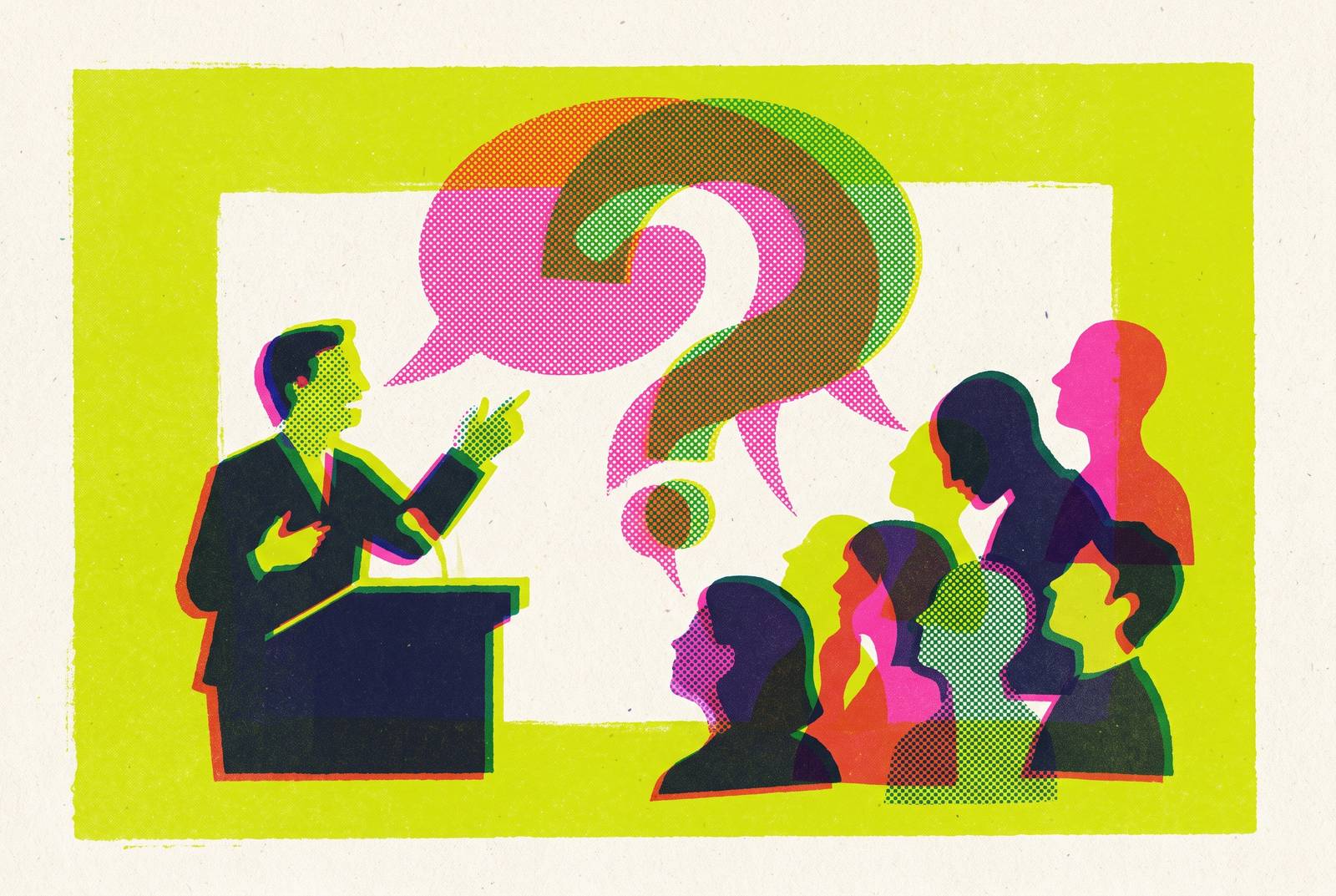
Rhetorical questions are one of the few tools in public speaking that work by doing less, not more. Instead of handing an audience a conclusion, the speaker hands them a gap and lets them fall into it, which is a stranger and more reliable mechanism than most speakers give it credit for.
The technique behind a rhetorical question
Sit in an audience for long enough and a pattern becomes obvious: the moments that stick are rarely the moments where a speaker told the room something. They're the moments where the room was made to ask itself something. That's the entire trick behind a rhetorical question, and it's a narrower move than most speakers assume. VirtualSpeech defines it as a question asked for effect, with no answer expected, where the answer is either supplied immediately by the questioner or obvious enough that the audience fills it in without effort. No mystery novel ending. No open-ended debate. The gap is real but short, and it closes fast.
What makes that gap valuable is what it forces the listener to do. A rhetorical question converts a claim the speaker wants the audience to accept into a thought the audience generates on its own. "Our infrastructure is failing" is an assertion a listener can take or leave. "How many more bridges have to fail before this gets fixed?" is a question the listener has to answer internally, even for a half-second, and the conclusion they reach feels like theirs. That distinction, between a statement handed to you and a thought you produced yourself, is the entire mechanism. Self-generated conclusions carry more weight than imported ones, because they arrive dressed as the listener's own judgment.
Research on audience engagement in speeches frames this as the central challenge of the format: a passively listening audience and an actively reflecting one are not in the same cognitive state, and most of the craft of public speaking is about moving a room from the first state to the second. A rhetorical question is one of the most efficient levers for doing that, because it doesn't require the production values of a story or the risk of an actual audience interaction. It just requires a question mark in the right place.
The neuroscience of being asked something you weren't expecting to answer
The mechanism gets more interesting once you look at what's actually happening in a listener's head when a rhetorical question lands. Being asked something, even something you're not meant to answer out loud, triggers a kind of involuntary mental reflex. The brain treats a question as an invitation to search for an answer, and it does this automatically, before the listener has consciously decided whether the question deserves a response. That reflex is what a skilled speaker is borrowing.
This connects directly to why rhetorical questions increase what researchers call cognitive elaboration, the depth of mental engagement a listener brings to a message. A question prompts the listener to mentally engage with the point the speaker is implying. That effect isn't universal or automatic. That effect depends heavily on how personally relevant the topic already is to the listener, a qualification that becomes the whole subject of the next section.
The same body of research on audience engagement establishes that presentations moving listeners from passive reception to active participation produce measurably better understanding and retention. Rhetorical questions are one of the specific mechanisms that produce that shift, alongside more overt participation techniques like a show of hands or small group exercises. What a rhetorical question offers that those other techniques don't is speed: it produces an internal moment of participation without requiring the audience to do anything visible.
There's a useful parallel in storytelling. A story works as what communication researchers sometimes call a memory delivery system, because it opens a gap, some unresolved struggle or uncertainty, that the listener's mind races to close before the story is over. A rhetorical question performs an almost identical operation, just compressed into a single sentence instead of a ten-minute narrative arc. Both exploit the same basic appetite of the human mind: it does not like loose threads, and it will do real cognitive work to tie them off, even when nobody asked it to.
When rhetorical questions backfire: the involvement paradox
The persuasive effect of a rhetorical question is not stable across audiences, which keeps it from being a simple "always open with a question" rule. It depends on how invested that audience already is in the topic, and that dependency is the central calibration challenge for anyone trying to use the technique deliberately.
Research on rhetorical questions as a persuasive device, going back to classic work by Petty, Cacioppo, and Heesacker in 1981, found a pattern that looks paradoxical on first read. When personal relevance is low and the argument is strong, rhetorical questions increase persuasion, because they jolt a disengaged audience into thinking harder about a case that can actually survive the scrutiny. But when personal relevance is high and the argument is strong, the effect flips: rhetorical questions disrupted thinking, and a message with strong arguments became less persuasive once rhetoricals were introduced. An audience that was already engaged, already reasoning carefully, gets knocked off that careful reasoning by a device meant for people who weren't reasoning carefully.
What does that mean practically? It means the tool is most reliable as a way of raising a disengaged room up to a baseline level of attention, not as a way of sustaining or deepening engagement in a room that's already analytical and invested. Ask a packed auditorium of policy specialists "can we afford to ignore this?" and the likely internal response isn't galvanized agreement, it's mild irritation at being asked something they settled for themselves an hour into their careers. Asking the same question to a general audience that hasn't spent any time with the issue can be exactly the nudge that gets them leaning forward.
That raises an obvious question for anyone drafting a speech: who's actually in the room, and how much have they already thought about this? A speaker who reaches for rhetorical questions by reflex, regardless of audience state, risks landing on one of two failure modes. Either the question states the painfully obvious to people who've already done the thinking, or it reads as a manipulation attempt to a skeptical audience that notices it's being steered. Neither failure is catastrophic on its own, but both quietly erode the trust the technique is supposed to build: that the speaker is reasoning with the audience.
How political speeches use rhetorical questions
Political speechwriting treats the rhetorical question less like a flourish and more like load-bearing structure. Research on political discourse identifies rhetorical questions as central to shaping public opinion and reinforcing ideological positions, not decoration sprinkled over a speech but one of the mechanisms doing the actual persuasive work. A study of speeches by heads of state including Barack Obama, Vladimir Putin, and Shavkat Mirziyoyev found rhetorical questions functioning across registers: stimulating cognitive reflection, deepening emotional involvement, and reinforcing the speaker's authority all at once.
One classic structure stacks several questions in sequence, each one narrowing the range of acceptable answers until the final question in the chain only has one answer left standing, a moral pivot the audience has been walked toward one step at a time. By the time the last question lands, disagreeing with it would mean contradicting every "yes" the audience already gave silently to the questions before it.
Shakespeare used a version of this centuries before anyone called it a persuasive strategy. If you tickle us, do we not laugh?" Each question is built so the only honest answer is yes, and the cumulative effect makes the conclusion the speech is actually arguing for, shared humanity, feel like something the audience arrived at through their own senses.
Political speeches also lean on a second type: the question left open, with no answer supplied, used to create philosophical or emotional space. Paired against it is the question the speaker answers immediately, used to introduce a topic and frame the answer before any skepticism has time to form in the audience's mind. Knowing which of the two a moment calls for, open or immediately resolved, is itself part of the craft, and it's the bridge into the next section, where that craft gets broken down into usable technique.
Six concrete uses of rhetorical questions in speeches
VirtualSpeech catalogs eight distinct deployment strategies for rhetorical questions in speeches, and several of them collapse naturally into a working set of core techniques any speaker can rehearse. The first is using a question simply to open and hold attention: asking it, then pausing long enough for the listener to form an answer internally before continuing, since an opening rhetorical question measurably raises the odds an audience stays engaged through a talk's early minutes. A question like "why is doing this actually harder than anyone admits?" opens more cognitive interest than the flat declarative version of the same claim, because it hands the listener something to chew on.
The second technique is personalizing the question by choosing pronouns deliberately. Swapping "does anyone want this?" for "do you want this?" isn't a grammatical nicety, it changes who the question feels addressed to. "Anyone" lets every individual listener assume someone else will answer; "you" removes that escape hatch and makes the question land on each person in the room individually, even though nothing about the actual content changed.
The third is using a rhetorical question to build agreement momentum, asking something whose answer is obviously yes so that the audience starts accumulating small moments of assent before the speech reaches its real argument. A line like "we've all felt this, haven't we?" does double duty here: it builds that agreement momentum while also establishing shared experience between speaker and audience, which does useful work for the speaker's credibility independent of the persuasive chain it's part of.
The fourth technique reframes a declarative claim as a question to produce emotion. "What has this policy ever done for our community?" generates a different kind of reaction than the flat assertion "this policy has done nothing," because the listener has to reach the indignant conclusion themselves rather than receive it ready-made, and a conclusion someone reaches on their own tends to sit with more weight and last longer than one simply handed to them.
The fifth use places a rhetorical question immediately after a key claim, not to introduce new content but to extend the audience's engagement with what was just said. The question functions as a kind of pause mechanism, holding the audience's attention on the preceding point a beat longer than they'd naturally give it, preventing the room from moving on before the claim has had time to land fully.
The sixth technique is anticipating the audience's own silent questions and asking them aloud before anyone else does. This accomplishes two things simultaneously: it signals that the speaker is tracking what the room is actually thinking, and it lets the speaker control the framing of the answer rather than leaving that framing to whatever the audience would have concluded on its own. A variant worth building into longer talks involves introducing two or three rhetorical questions early and explicitly promising to answer them later; this creates a structural suspense that can carry attention through an otherwise dry middle section of a speech.
How vocal delivery determines whether a rhetorical question lands
None of the six techniques above work as written words on a page. A rhetorical question delivered in a flat, rushed, or anxious voice is functionally a different device than the same sentence delivered with controlled pacing and tonal authority, because the cognitive effect the question is supposed to trigger depends on what happens immediately after it, specifically the pause.
Audiences read confidence before they finish processing content. Vocal tone shapes perceived leadership and credibility well before the literal meaning of a sentence registers, which means a rhetorical question's persuasive effect starts with how it sounds and only secondarily with what it asks. A technically well-constructed question delivered in a voice that signals nervousness can undercut its own mechanism before the listener's mind even gets the chance to reach for an answer.
Stress physiology works directly against this technique. When a speaker's nervous system is dysregulated, pitch climbs, pacing accelerates, and the deliberate pause a rhetorical question depends on becomes almost impossible to hold onto. That's a genuine physiological constraint, not just a confidence problem: a speaker can know the mechanism perfectly on paper and still be unable to execute it under the exact high-stakes conditions where it would matter most, because the body's stress response and the technique's requirements pull in opposite directions.
The pause itself deserves direct attention, because it's where the actual mechanism operates. The silence after a rhetorical question is the window in which the listener's mind is doing the work the whole device was designed to produce. Cutting that pause short stops the rest of the mechanism from completing.
Why rhetorical questions are hard for Gen Z speakers
For a generation whose default mode of communication is carefully edited text, the rhetorical question asks for something unusually exposed: performed spontaneity, tolerance for an open loop in real time, and projected authority with no option to delete and retype. A RiseGuide survey found that public speaking ranks as the single hardest communication situation for Gen Z and millennials, with 33% identifying it as harder than any other communication challenge they face, ahead of requesting help from someone or sitting through a job interview. The same survey found that poor communication had already cost a substantial majority of respondents real opportunities.
Part of what makes the rhetorical question specifically difficult is what might be called the edit button problem. Real-time speech offers no revision pass, and a rhetorical question demands instant, visible, spontaneous cognitive engagement from an audience, which makes the moment feel exposed precisely because it can't be drafted, reviewed, and smoothed over before anyone hears it. The speaker has to deliver the question with conviction, hold the silence that follows it, and project certainty about where the room is headed, all without the safety net that a generation raised on editable text has come to rely on.
A CNBC and SurveyMonkey survey found a particular gap in self-perception here. Nearly all Gen Z respondents rated themselves confident in their social skills, yet a large majority, Gen Z respondents among them, named active listening as the skill most lacking in young people today. Active listening is precisely what a rhetorical question asks of an audience: it only works if the listener is actually tracking the question closely enough to feel the pull toward an answer. Many Gen Z speakers are being handed a technique built on a skill they privately suspect their own generation hasn't fully developed, which makes the rhetorical question not just a performance challenge but a small, honest mirror held up to exactly the gap the surveys describe.
Sources
- (PDF) Audience Engagement Techniques in Oral Presentations
- Audience Engagement Techniques in Oral Presentations - Daniel Usera, 2025
- (PDF) THE POWER OF QUESTIONING: RHETORICAL QUESTIONS AS A PERSUASIVE STRATEGY IN UZBEK AND ENGLISH POLITICAL DISCOURSE
- RESEARCH ARTICLE Effects of rhetorical devices on audience
- (PDF) Effects of rhetorical questions on persuasion: A cognitive response analysis
- (PDF) Answering Questions About Questions: A Persuasion Knowledge Perspective for Understanding the Effects of Rhetorical Questions
- Rhetorical Questions and their Communicative Functions in the Speeches of Heads of State
- Asking too much? The rhetorical role of questions in political discourse