Speech Rate and Perceived Argument Strength
Faster speech boosts credibility until it obscures argument quality.
Speech rate is a lever that shapes how strong an argument sounds, independent of whether the argument is actually any good, and the research on this gives a surprisingly exact shape: moderate-to-fast speech builds credibility right up until a threshold, after which the same speed that made a speaker sound sharp starts making their best points disappear. Most people never learn where that threshold sits for them, which makes it one of the few communication skills that is both measurable and almost entirely untrained.
Delivery Cues and Argument Strength
The assumption behind most advice about arguing well is that the content does the work: get the logic right, marshal the evidence, and the listener will follow along and reward the better case. That assumption misses a step. Before a listener can weigh an argument, they first form an impression of the person making it, and that impression is built largely from cues that have nothing to do with logic: tone, pacing, hesitation, rhythm. Miller, Maruyama, Beaber, and Valone showed in 1976 that speech rate acts as a general cue that boosts credibility on its own, meaning listeners read speed as a proxy for knowledge rather than evaluating it apart from the claim being made. That finding means two speakers can deliver identical words, point for point, and walk away with different levels of persuasion purely because one talked faster. Once delivery is doing that much lifting, treating it as decoration rather than mechanism stops making sense. The rest of this piece traces what that mechanism actually does, where it helps, and exactly where it quietly costs a speaker their strongest material.
What faster speech signals to a listener's brain
Speed up a bit past a normal conversational pace and a cluster of favorable impressions tends to follow: the speaker reads as more confident, sharper, more in command of the facts, more objective. Miller and colleagues found in 1976 that rapid speech increases persuasion, and the effect held even after ruling out the idea that it works by rushing listeners past their own counterarguments. In other words, the listener was not too busy to object. The listener simply gave the faster speaker more credit. More recent work from Guyer, Vaughan-Johnston, Fabrigar, Paredes, Briñol, and Shen in 2024 confirms the direction of that effect while adding a wrinkle: speeding up does raise perceived confidence and increase how much the listener engages with the message, at least at first. That "at first" matters, and it is the hinge the rest of this piece turns on. But taken on its own, the early part of the curve is good news for anyone who has ever worried that talking a little faster than usual in a high-stakes conversation might come across as nervous rather than sharp. A touch more pace than baseline is, if anything, borrowed credibility, and in a room that starts out neutral or skeptical, that borrowed credibility does real work before a single argument has been fully processed.
Where Speed Stops Helping
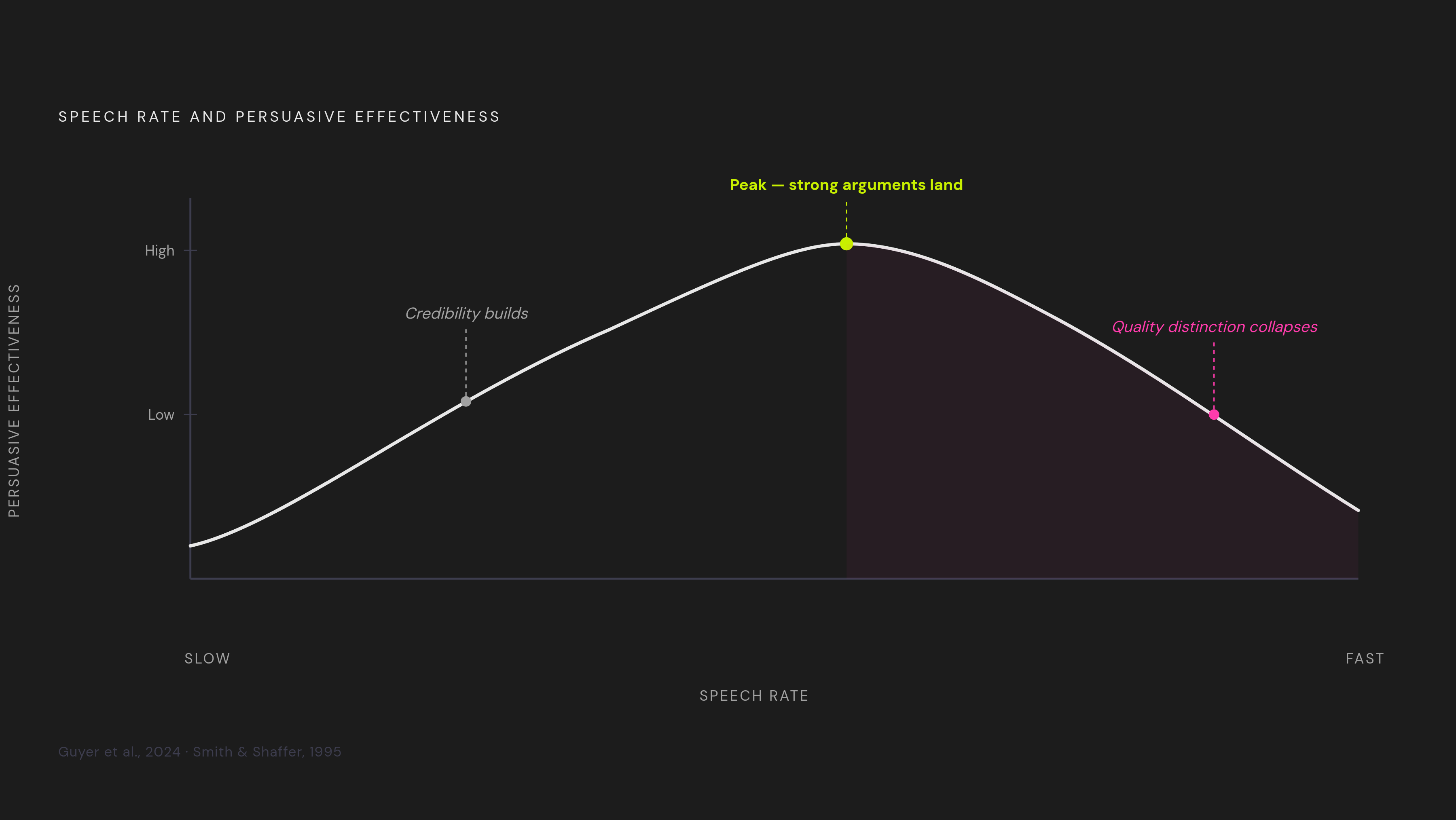
Here is where the picture gets less flattering for anyone who thinks faster is simply better. Guyer and colleagues ran six studies, with a combined sample in the thousands of participants, and found that the relationship between speech rate and how well listeners process a message is curvilinear rather than straight-line. Confidence and engagement climb as speed increases, but only up to a point. Past that point, the gains flatten out and then reverse. The reversal happens because at high speech rates, listeners stop being able to tell a strong argument from a weak one. Guyer et al. found that increasing speech rate widens the gap between how persuasive a strong argument is compared to a weak one, but only at the low-to-moderate end of the range. Beyond that point, the gap narrows, then closes. Smith and Shaffer's 1995 work, cited in the same 2024 paper, found something similar: fast speech stopped listeners from agreeing more with strong arguments than weak ones, which is another way of saying the distinction simply stopped registering. Picture a listener trying to grade two essays while someone reads them aloud at double speed. At some point the grading stops tracking content and starts tracking whatever the listener can still catch. The listener's attention narrows down to the confidence signal because that is the only signal still coming through clearly; that narrowing is what produces the drop in argument quality under speed pressure, and the content underneath it, however good, stops mattering as much as it should. The uncomfortable consequence is that a speaker who races through their single best point is not saving time. They are spending their strongest asset at a moment when the audience is least equipped to notice it.
Argument Selection and Pace
Speed is not the only variable in play, and it gets worse when combined with a second, more familiar mistake: padding an argument with weak supporting points. Research published in Scientific Reports in 2024 found that adding weak supporting arguments next to a strong one pulls down the strong argument's persuasive power. It pulls the average down. That is an averaging effect rather than an additive one, which runs against the instinct that more supporting points, even mediocre ones, can only help. Moderate-strength arguments alongside a strong one still add something net positive. Weak ones do not just fail to help. They actively drag the overall impression toward the bottom of the pile. Now put that alongside the speed finding from the previous section. A speaker going fast enough that the audience can no longer tell a strong argument from a weak one has already lost the ability to let their best point stand out. Weak filler points added into that same fast delivery make the listener average across material whose quality they cannot distinguish. The two problems do not just coexist. They multiply each other: an unfiltered argument list under fast delivery compounds both problems, so curating the argument list before stepping into a fast-paced delivery affects the outcome even more than it would at a slower, more deliberate pace. At high speed, there is no quality filter left to catch a weak point. The pace has already disabled it.
Audience Engagement and the Curve
None of this plays out the same way in every room, because the curve itself shifts depending on who is listening and how engaged they already are. In a neutral or skeptical audience, one that has no particular motivation to pick apart what is being said, speed functions largely as a stand-in for scrutiny. The listener is not working hard to counterargue, so the confidence signal that comes from pace ends up carrying a disproportionate share of the persuasive load. That is the condition under which the earlier Miller et al. findings and the early part of the Guyer et al. curve apply most cleanly: a skeptical investor, a distracted panel, a room that has not decided to care yet. An engaged or expert audience behaves differently. They are already processing the content regardless of pace, so the credibility shortcut from speaking faster adds less on the margin, while the risk of overloading them climbs. One might ask what happens when an audience already agrees with the speaker going in. Earlier work noted in Guyer et al.'s 2024 paper suggests that slowing down actually helps persuasiveness in that situation: a receptive audience rewards a speaker who trusts the argument enough to let it breathe rather than rushing it past them. Put differently, pace is not a single dial to be set once and forgotten. A job interview panel, a skeptical investor, and a room of students who have already bought in are three different rooms, and each calls for reading where the audience sits before deciding how fast to talk.
Verbal Fluency and the Credibility Signal
Pace sets a baseline impression, but what fills the space between words either holds that impression together or quietly undercuts it. Filler words are one of the clearest examples. Research on the subject finds that heavy or emphatic filler use reduces how effective a speaker seems, though how much it hurts depends partly on how engaged the listener already is with the content. The awkward case is a speaker who has nailed the pace, moderate-to-fast, confident-sounding, right in the productive zone of the curve described earlier, but who scatters that delivery with "um," "like," and false starts. That speaker is sending two signals at once that flatly contradict each other: speed says confident, hesitation says unsure. Listeners do not necessarily average those two signals into something neutral. They can just as easily read the mismatch as a kind of tell, the sense that something about the delivery does not add up even if they cannot say what. The practical target, then, is not pace alone and not fluency alone, but the two working together: controlled speed paired with clean delivery is what keeps the credibility signal legible instead of garbled.
Why the pace advantage disappears when vocal delivery is stripped out entirely
All of this, the speed curve, the averaging effect of weak arguments, the filler-word tax, depends on one condition that is easy to overlook: a voice has to actually be present. When vocal delivery is stripped out of the picture, as happens in text-based argument, the whole mechanism this piece has been describing has nothing to attach to. Youk, Malik, Chen, Hopp, and Weber, in a study of large-scale text-based debates, identified the features that actually predict persuasiveness in that format: things like citing sources, using abstract language, and drawing on a wider, less repetitive vocabulary. None of that has anything to do with pace, because there is no pace in a block of text. What this means is that persuasion over text reverts entirely to content and word choice, with no speed-based shortcut standing in to do extra work. That asymmetry cuts in a specific direction. A speaker who has trained vocal delivery carries an advantage into live conversation that a text-native communicator cannot simply port over, because the lever that makes it work, an actual voice in an actual room, is not available in a comment thread or an email. Framed that way, the scarcity of the skill is the argument for building it: the pace lever only exists where a voice is present to pull it, so having it pays off precisely because so few people bother to train it.
How to find and train your own persuasive pace before it costs you a real conversation
Knowing the shape of the curve is not the same as knowing where a given speaker sits on it, and closing that gap takes repeated practice rather than a single read-through of the research. The target zone, based on the Guyer et al. 2024 findings, is moderate-to-fast: fast enough to signal confidence and keep an audience from drifting into counterargument, not so fast that the listener loses the ability to tell a strong point from a weak one. That curve is a map, and turning a map into something a speaker can feel in real time, the way a dancer feels a beat without counting it out loud, takes practice rather than memorization. One useful habit is deliberately slowing down on the single claim that matters most, the point the speaker most needs the listener to actually register, rather than letting the general pace carry it past unnoticed. A second habit is curating the argument list before opening one's mouth, cutting weak supporting points so that a fast pace has nothing weak left to average into the strong material, consistent with the Scientific Reports finding on how weak arguments drag down a strong one. A third is the deliberate pause, something like two full seconds before answering a high-stakes question, which reads as thoughtful rather than hesitant, buys a moment to find the sharpest version of the point, and resets the pace heading into the answer rather than letting momentum carry a speaker past the productive part of the curve. The hardest obstacle to fix is not technique but awareness: most speakers have never heard their own pace the way a listener actually experiences it, so the errors costing them persuasive power stay invisible to them by default. Recorded practice, reviewed honestly and often rather than once in a while at a workshop, is what closes that gap, because it turns an abstract curve from a 2024 journal into something a speaker can actually hear happening in their own voice.