The Pratfall Effect and Speaker Likability
Competence must come first for small mistakes to boost likability instead of harm it.
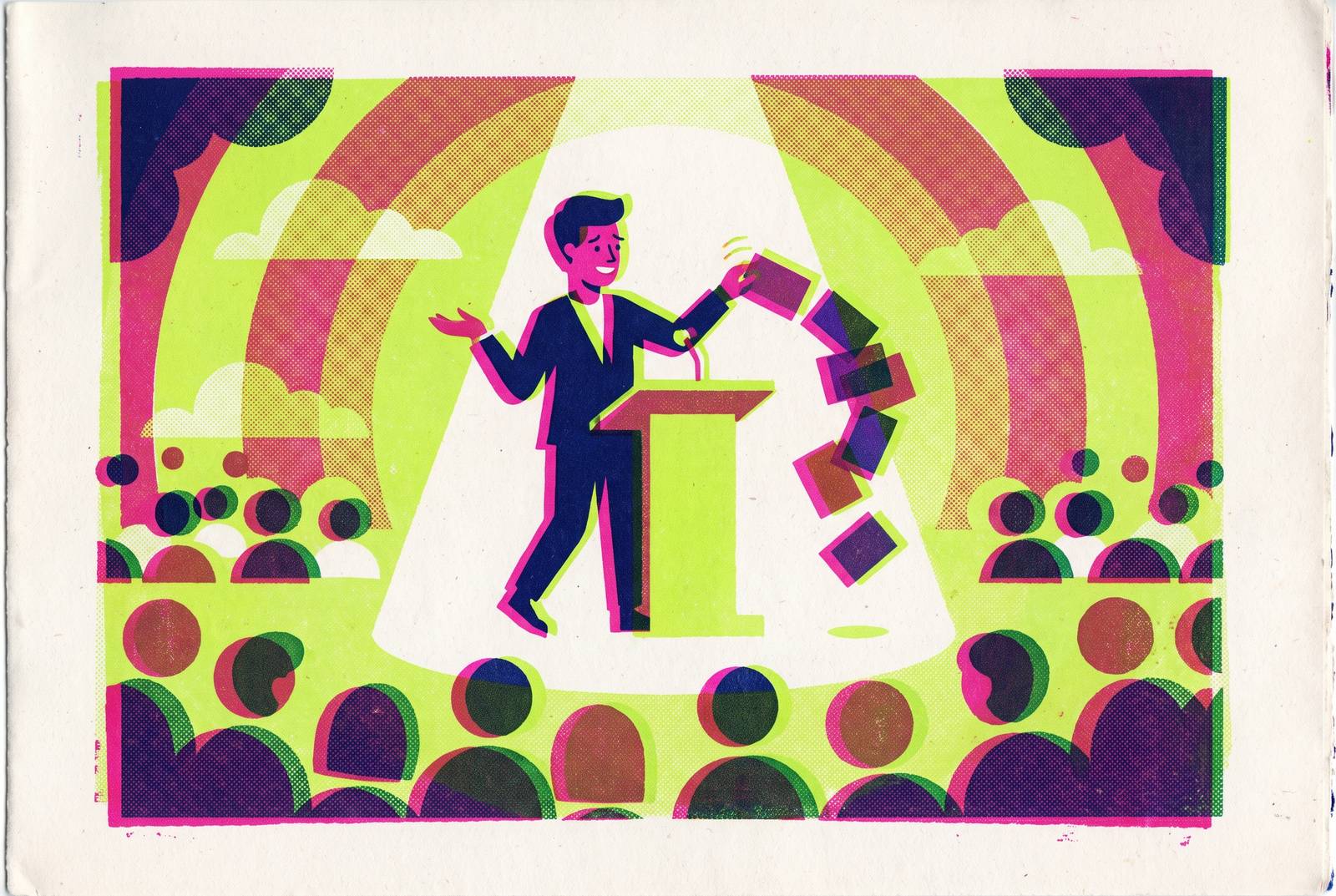
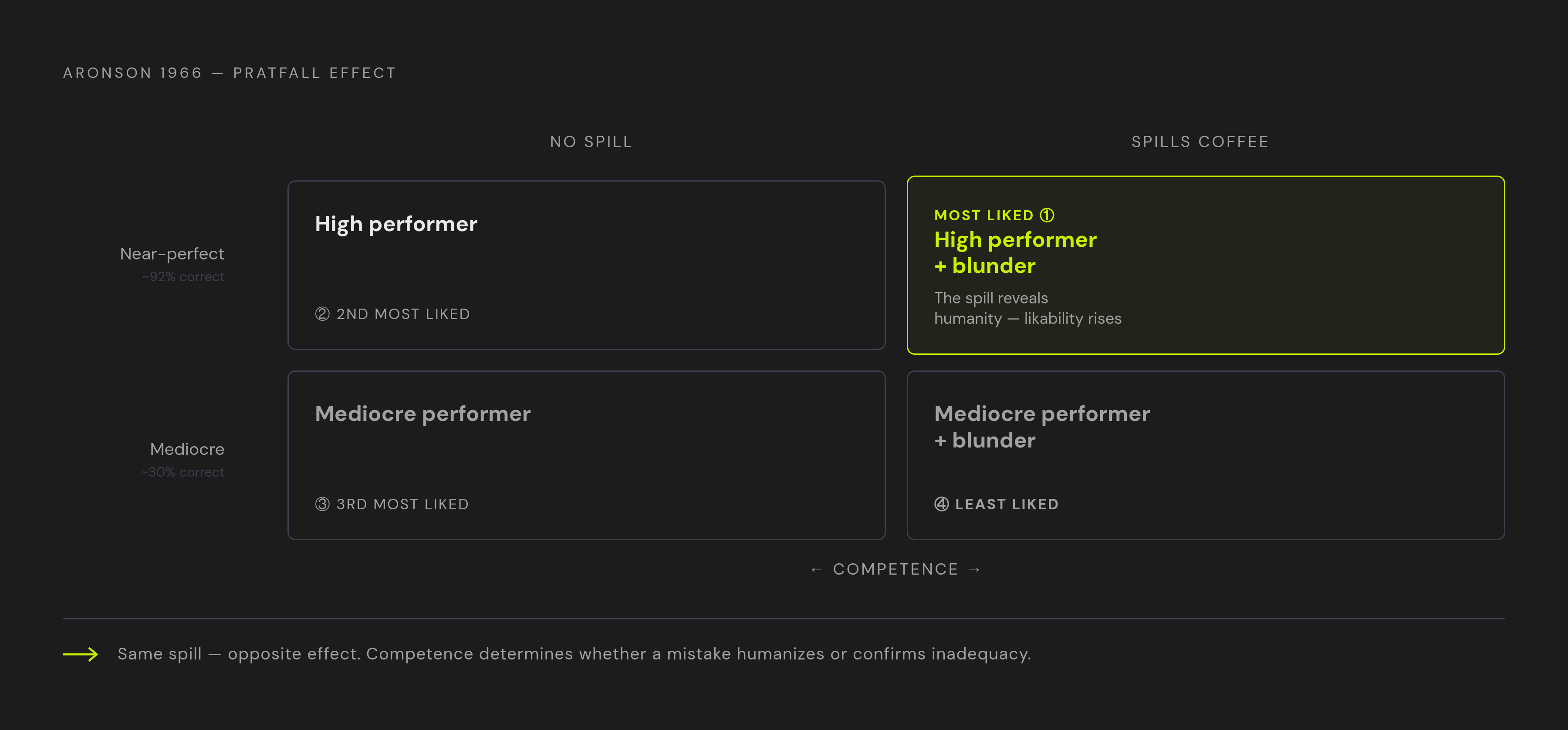
A near-perfect quiz performance followed by a spilled cup of coffee makes an audience like the speaker more. The same spill, attached to a mediocre performance, makes them like the speaker less. That is the pratfall effect in its original, laboratory form, and it is the subject of this piece: not that mistakes are charming, but that charm is conditional on something the mistake itself can't provide.
Competence as the condition for small mistakes to help
Picture the room. Elliot Aronson, running the study at the University of Minnesota in 1966 while affiliated with the University of Texas, had an actor sit for a recorded quiz interview. In one condition, the actor answered almost everything right, a near-flawless run. At the end of some of these recordings, the actor knocked over a cup of coffee. Nothing dramatic. A clumsy, ordinary, forgettable few seconds of fumbling with a napkin.
The near-perfect performer who spilled the coffee was rated significantly more likable than the near-perfect performer who sat through the interview without incident. But Aronson's design had a second condition that complicates the tidy version of the story, and it is the condition most retellings leave out. The mediocre performer who spilled the coffee was rated less likable than the mediocre performer who did not spill anything.
Run those two outcomes side by side: the coffee stops looking like a cause and starts looking like a switch. It does not generate likability out of nothing. It activates likability that already exists, built from the perception of competence, and sitting there waiting for a trigger. Take away the competence and the same physical event, the same spilled cup, the same fumbled napkin, reads as confirmation that this person is as careless as their 30 percent suggested. The mistake just gives the audience one more data point for the verdict they had already started forming.
This is the paradox the rest of this piece has to work through, where a small mistake's effect on likability depends entirely on what the audience already believes about your ability before the mistake happens. That sequencing, competence first, imperfection second, is the whole argument, and the same mechanism runs through everything from a celebrity's public stumble to a decades-old ad campaign's copy.
Why flawless performance creates distance instead of trust
If competence alone were sufficient for likability, the near-perfect quiz-taker in Aronson's study would have been the most liked performer in the entire experiment. Instead, the near-perfect performer who sat through the interview cleanly, no spill, no stumble, rated lower than their coffee-spilling counterpart. Flawlessness, on its own, seems to cost something. Understanding what it costs makes the rest of the pratfall effect feel less like a cute psychological quirk and more like a predictable response to a specific kind of social discomfort.
Three mechanisms appear to be doing the work, and each is worth taking on its own terms. The second is a trust signal. The third is an empathy trigger: a minor mishap produces a quick, almost involuntary flash of fellow-feeling, the kind of shared wince that two strangers exchange when one of them trips on a sidewalk, and that flash does more bonding work in half a second than ten minutes of polished delivery.
A relief of inferiority connects all three mechanisms. Perfection, witnessed at close range, can make an audience feel small by comparison. A mistake levels the field. It tells the room that the person at the front is operating under the same physics as everyone else, gravity included, and that permission to be ordinary is worth more to an audience's affection than another minute of flawless execution. People appear to warm more to any agent, human or otherwise, that reads as both skilled and fallible at once, which suggests the rule is less about schadenfreude and more about what trust actually requires: evidence of ability, paired with evidence that the ability belongs to someone real.
How recovery does the actual work
None of this licenses a strategy of visible imperfection for its own sake. The likability bump in Aronson's data did not come from the coffee landing on the table. It came from whatever happened in the next several seconds: the pratfall effect stops being merely an interesting finding about perception once that recovery becomes a usable skill.
Performed humility is its own kind of tell. A speaker who stumbles and then visibly, almost theatrically, draws attention to their own humanity, as if inviting the audience to notice the vulnerability on display, reintroduces the exact skepticism the mistake was supposed to dissolve. Audiences are reading for authenticity, and a managed display of imperfection is still a display. What reads instead as grounded confidence is a clean, almost boring sequence: acknowledge the slip quickly, correct it, move back to the point. No lingering. No apology tour. The mistake gets one beat, not three.
The alternative, defending or minimizing the error, tends to backfire in a specific way. Observers don't just register the defensiveness as a response to the mistake. They attribute it to the person's character, reading excuse-making as a trait. Over-explaining a slip keeps the audience's attention fixed on the slip itself, extending the scrutiny; brevity closes the episode and gives the room permission to move on with the speaker.
Jennifer Lawrence's trip up the stairs at the 85th Academy Awards in 2013 is the textbook case, mostly because the recovery was so fast it barely counted as a pause. Three steps, no drama, point made.
What an audience responds to in these moments is not the stumble itself but the speaker's visible relationship to it: whether the person seems rattled by their own humanity or simply unbothered by it.
What brands discovered when they admitted their own failures
The same mechanics appear at the level of institutions, where the stakes are measured in dollars rather than applause: Avis spent thirteen consecutive years losing money to Hertz before building an entire campaign on the plain admission that it was not the leader: "When you're only No. 2, you try harder. That single sentence, owning the inferior market position instead of disguising it, is credited with turning a substantial loss into a $1.2 million profit. Audiences responded less to the self-deprecation and more to the fact that a company was willing to say something true about itself out loud.
KFC ran a version of the same play under much worse conditions. A supply failure forced hundreds of UK stores to close, and instead of a defensive statement from legal, KFC took out a full-page ad rearranging its own logo into "FCK" alongside an apology. Sales rose afterward. In each case the admitted flaw functioned less like a liability and more like a credential, proof that the company was telling the truth about something, which made its other claims easier to believe.
Volkswagen got there earliest. In 1960, the company ran an ad describing one of its own cars as a "lemon," walking through the minor flaw that had gotten the vehicle pulled from the assembly line, framed as evidence of the quality control behind every car that didn't get pulled. The honesty, rather than undercutting the brand, reinforced it. The negative detail functions as a kind of truthfulness tax, a small cost paid upfront that buys belief in everything stated afterward.
What ties Avis, KFC, Domino's, and Volkswagen together is that each of these organizations already had standing in its category before the admission ran. None were unknown entities confessing from a position of zero credibility. Each had competence banked, in the Aronson sense, and the admission spent a little of that balance to recover a great deal more.
When the pratfall effect backfires or does not apply
None of the preceding sections should be read as a blanket endorsement of mistakes. The effect has real edges, and ignoring them is how a speaker turns a useful psychological mechanism into a liability.
The most basic limit is timing. In a cold pitch, a first interview, or any situation where an audience has not yet formed a view of someone's competence, a mistake has nothing to activate. It simply reads as evidence, the same way the mediocre quiz-taker's spilled coffee did in Aronson's data. Competence has to be established first; there's no shortcut around that sequencing.
Fabricated vulnerability runs into a related problem. Staging a mistake to appear relatable violates the authenticity signal the entire effect depends on, and audiences are generally better at detecting manufactured stumbles than speakers expect. A pratfall that is obviously performed reactivates the exact skepticism it was meant to dissolve, putting the speaker back at square one, this time with less credibility than before.
Severity matters as much as timing. The effect holds for minor, harmless slips, not for significant ethical lapses, major factual errors, or anything touching safety. High-stakes domains, fiduciary, medical, safety-critical, tend to invert the whole mechanism: audiences in those contexts are listening for certainty, and a mistake signals risk rather than warmth.
Repetition closes the loop. One pratfall humanizes. Aronson's later replications sharpened this boundary further, finding that strategic vulnerability performed without real competence underneath tends to backfire reliably. The effect holds, but only inside a fairly narrow set of conditions, which is less a flaw in the theory than the reason it's worth understanding precisely rather than applying loosely.
Gen Z's response to imperfection over polish
One might expect a generation raised inside algorithmic feeds to have the highest tolerance for curated perfection of any demographic in history. The data suggests closer to the opposite. Gen Z's communication culture leans toward emotional accuracy over polish, more concerned with whether a message is true to intent than whether it's grammatically clean, a shift from the aspirational, curated content that Millennials largely accepted without objection.
A McKinsey study, "True Gen," found Gen Z consumers anchored in a search for truth: they value individual expression, mobilize around causes, prefer dialogue to confrontation, and tend toward pragmatic decision-making. A polished, error-free presentation risks reading as corporate rather than credible to this audience, while a genuine, quickly resolved stumble reads as real precisely because it couldn't have been manufactured.
But what if the picture is less clean than "Gen Z wants authenticity, full stop"? The preference sits beside a paradox worth considering. The same generation that rewards visible humanity in others reports real difficulty producing it live. Public speaking, asking for help, and job interviews rank among the hardest communication situations for Gen Z and millennials alike, and a RiseGuide survey found 33 percent of Gen Zers and millennials naming public speaking as the single hardest. South Western Railway noticed a related pattern among its Gen Z apprentices, many of whom defaulted to messages and texts over real-time interaction, and Keeley Quinn, the company's Apprenticeship Compliance Manager, responded by introducing improv training to rebuild comfort with unscripted, live exchange.
That tension, wanting authenticity while finding its live performance genuinely hard, defines this generational moment, and the pratfall effect was never generation-specific, but it operates with unusual force here, in a cultural moment that has built active antibodies against anything that looks too finished.
Building the competence baseline
Every mechanism in this piece depends on one prior condition: the audience has to believe, before the mistake ever happens, that the speaker knows what they're doing. That belief doesn't arrive by accident, and it isn't a personality trait some speakers have and others lack. It gets built, specifically through repetition.
Research into storytelling competitions found a consistent pattern among participants: nearly everyone described doubt, nervousness, and shyness on their first attempts, and nearly everyone reported that repeated participation gradually turned those emotions into confidence. Audiences, for their part, tend to read confidence and competence as a package, attributing ability to a speaker before the content of the talk has even had a chance to prove it.
The perfectionism trap undercuts this process from the inside. Chasing error-free delivery burns time in over-editing, narrows a speaker's willingness to take risks in the room, and shrinks their range over repeated attempts, the opposite of the mastery-through-repetition pattern that actually builds the competence bank the pratfall effect draws from. A different kind of credibility comes from showing the process. When an audience only ever sees the polished result, they tend to attribute the success to talent or luck, something unrepeatable. When they see the drafts, the wrong turns, the version that didn't work, success gets reattributed to effort, and the speaker becomes both more relatable and more useful as a model to follow. Brené Brown's public work runs on this exact logic: she shares personal struggle alongside expertise, often in the same talk, so the audience sees competence and humanity occupying the same space.
Stories accelerate the whole process because a story functions as a kind of memory delivery system. A point attached to a struggle, a turning point, and a lesson tends to stick in a way that a bare claim does not, and the structure required to tell a story well, setup, complication, resolution, signals competence in its own right. Speakers who tell stories with that kind of coherence tend to be perceived as more capable across the board, and they form two parts of the same sequence as the humanizing mistake, with getting the order right as the whole craft.