Inoculation Theory and Preemptive Counterargument
Exposing weak attacks first builds immunity to stronger ones later.
Inoculation theory explains why the standard response to misinformation, correcting it after the fact, loses most of the fights that matter, and why a preemptive dose of the attack works better than any rebuttal written afterward. Picture a campaign war room the morning after an opposition ad drops: staffers drafting statements, surrogates booked for cable hits, a fact-check page updated by noon. All of that activity arrives after the ad has already done its work inside the heads of everyone who saw it. Persuasion does not wait for a response. It lands, settles, and starts shaping judgment the moment the message is received, while the rebuttal is still being drafted.
William McGuire, the psychologist who formalized this problem, observed that a belief which has never encountered a counterargument carries no cognitive antibodies. When the real attack arrives, that unprotected belief simply flips, the way an immune system with no prior exposure collapses at first contact with a pathogen. Debunking, by contrast, behaves like treatment after diagnosis: therapeutic, sometimes helpful, frequently too late and occasionally counterproductive. The phase-aware coherence detection study published in When Truth Misleads found traditional fact-checking produces a 39.3% backfire rate, with corrections often entrenching the very belief they were meant to dislodge. Inoculation operates on the other side of the timeline: it builds resistance before exposure, which is the only place in the sequence where defense actually has a chance of winning. Attackers need to land one first blow. Defenders stuck debunking are permanently a step behind, rebutting an argument that already won the room.
What inoculation theory claims
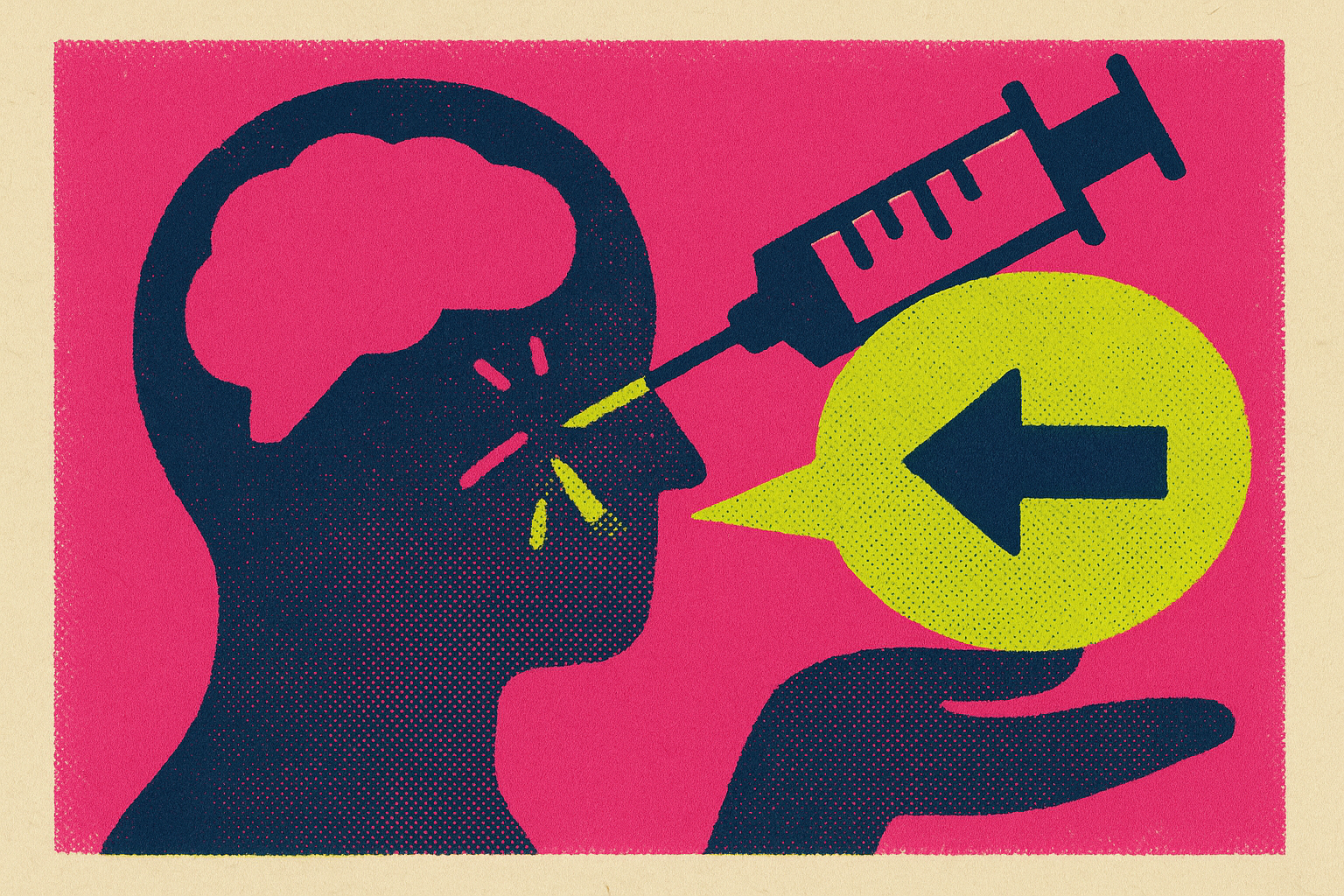
The theory borrows its logic directly from vaccination, matching the sequence step for step. A vaccine introduces a weakened version of a pathogen so the immune system can build defenses before the real infection arrives. Inoculation theory proposes the same sequence for belief: expose someone to a weakened form of a counterargument, paired with a refutation, and the mind builds resistance to the full-strength version of that attack later. McGuire formalized this framework in experiments published between 1961 and 1964 at the University of Illinois and Columbia University, working with collaborator Demetrios Papageorgis, testing it across a range of beliefs people generally assumed were unshakeable.
Subjects who received inoculation treatments showed greater and more durable resistance to persuasion across a wide range of topics, including politics, health, and environmental issues. The result that made the theory worth revisiting decades later was not simply that forewarning helps, people had long suspected that; it was that a belief previously unchallenged is the most fragile one in the room. A person raised in a sterile environment does not have a stronger immune system for having avoided every germ; the opposite is true. The same logic applies to beliefs that have floated along unchallenged: they look stable right up until the moment someone attacks them with a real argument, at which point they often collapse faster than beliefs that have already taken a few hits and recovered.
That timing constraint is the whole argument. Once an audience has already been persuaded by the attack, the only intervention available is debunking, and the evidence on debunking, as established above, runs considerably less favorably. Inoculation is a tool for before. It has no claim on after.
The two components that must both be present
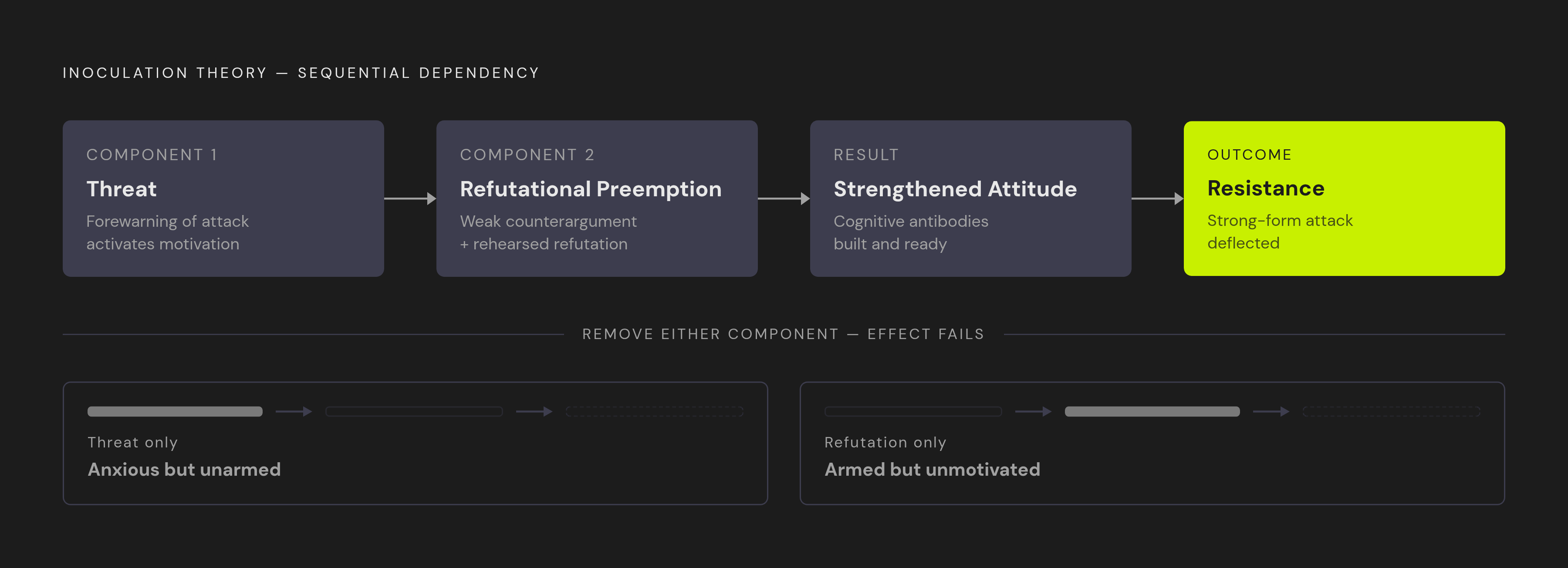
Inoculation is not a single mechanism but two, and both have to be present or the effect does not appear. The first is threat: a forewarning that an attack is coming, carrying the implicit suggestion that the belief in question is actually vulnerable. Threat does the motivational work. It signals to a person that defense is necessary, activating the psychological machinery of resistance. Without it, a counterargument is just information, filed away rather than defended against.
The second component is refutational preemption: exposure to a weakened form of the counterargument, followed immediately by a refutation the audience mentally rehearses. This is where McGuire's cognitive antibodies actually get built. The weakened counterargument gives the mind something concrete to practice against, and the refutation that follows becomes rehearsed ammunition, available the moment the real, stronger attack lands later. Neither component substitutes for the other. Threat without refutational preemption leaves someone anxious but unarmed, aware that an attack is coming but with no rehearsed response to meet it. Refutational preemption without threat leaves someone holding a counterargument they have no motivation to deploy, because nothing told them the belief needed defending.
The cognitive sequence runs in order: perception of threat, active engagement in refuting the weak version of the argument, a strengthened and more stable original attitude, and resistance when the strong-form attack eventually arrives. Each step depends on the one before it. Passive reading does not reliably inoculate. The refutation has to be mentally rehearsed, the same way a fire drill only works if people actually walk the route. Quiz-style and role-play interactions reliably produce the effect; passive consumption of the same material typically does not. Research comparing affective and cognitive inoculation adds a useful wrinkle here: affective inoculation, the kind that engages emotional response rather than pure logic, more significantly strengthens threat perception. That matters a great deal when the attack being defended against is itself emotional, which describes most misinformation that actually spreads.
Issue-specific versus technique-based inoculation
Once the two-part mechanism is in place, the next decision is what exactly gets inoculated against, and here the field splits into two meaningfully different approaches. Issue-specific inoculation targets a known false claim directly: expose someone to a weak version of the claim that the election was stolen through a specific mechanism, refute it, and that person becomes more resistant to that particular claim. It works, but it is brittle by design, offering no protection against an attack the communicator did not anticipate. Misinformation rarely repeats itself exactly, which limits how far issue-specific inoculation can travel.
Technique-based inoculation targets the manipulation techniques and logical fallacies that misinformation commonly relies on. Because it trains pattern recognition instead of a specific rebuttal, it transfers to attacks the person has never encountered. The clearest demonstration of that transfer comes from Roozenbeek and van der Linden's Bad News game, which taught six manipulation techniques to players and produced resistance to claims those players had never previously seen. That is the entire argument for technique-based inoculation in a single result: train the move, not the opponent's specific play, and the defense generalizes.
Biddlestone and colleagues tested this more granularly in 2025, running six short inoculation videos, three targeting manipulation tactics (polarization, conspiracy theories, fake experts) and three targeting logical fallacies (whataboutism, moving the goalposts, strawman). Five of the six increased detection of relevant manipulative content without distorting how viewers perceived content that was not manipulative, a reassuring result given how easily an overzealous training program could turn people into reflexive skeptics of everything. The polarization and strawman videos went further, improving manipulation discernment, so viewers got better at distinguishing manipulative content from non-manipulative content. The moving-the-goalposts video increased overall distrust of relevant content, showing that technique-based inoculation can tip into overcorrection if the training is not calibrated carefully. For a communicator who cannot predict every argument they will face, which describes nearly everyone, technique-based inoculation is the more rational investment.
What the evidence shows at scale
The objection any of this invites is predictable: train people to spot manipulation and they will start seeing it everywhere, distrusting legitimate information along with the fake. A 2025 Signal Detection Theory meta-analysis by Almog Simchon and colleagues addressed that objection directly, re-analyzing 33 inoculation experiments and finding that cognitive inoculation consistently helps people discern reliable from unreliable information without inducing undue bias or skepticism. That is the trade-off result the field needed: better discernment, not blanket suspicion.
Appel, Roozenbeek, and colleagues extended the finding from perception to behavior in a Scientific Reports paper, demonstrating that psychological inoculation improves resilience to vaccine misinformation and reduces willingness to share it, connecting what happens in a lab setting to what people actually do with a mouse and a share button. Durability is the harder question, since most psychological interventions fade quickly, and here the picture is encouraging without being settled. One Instagram field study found the treatment effect remained stable at the group level for five months, a genuinely notable result given how fast inoculation effects are known to decay elsewhere. The caveat sits in what is actually being measured: the strongest effects concern recognition of manipulative techniques, and recognition correlates with resistance without guaranteeing it. Being able to name a manipulation tactic is a different skill from staying immune to it when that tactic is deployed by someone persuasive, charismatic, and standing directly in front of a person. That gap between naming and resisting is exactly where the next section goes.
Where inoculation breaks down
Three documented fault lines mark where inoculation underperforms, and treating them as design constraints rather than refutations is the more useful way to read them. The first is the gap between recognition and resistance already flagged above. Across multiple studies, inoculation against emotional manipulation improved people's ability to identify fallacies without improving actual truth discernment, unless the training was paired with an explicit accuracy prompt. A person who can correctly label a strawman argument in a quiz may still flinch and concede ground when that same strawman is deployed by a confident speaker in a live argument. Naming the trick is vocabulary. Resisting it under pressure is fluency, and the two do not automatically arrive together.
The second fault line concerns the source delivering the inoculation. Müller and Holzinger found that traditional fact-checking produced a meaningful backfire rate when corrections came from institutional sources aimed at audiences whose epistemic orientation was pro-institutional or moderately skeptical. A mismatch between who delivers the message and who is receiving it can flip the intended effect, and the same asymmetry applies when inoculation itself is delivered by a source the audience does not trust.
The third fault line is newer and specific to AI-generated content. Researchers at the University of Western Australia and Northeastern University found that preemptive, source-focused inoculation reduced general trust in AI-generated information but did not significantly reduce the misleading article's actual influence on reasoning, across two separate experiments. Knowing a source is suspect and being resistant to the argument that source makes turn out to be two different outcomes, and current inoculation methods are better at producing the first than the second.
Two further constraints are more about maintenance than mechanism. Without reinforcement, resistance has a half-life of roughly two weeks, meaning inoculation functions as a maintenance discipline rather than a single campaign that can be run once and trusted to hold. Personalized, conversational inoculation also tends to work better than broadcast formats, which creates an unresolved tension between what is effective and what can realistically be delivered to large numbers of people at once.
How active generation beats passive exposure
The variable running through nearly every fault line above is whether the person on the receiving end actively generates the refutation or merely absorbs one that was handed to them. Research on what has been called Conversational Inoculation, a chatbot-driven method in which the system proactively leads the refutation-building process and structures the user's own generation of counterarguments, found that active construction of a refutation outperforms passive reading of the same material. One method asks a person to produce the counter-move themselves; the other asks them to read someone else's.
A study found that active inoculation outperformed passive inoculation in text-based interaction specifically among younger adults resisting misinformation, a finding with particular weight given that younger adults are also the demographic most exposed to high-volume information environments. The Octalysis design principle underlying much of this work identifies the mechanism: force active refutation through feedback-driven interaction. Quiz formats and role-play formats produce the effect. Passive reading, reliably, does not.
What this suggests is that durability in inoculation does not come from encountering a weak counterargument once. It comes from rehearsing a response to that counterargument until retrieval becomes close to automatic, the same logic underlying athletic training, where a movement repeated enough times stops requiring conscious thought and becomes reflex. One underexplored application of this logic is public speaking anxiety. Research from the University of Western Australia and Dartmouth College identified inoculation theory as directly relevant to protecting people against challenges to an existing attitude, belief, or psychological state, including the state of standing in front of an audience and believing oneself capable of holding its attention. Despite how widespread public speaking anxiety is, the strategy had not been applied to it before 2017, which raises an obvious question: if rehearsed refutation builds resistance to persuasion, what stops the same mechanism from building resistance to the fear of being persuaded against, mid-sentence, by one's own nerves?
A generation that speaks less and persuades more rarely
The demographic data sharpens the timing constraint. A study in Perspectives on Psychological Science, drawing on recordings of thousands of people across daily life, found that people now speak considerably fewer words per day than they did in 2005, with the steepest drop concentrated among people under 25. Less verbal output in daily life means less rehearsal of any spoken response, refutations included, which is precisely the activity inoculation theory depends on for its effect to take hold.
Psychologists have tied the so-called Gen Z stare, the blank pause that follows when a reply is expected and does not arrive, to this decline in daily speech. It reads to observers as a personality trait, flat affect, disengagement, but the more accurate description is a skills gap: less practice generating a verbal response in real time produces exactly this kind of hesitation, regardless of how much the person actually has to say. A majority of Gen Z respondents report that young people lack confidence meeting new people, and nearly all Gen Z respondents in the same research said they would like colleges to help close that gap, favoring smaller discussion-based classes, clubs, and internship opportunities over larger, more passive formats.
Put the two findings side by side. Inoculation theory shows that resistance to persuasion depends on active, rehearsed refutation, the kind of cognitive muscle memory that builds through repeated generation. Daily life for the generation most exposed to high-volume information environments is simultaneously producing less raw verbal practice than any comparable cohort in two decades. One communications industry professional summarized the stakes bluntly in 2026: "AI won't raise your juniors, but it will reveal who's" never had to generate a counterargument out loud. The information environment is not slowing down to accommodate anyone's comfort level, and inoculation theory offers no shortcut around the rehearsal it requires. It simply clarifies, with unusual precision for a sixty-year-old psychological framework, what the rehearsal needs to look like and why skipping it leaves a belief standing in exactly the condition McGuire described: unchallenged, unpracticed, and one good argument away from falling over.
Sources
- Tune in to the prebunking network! Development and validation of six inoculation videos that prebunk manipulation tactics and logical fallacies in misinformation - Biddlestone - 2025 - Political Psychology - Wiley Online Library
- When Truth Misleads -- Phase-Aware Coherence Detection for Misinformation Correction Across Epistemic Communities
- Correction: ‘Technique-based inoculation against real-world misinformation’ (2023), by Roozenbeek et al
- The Handbook of Inoculation Theory and Practice
- Psychological Inoculation against Misinformation: Current Evidence and Future Directions - Cecilie S. Traberg, Jon Roozenbeek, Sander van der Linden, 2022
- Prebunking misinformation techniques in social media feeds: Results from an Instagram field study
- A signal detection theory meta-analysis of psychological inoculation against misinformation - ScienceDirect