Building a Verbal Training Schedule That Treats Conversation Like Conditioning
Daily practice with recorded feedback builds conversational skill like athletic training.

Verbal communication is a trainable daily habit. Building a verbal training schedule means working on specific speaking skills for a short time each day, recording how it goes, and making the work harder as control improves. This works like athletic conditioning, where deliberate reps and feedback that can be measured build skills that last.
Why verbal fluency is a trainable skill, not a fixed trait
The thought is clear until someone asks for it. Then the sentence stalls, a qualifier slips in, and the point that seemed clear becomes strangely hard to explain. That gap feels personal because speaking happens in public, often before there is time to prepare. Yet knowing what to say and producing it in real time are different capabilities. Difficulty with the second is not proof of a deficiency in the first.
The biological basis for improvement is adult neuroplasticity. The brain retains the capacity to form new habits well into adulthood, including habits involved in communication. That makes speaking open to the same broad approach used to develop expertise in music, athletics, and surgery, namely focused repetition with corrective feedback. A conversation can become practice when a speaker knows which pattern needs attention.
But surely some people are naturally more articulate? Speaking can look like an expression of personality because much of the practice behind it has been informal or unconscious. A fluent response reveals the performance made possible by accumulated repetitions. The useful reframe is therefore not that every speaker starts in the same place. It is that current ease is not a fixed limit on future skill.
How athletic conditioning and verbal conditioning follow the same logic
Athletic conditioning breaks a broad goal into the skills it takes to reach it. Strength, endurance, and agility need different work, even though they eventually contribute to the same performance. Speaking has a similar structure. Working on pacing trains a different skill from putting a story together or answering a question that comes as a surprise. Simply trying to “communicate better” leaves the training target too vague.
Progressive overload supplies the next part of the model. Once a speaking task becomes manageable, a harder prompt, less preparation, or more pressure creates a new demand. The progression needs to challenge the specific skill being trained. Short, focused sessions make that challenge repeatable across the week. A long speaking session now and then does less than a set time to practice each day that the speaker sticks to.
Periodization also means allowing different skills different timelines. Filler reduction and less habitual hedging can become noticeable in one to four weeks, while vocal authority and composure may take weeks to months to become automatic. Feedback shows how these skills are changing and what to work on next. Without it, repetition can simply rehearse an existing habit. The calendar records attendance, but it does not grade the workout.
What verbal conditioning is actually up against in 2026
Digital-first communication changes where everyday practice comes from. When people write to each other, they can edit and take time to reply, while in spontaneous conversation a speaker has to put a thought into words in front of someone else. When fewer daily exchanges happen that way, there are fewer incidental repetitions from which conversational ease can grow. Intentional training has to replace some of what daily life once supplied.
At the same time, AI handling more routine cognitive tasks puts greater emphasis on verbal persuasion, real-time rapport, and navigating ambiguity. Written communication remains valuable, but it exercises a different degree of control over the finished message. In conversation, the listener hears the words before the speaker has a chance to revise them. Comfort with an imperfect sentence is therefore part of the skill.
That distinction changes the target of a conditioning program. Functional fluency means communicating meaning spontaneously. A schedule must therefore make room for speaking under something like real pressure as well as preparing with care in a comfortable setting. Clarity remains the goal. The speaker needs enough freedom from self-monitoring to stay engaged with the exchange as it unfolds.
The sub-skills that make up verbal fluency and why each needs its own training
Conversational fluency is the ability to keep communication moving without long pauses to construct each sentence. Its diagnostic question is straightforward. Can the speaker complete a thought without repeatedly stopping or restarting? Real-time speaking repetitions train this flow by prioritizing meaning over perfect wording. Studying what a good answer looks like does not supply the same practice as producing one.
Vocal delivery concerns tone, pacing, volume, and intentional pauses. A response can be well worded yet sound rushed or flat, which points to a delivery problem. Slowing during tension, speeding during action, and pausing before a key point are distinct moves that can be rehearsed. Narrative structure solves a different problem, which is giving those ideas a shape. The Three-Act Structure moves from scene to conflict to resolution, while the ABT model uses And/But/Therefore to connect events through contrast and consequence.
Hedging and filler elimination target habits within that flow. Qualifiers such as “kind of” can weaken a point, while filler can occupy a space that would work better as a deliberate pause. These habits may change fairly quickly when the speaker pays close attention to them. Composure under pressure is deeper and slower to become automatic because the speaker must remain clear when the exchange becomes demanding.
Cultural and contextual adaptability adds the ability to shift register. A speaker may need to switch between formal and informal language, or be assertive at one point and collaborative at another, while staying clear. These components should be diagnosed separately. Someone who finishes every sentence but never reaches a conclusion needs different practice from someone who loses the thread under pressure. Where the speaker struggles most should help guide the choice of drills, even when other drills are more enjoyable.
How do you structure a weekly verbal conditioning schedule?
To turn those distinctions into a usable routine, start Monday with a timed spoken response to a prompt. Record it without editing or restarting, making completion the immediate target. Do this fluency session again on Wednesday and Friday. Keep each session short enough to do every day without debating whether to fit it in. Fluency and filler reduction are skills to work on early because they can show clear gains before deeper changes take hold.
Use Tuesday and Saturday for vocal delivery. Repeat the same prompt or a short passage while deliberately changing pace, pauses, and volume. Instead of generating a new argument each time, practice how the existing point sounds when a pause precedes it or its pace changes. That gives delivery its own training space rather than hoping it improves as a side effect of talking more.
Reserve Thursday for narrative structure. Build a response with either the Three-Act framework or ABT before speaking, then follow the chosen shape through to a clear conclusion. Sunday becomes the review day, when recordings from the week supply the evidence for choosing one pattern to improve next. The week now has distinct work for flow, delivery, structure, and feedback without turning every session into an exam on everything.
As the routine becomes manageable, increase difficulty from week to week. Use harder prompts, shorten preparation, record in a new space, or respond to an adversarial prompt to introduce pressure. You can practice register shifts in these responses by choosing when to use formal or informal language, or when to be assertive or collaborative. Let the weakest sub-skill guide the challenge. A well-structured response does not need more complexity if the real difficulty is staying composed while delivering it.
Expect the first sessions to feel uncomfortable. Speaking without a restart removes the editing refuge, so awkwardness can be a sign that practice is reaching the intended demand. It is not, by itself, proof of improvement. The recordings and scores must show whether that challenge is producing greater control. Output begins on the first day, while feedback determines what the next day should address.
How to track progress so the schedule produces real improvement
The minimum viable tracking unit is one prompt, one recorded response, and one score. It is small enough to repeat and specific enough to compare over time. Playback should answer a question about one part of how the speaker did, without turning into a judgment of the speaker as a whole. Listen for filler frequency, sentence completion, or variation in pace. “That sounded awkward” is an impression.
Score sub-skills separately on a consistent numerical scale. A single overall communication score can hide improving fluency behind stagnant delivery, or overlook growing hedging in an otherwise well-structured answer. The scale need not be elaborate to create a baseline. Its usefulness comes from judging the same feature consistently across sessions. Otherwise, a changing standard can look like a changing skill.
Early indicators should stay close to the drills. Filler words per minute, completion of responses without restart, and the ability to sustain a narrative through its conclusion all show whether the trained behavior is changing. These measures give the weekly review something firmer than memory. They also help distinguish an awkward but successful attempt from a comfortable repetition of an old pattern. Familiarity can feel like competence even when the target remains untouched.
Signs that practice is carrying over into everyday life usually take longer to appear. Unsolicited feedback from regular conversation partners, increased ease in previously stressful exchanges, and shorter recovery after a difficult conversation can confirm that practice is extending beyond recordings. Those signals complement the scores. For a speaking app to support this kind of conditioning, the relevant criteria are repeated spoken output, useful feedback, and progress tracking by sub-skill. Tools should be compared by how well they support the practice loop, with care to distinguish that support from the reward of taking part.
What a realistic improvement arc looks like across the first 90 days
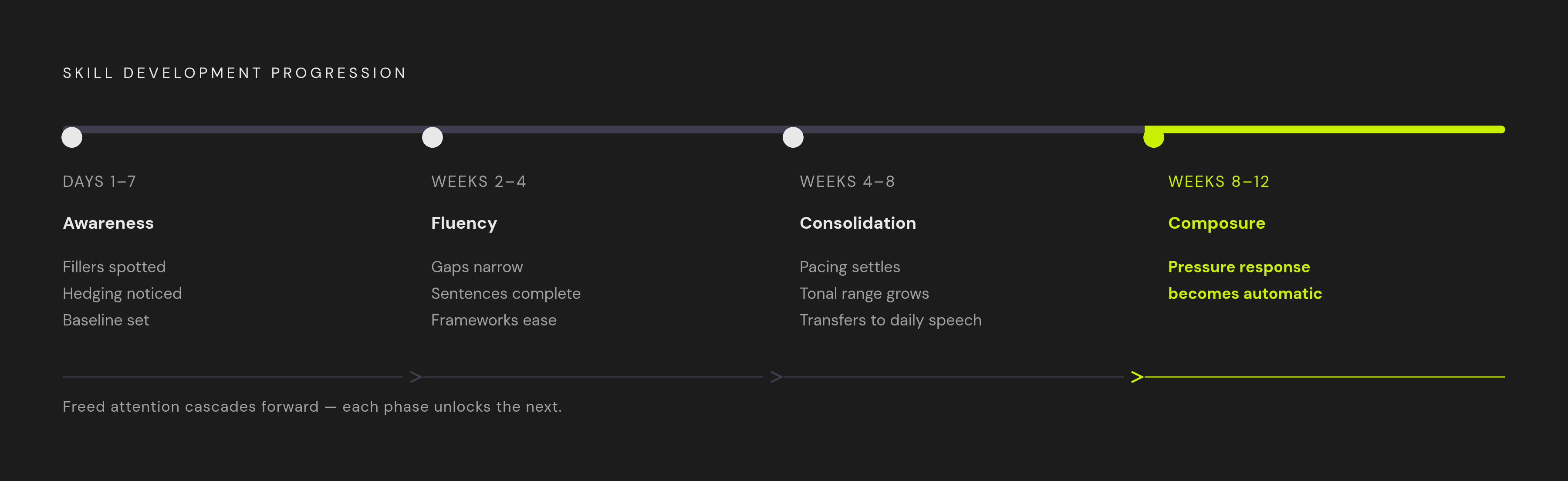
During days 1–7, the first change may be what the speaker notices. Filler, hedging, and unfinished sentences become easier to spot once the speaker starts working on them. Some micro-habits may begin to shift, but awareness should not be confused with reliable control. Noticeable filler reduction more realistically belongs to the one-to-four-week window of consistent practice. The first week establishes a baseline and starts interrupting patterns that previously passed unnoticed.
Across weeks 2–4, accumulated speaking repetitions can begin to narrow the gap between intended meaning and spoken response. Finishing becomes less of a struggle. Narrative frameworks may also feel less mechanical as the speaker gets used to bringing a story to a resolution. These changes free attention that was previously occupied by assembling every sentence. The speaker can then give more attention to delivery and structure.
During weeks 4–8, pacing, pauses, and tonal variation may begin to consolidate. As speakers sound better in a familiar drill, they should also begin to choose how to use their voice in everyday conversation. Transfer is the test. In weeks 8–12, composure under pressure may start to come more automatically, so speakers can still draw on what they have practiced when things get demanding.
The arc describes a direction. Different starting points and uneven progress make a scored daily record more useful than a fixed promise about the final day. Improvement can compound because greater fluency reduces the effort of producing speech, leaving more attention for how a point is shaped and delivered. By day 90, the meaningful question is which skills remain available when the conversation stops being easy.