Acoustic Differences Between Confident and Anxious Speech
Anxiety subtly reshapes your voice through pitch, tremor, and timing before words betray doubt.
Anxiety can change the sound of speech even when the words are well chosen. The acoustic differences between confident and anxious speech lie in pitch, vocal steadiness, pace, and pauses, but they are not a universal diagnostic code. Understanding those differences gives speakers a way to practice how to “sound confident” through repeated speaking with measured feedback.
Why your voice gives away anxiety before your words do
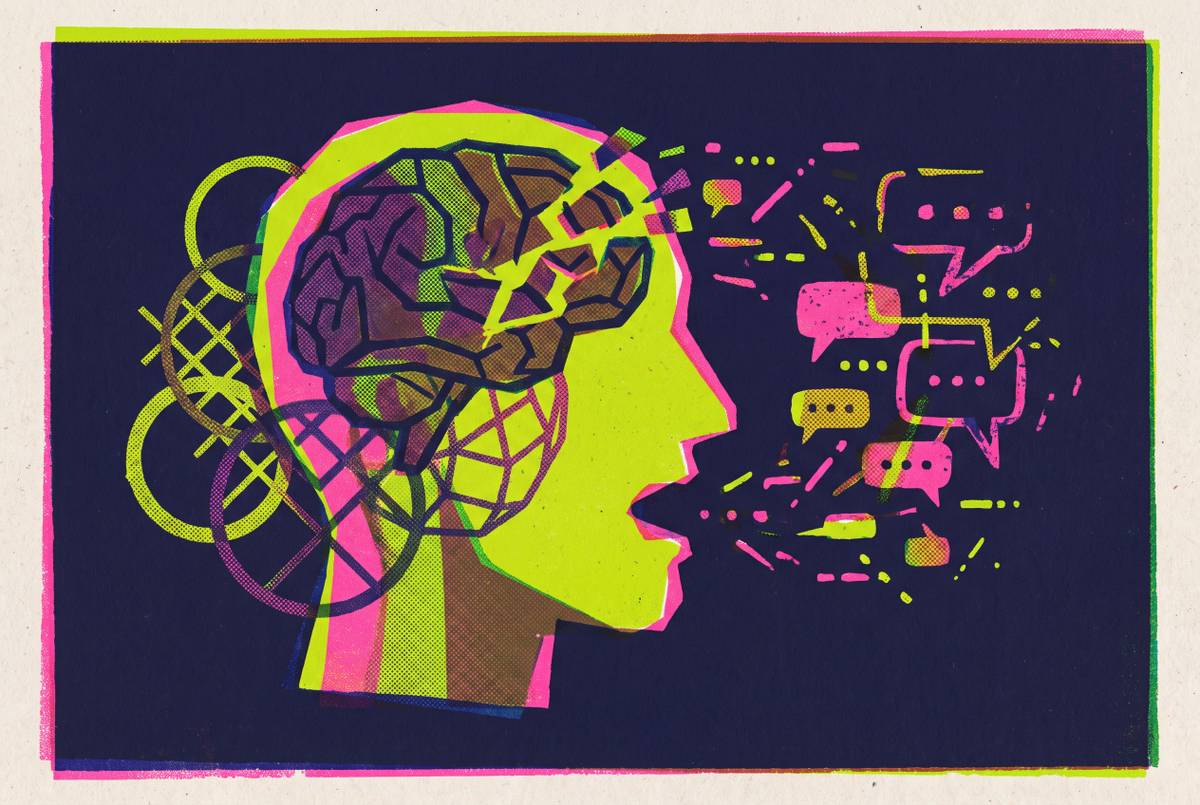
Most people look for anxiety in what a speaker says, including uncertain wording, stumbled phrases, or an answer that loses its way. Yet the acoustic layer can reveal strain before a listener consciously registers a problem with the words. Speech depends on the respiratory, phonatory, and articulatory systems working together. Anxiety can disrupt all three at once, so its effects enter the sound even when the speaker knows exactly what to say. A carefully prepared sentence is not soundproof.
The SpeechSense dataset distinguishes “confident” from “nervous” speech through prosodic cues alone, independent of word choice. That distinction matters because it separates the message from its delivery. A speaker’s words can sound certain while their pitch and timing sound less sure. The mismatch helps explain why knowing the material and sounding assured are different skills. To understand that gap, it is necessary to follow the physical process that turns breath into speech.
What anxiety actually does to your voice: the body-to-sound chain
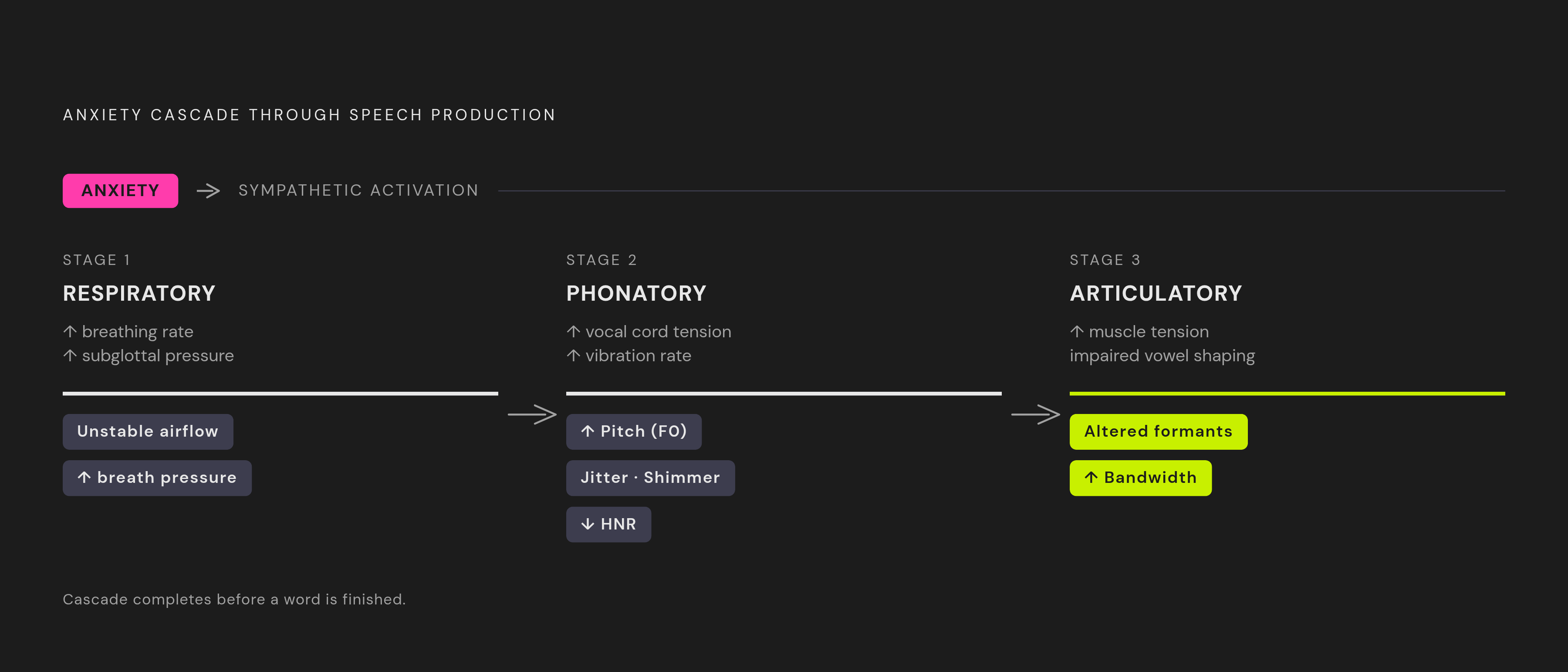
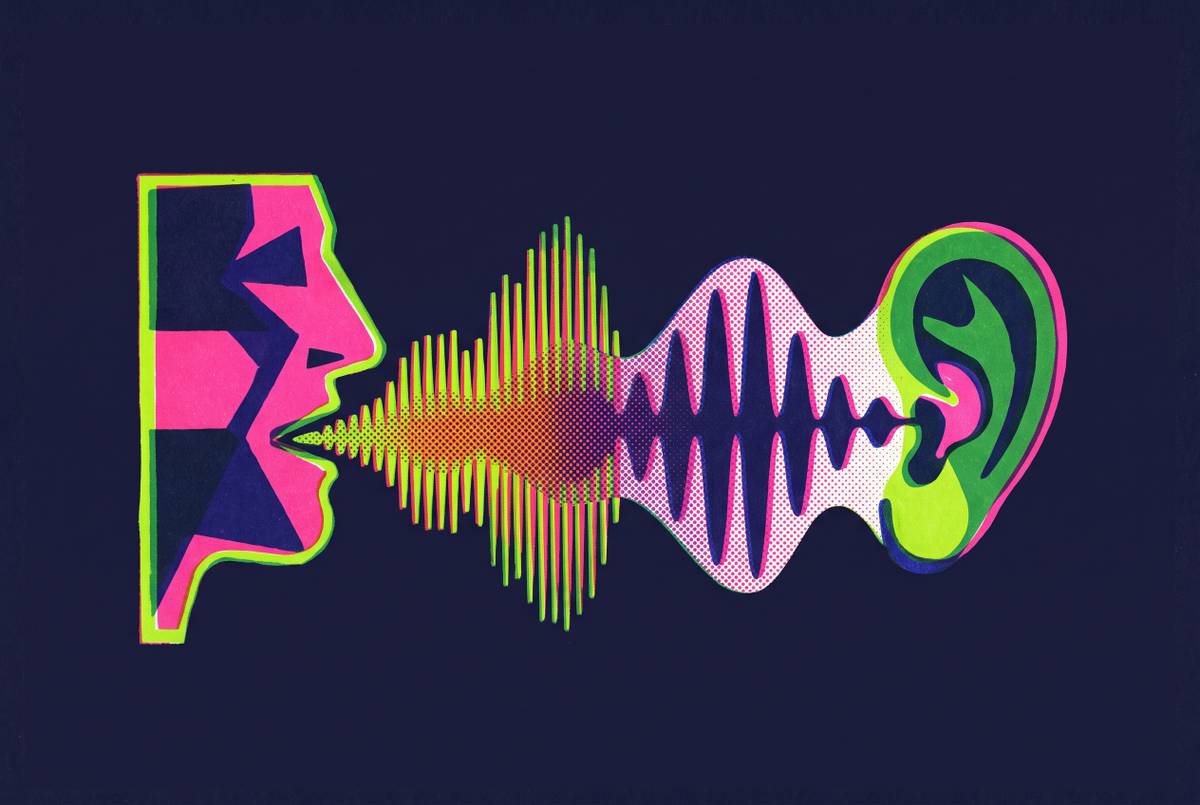
The process begins with sympathetic nervous system activation, which tightens muscles and accelerates breathing. At the respiratory stage, a higher breathing rate alters the airflow pressure beneath the vocal cords. That pressure helps govern how regularly the cords vibrate, so a change in breathing can disturb the stability of the sound they produce. This begins as an involuntary physical response. A speaker cannot simply decide that the next breath will carry no trace of anxiety.
The effect then moves through the phonatory system, where the vocal cords produce sound. Increased muscle tension raises their rate of vibration, which raises fundamental frequency, heard as pitch. Meanwhile, changes in airflow pressure can destabilize the regularity of each vibration cycle. Those instabilities appear as jitter, shimmer, and reduced clarity in the harmonic signal.
Finally, the articulatory muscles shape that sound into recognizable speech. Under stress, these muscles can tighten, impairing the precise shaping of vowels and altering formant bandwidths. Formants are part of the acoustic structure of vowels, so these changes affect clarity as well as tone. Anxiety does not have to interrupt the wording to interfere with the production of the words.
Qingyi Wang and colleagues’ 2025 network analysis in Brain Sciences suggests that these changes also affect how speech parameters relate to one another. High-anxiety speech showed intensity coupling with formant frequencies in a way that low-anxiety speech did not. In other words, stress did not merely turn several separate controls up or down. It changed how parts of the vocal system behaved together.
The four acoustic markers that separate anxious speech from confident speech
The first marker is fundamental frequency, or F0, which a listener hears as pitch. Elevated mean pitch is one of the most studied signs of speech anxiety and fits the mechanism of increased laryngeal tension. By contrast, perceived confidence is associated with lower pitch and falling intonation, while uncertain utterances tend toward rising intonation. A 2024 Journal of the Acoustical Society of America study found that mean fundamental frequency, F0 range, and duration distinguished confident from doubtful expressions.
The second marker is pitch variability, which describes how pitch moves. Public-speaking research has identified it as the single best acoustic indicator of speech anxiety. Anxious speakers can show erratic, uncontrolled F0 swings, whereas confident speakers use variation that listeners hear as engagement and command. The distinction is therefore not between a changing voice and a flat one. It is between variation that seems to serve the message and variation that seems to escape the speaker’s control. Two voices can have a similar average pitch yet create different impressions because their movement differs.
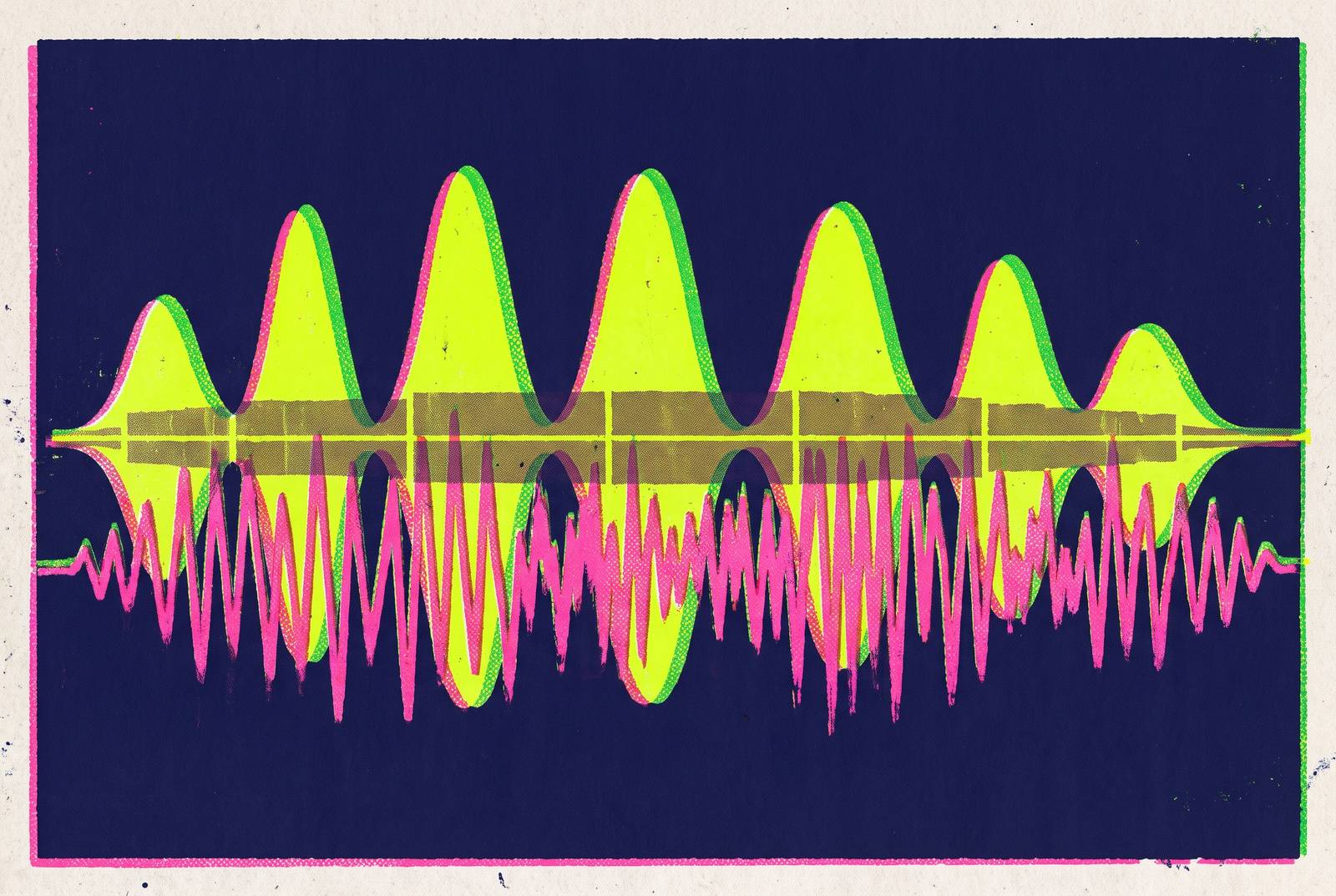
The third marker is voice quality, including jitter, shimmer, and harmonics-to-noise ratio, or HNR. Jitter measures small cycle-to-cycle variations in the pitch period, giving the voice signal a tremor-like irregularity. Shimmer measures small changes in loudness from one cycle to the next. HNR describes how clean and periodic the voice is compared with how much noise or breathiness it contains.
Wang and colleagues’ 2025 network analysis found that jitter was the only parameter in the network with a direct link to anxiety state. That makes it a particularly specific finding, because the analysis placed it closest to anxiety rather than simply among a collection of associated features. It does not mean that a listener can diagnose anxiety by hearing a tremor. The 2024 Journal of the Acoustical Society of America study also found that harmonic-to-noise ratio and cepstral peak prominence, a related voice clarity measure, distinguished confident from doubtful expressions. These findings show how advice about posture or wording can miss this part of how a voice sounds.
The fourth marker is the pattern of pace, pauses, and disfluency. Confident speech tends to be faster, with higher intensity and fewer and shorter pauses. Anxious speech contains more interruptions in its forward flow, including silent pauses and filled pauses such as “um” and “uh”. A listener hears these as breaks in momentum, while reduced vowel clarity can make the same delivery sound acoustically muddier. Fluency is therefore more than speed, because a fast stream of speech and a smooth one are not the same thing. These timing features can be measured, and how people practice can change how often disfluencies occur.
Why the acoustic fingerprint is messier than the clean version above suggests
Does this mean that a high voice, a hesitation, or a rough phrase reveals anxiety. No single feature supports that conclusion for an individual speaker. The research is less consistent than a neat comparison between anxious and confident delivery suggests, especially for fundamental frequency. Studies have found mixed links between pitch and self-reported anxiety, with some finding no significant change. The acoustic fingerprint is real as a research problem, but it is not a barcode that returns the same answer for every person.
Silvia Ciampelli and colleagues’ 2025 Psychological Medicine study illustrates the difficulty in adolescents. In males, higher anxiety correlated with reduced pitch slope, narrower pitch range, lower first formant frequency, and greater MFCC1 variability. Females with higher anxiety had less pitch slope variability. Yet none of those correlations held up after multiple-testing correction in a sample of several hundred adolescents. The qualification is essential, because an apparent pattern is weaker evidence when it does not hold up under that correction.
Findings in the notes include a strong positive correlation between mean F0 and anxiety severity in males but a near-zero correlation in females. A feature that tells much about anxiety in one group may tell little in another. That limits what can be inferred from one recording.
This uncertainty strengthens the case for repeated, multidimensional feedback. What matters for training is how a given speaker’s pattern changes over time. A system that scores several aspects of delivery across recordings is better suited to that task than a single verdict about confidence. It can keep the focus on observable speech features without pretending to read the speaker’s mind. The goal is not to pass an acoustic personality test, but to make delivery more controlled and fluent.
Why Gen Z is particularly exposed to this gap between knowing and sounding confident
For Gen Z, this distinction comes up in a world where writing to others can take the place of talking live. People who communicate often may still get little practice speaking under pressure. Text gives a person time to reconsider an answer before anyone receives it. In live speech, the speaker has no such time to spare and must plan and speak at once. The gap is therefore not simply between being social and being shy, but between two forms of communication with different demands.
A 2024 Media Psychology study describes the “edit button effect”, in which people with social anxiety prefer texting, particularly for difficult conversations, because it allows revision. Less live speaking means fewer repetitions, leaving acoustic signs of anxiety unaddressed and making further avoidance more likely. The edit button is useful for a sentence, but it cannot rehearse the voice that will eventually have to say it.
The 2025 Harris Poll/Freeman survey found that a large majority of Gen Z want to feel more comfortable expressing themselves in person. That desire matters because it challenges the idea that this generation simply prefers not to speak. The problem described here is a gap between wanting the skill and having a systematic way to develop it. Better wording alone cannot close that gap, because people still need to practice the physical work of speaking. The acoustic evidence makes the need more precise, turning an abstract wish for confidence into a set of features that can be observed and trained.
How repetition and scored feedback close the acoustic gap
The training argument begins with a distinction between feeling confident and practicing fluent delivery. The former is difficult to command, while the latter provides a task that can be repeated and assessed. Fluency research shows that speech can improve with structured repetition, so the acoustic patterns linked to anxiety need not stay the same. That does not establish that every marker will change in the same way for every speaker.
The 4/3/2 technique puts repetition at the center of the task by having learners speak on the same topic for decreasing time intervals. Learners make substantial gains in delivery speed and show a considerable decrease in hesitations. Researchers attribute those changes to the underlying attentional planning mechanism.
Kakitani and Kormos tracked Japanese learners across four fluency-training sessions with either one-day or seven-day intervals. Both groups did better in posttests held a week and nearly a month later. Those results support spaced practice and show that improvement can outlast the immediate session. They do not establish that daily practice is the only effective schedule, since both intervals produced gains. Repeated speaking should move from occasional marathon preparation into a routine.
Feedback gives that routine direction. A score or structured assessment makes it possible to speak, identify a feature to adjust, and compare the next attempt with the last. Because the research shows individual variation, feedback should cover multiple dimensions across recordings rather than reduce performance to a single supposed anxiety signal. Brief daily practice provides a manageable format for this repeated cycle of speaking, assessment, and adjustment.
Starting earlier also matters, because speakers who began practicing earlier were less disfluent. Confidence need not be the admission requirement for that process. It can develop with a delivery that becomes smoother and more controlled. Understanding the acoustic fingerprint is useful precisely because it turns “sound confident” from a vague demand into work a speaker can actually do.
Sources
- SpeechSense: A Paralinguistic-Focused Dataset for Fine-Grained Speech Sentiment Analysis
- Cross-sectional and longitudinal associations between anxiety and acoustic-prosodic markers in adolescents - PMC
- (PDF) Acoustic encoding of vocally expressed confidence and doubt in Chinese bidialectics
- Acoustic encoding of vocally expressed confidence and doubt in Chinese bidialectics - PubMed
- How Anxiety State Influences Speech Parameters: A Network Analysis Study from a Real Stressed Scenario
- How Anxiety State Influences Speech Parameters: A Network Analysis Study from a Real Stressed Scenario - PMC
- Acoustic characteristics of public speaking: Anxiety and practice effects - ScienceDirect