What an App That Listens and Scores Your Voice Every Day Actually Measures
A single voice score hides which speaking skill actually needs improvement.
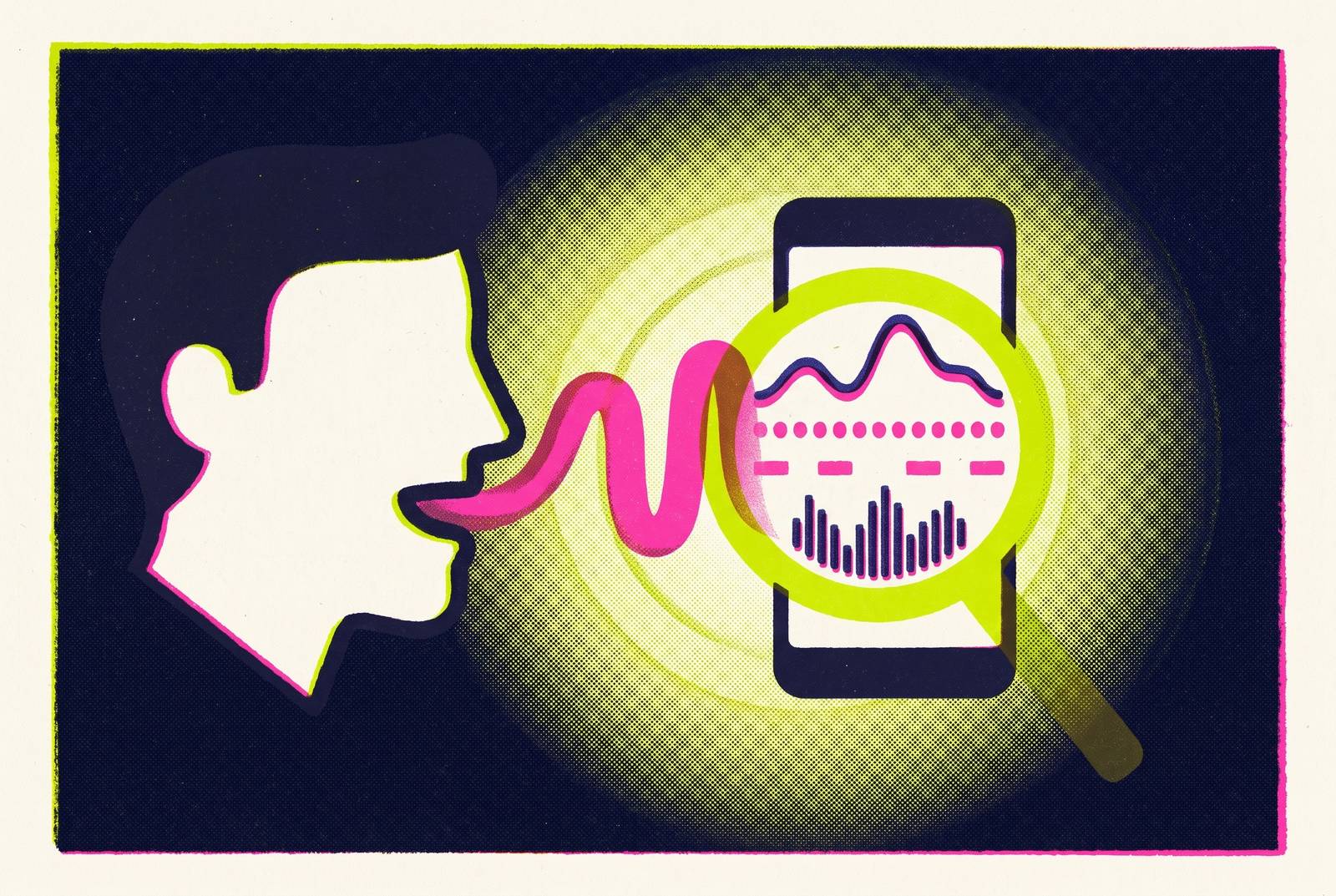
A daily speaking prompt app with AI scoring turns a recorded response into feedback on distinct skills. Pace, fillers, pronunciation, structure, and confidence each reveal a different part of the performance. For public-speaking practice at home, the useful feature is a dimension breakdown that shows what to work on next and lets you track that skill over time.
Why a single voice score is harder to trust than it looks
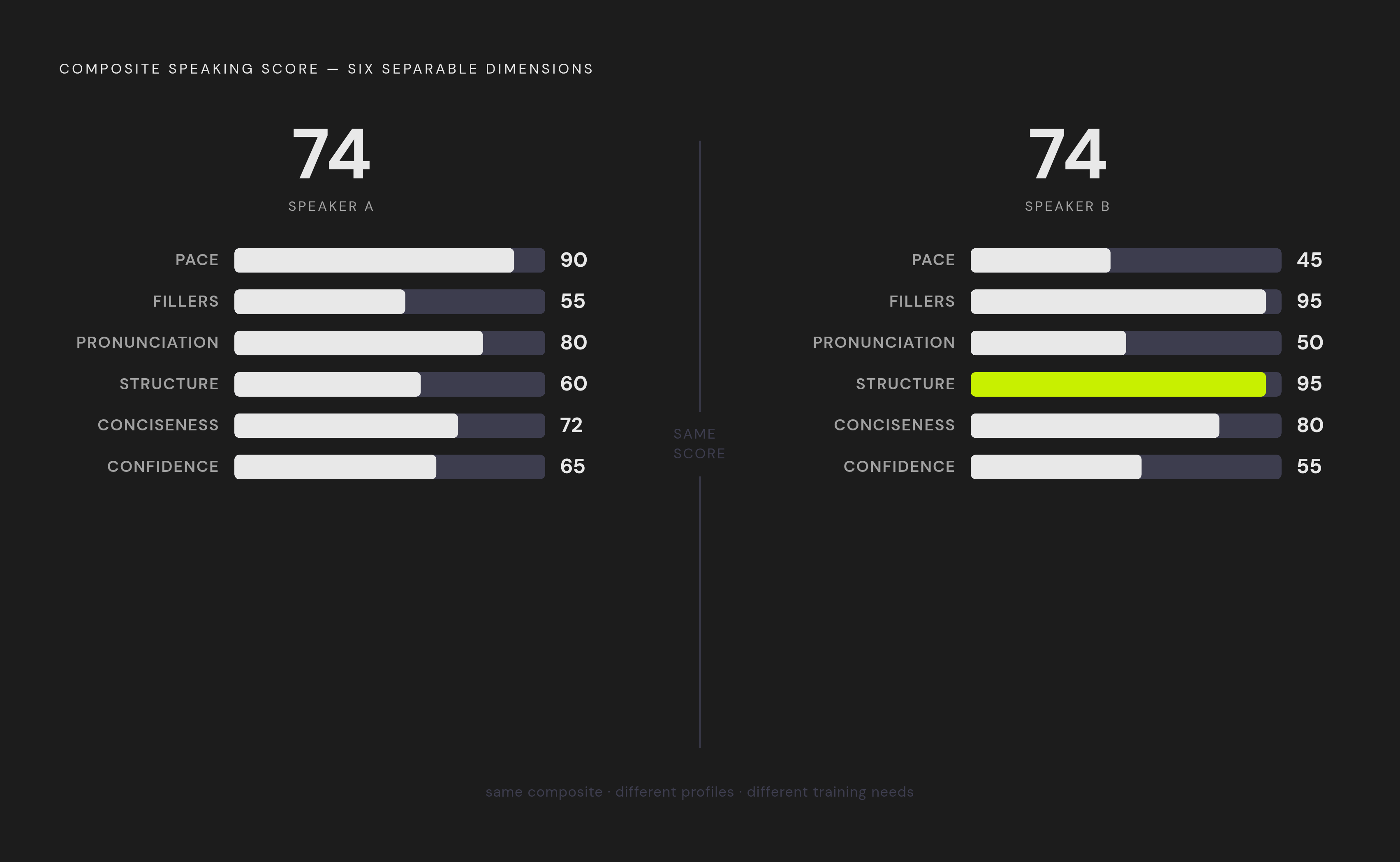
You got a 74, and the next step is unclear. Should you slow down, cut filler words, or restructure the answer? The number cannot tell you on its own. A daily voice score collapses several separable signals into one result, so very different performances can leave you with the same practical puzzle. It looks like an answer, but it still needs a key.
That ambiguity makes it easy to treat the score as a verdict on the day, obscuring what it says about particular skills. A higher result feels reassuring without necessarily explaining what improved. A lower one can prompt changes to the wrong habit. The gap between “your score went up” and “here is the specific thing that changed” is where a score stops being useful feedback.
What automated speech analysis is actually listening for at the signal level
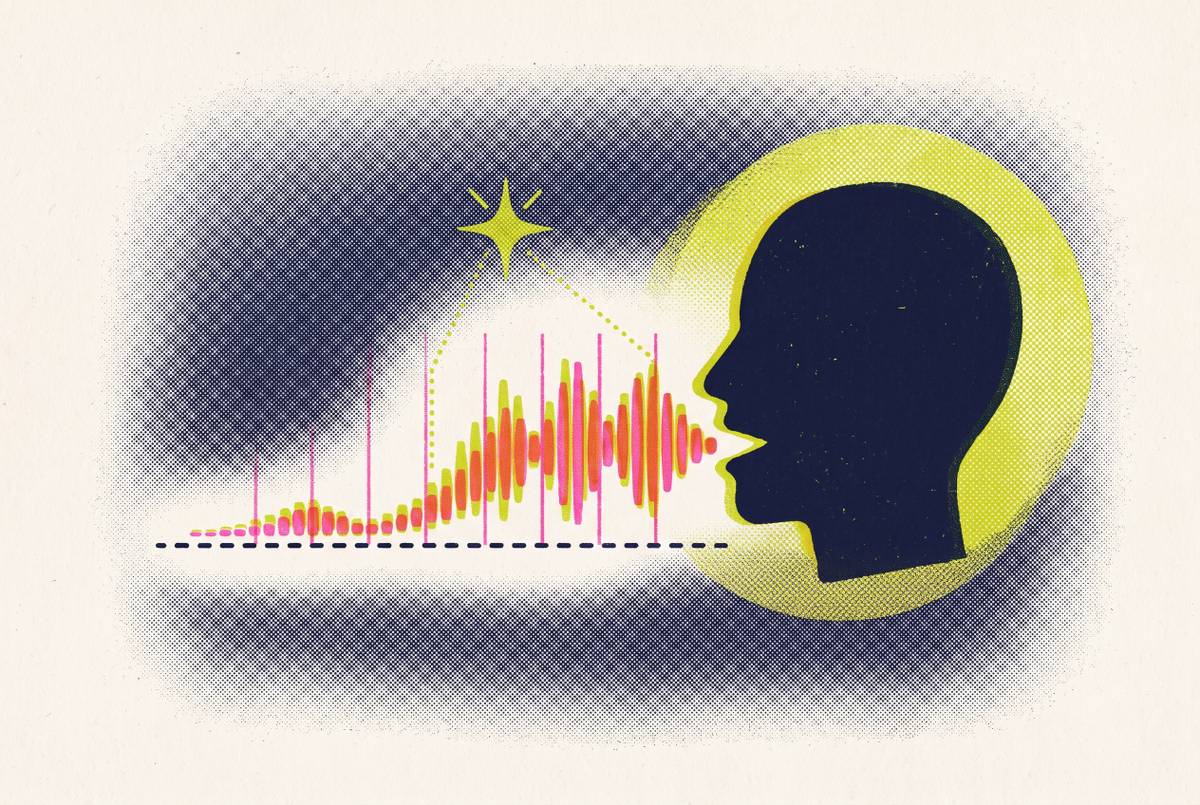
Before an app can score delivery, automated speech analysis separates raw audio into identifiable events. These include silent pauses, filled pauses, false starts, repetitions, phoneme sequences, rhythm patterns, and intonation contours. The machine extracts features that can feed different measures, without requiring a human to transcribe the recording first.
A pause tells the app something about fluency, while a phoneme sequence gives it sounds to use in pronunciation analysis. Content assessment adds another layer, because vocabulary and the organization of an answer are different questions from how its sounds were produced. Speechace’s assessment methodology generates reports covering pronunciation, fluency, vocabulary, grammar, cohesion, and comprehension. That breadth illustrates why the headline result is better understood as the top of a report than the whole assessment.
What pace and pause data actually reveal about a speaker
Words per minute sounds like the easiest thing to measure. Yet speech rate alone leaves out where a speaker pauses, how often those pauses occur, and whether the rhythm helps a listener follow the thought. A silent pause at a logical boundary can signal command. The same silence inside an unfinished thought can suggest that the speaker has lost the thread. Placement changes what the listener hears.
Pace analysis therefore has to distinguish useful space from disruption, rather than reward uninterrupted speech or automatically favor slower delivery. A global average cannot explain that difference. Two responses with a similar overall rate may have very different rhythms, with one giving ideas room to land and the other repeatedly breaking them apart.
Wellspoken names pace as a dimension and gives feedback on it after each session. That separation makes pace available as a specific practice target and makes its influence on the total visible. It also limits the temptation to interpret every fluency problem as a speed problem. Slowing down is not a universal repair.
How filler-word tracking works and what high filler rates signal
Filler tracking moves from silence to what fills it. Filled pauses such as “um” and “uh” can appear when thought retrieval lags behind the plan to keep speaking. In that sense, filler rate can act as a proxy for a mismatch between retrieval speed and speaking speed. It is not an intelligence test with a microphone attached. Nervousness-driven fast speech, poor preparation, and difficulty retrieving infrequently used words can all contribute.
Still, fillers need a closer look, because the expressions people call fillers do different jobs. Discourse markers such as “like” and “you know” also occur in planned speech and can serve conversational functions. Filled pauses may mean the speaker is struggling to form an idea as well as to find a word. A count identifies occurrences, but it does not by itself establish the cause of each one.
The useful interpretation concerns where planning and delivery fell out of step. Wellspoken’s methodology lists fillers and fluency as a named dimension in its Index, separate from pace and confidence. This lets a speaker look at filler use without assuming it causes every other weakness in the recording.
What pronunciation scoring measures beyond accent
Pronunciation scoring can work at the phoneme level, showing which sounds differ from a target model and specifying where delivery needs work. That is a much narrower claim than judging an accent as a whole. Per-phoneme or per-syllable accuracy can turn a broad concern about being understood into feedback on a particular sound. The target model matters because accuracy is always judged against something.
Speechace maps pronunciation scores to global standards including CEFR, IELTS, TOEFL, PTE, and TOEIC. Those mappings give the output a reference beyond an app’s internal scale. They also explain why pronunciation assessment may be especially relevant to a speaker preparing for an exam.
However, precision is not the only useful orientation. Fluency-first tools give more weight to conversational rhythm, response speed, and word choice, while precision tools look more closely at how accurate the sounds are. Exam performance and conversational confidence may call for different emphases, so neither orientation is automatically superior. A highly specific pronunciation result can be useful without being a complete account of effective conversation.
How structure and conciseness are scored as content dimensions, not delivery ones
Up to this point, the dimensions largely concern delivery. Structure and conciseness cross into content assessment, examining what was said. Structure scoring looks for a recognizable logical arc, including an opening claim, supporting reasoning, and a close. Conciseness scoring looks for redundancy, over-qualification, and padding.
Insight7’s AI Speaking Coach scores sessions across clarity, empathy, structure, and persuasion, with feedback tied to specific moments in a recorded conversation. An answer may flow well with few hesitations and still fail to make a case. Conversely, a logically organized response may still have uneven delivery. Bundling both into one number conceals which kind of work is needed.
Wellspoken includes structure and conciseness in its Index and offers exercises for individual dimensions. Its feedback can route a rambling answer to compression practice or an unclear opening to framework rehearsal. Oompf also includes structure and conciseness in its six-dimension scoring loop. Their inclusion changes the scope of assessment, because the result now reflects how the answer was built as well as how it was spoken.
The underlying research distinction is similarly useful. Traditional verbal fluency assessment counted words that were correctly retrieved, while newer automated language-based scoring also uses lexical measures such as word frequency, syllable count, and typicality. Separate semantic measures examine organization through clustering and switching across responses. These measures help explain why an assessment that includes content can reveal weaknesses a delivery-only score would leave untouched.
What confidence scoring is actually measuring, since it cannot hear an emotion
Confidence sounds like the least measurable dimension of all. How can an app know whether a speaker feels assured? It cannot hear an emotion directly, so the score is better understood as an estimate built from observable acoustic and linguistic signals. Those signals can include the energy in the voice, false starts or sentences left unfinished, hedging phrases, and how steady the pace is. The label describes an interpretation of behavior.
Articulate AI builds its confidence score from speech rate, vocabulary, flow, and filler words, updating the result each session. Wellspoken lists confidence separately from fillers, fluency, and pace. A confidence score depends on which proxies a tool combines, even when some of those same signals also contribute to other dimensions.
Oompf gives confidence and energy their own scores. Energy is based on volume and animation, while confidence is based on how free the speech is of retreat signals. The distinction prevents loudness from standing in for assurance. A hedging phrase can influence the latter interpretation without saying much about the former.
Why the dimension weighting in a composite score matters as much as the dimensions themselves
How much does each dimension influence the total? Two apps can measure the same six dimensions and still produce different scores from the same audio because their weighting models reward different qualities. The arithmetic contains a judgment about good speaking. It is not simply a neutral container for the measurements.
For example, a model weighted heavily toward fillers will respond more strongly to filled pauses than one weighted toward structure. That difference can favor smoother delivery over better-organized reasoning when those qualities diverge. A silent pause should not be confused with a filler, however, because they are different speech events. Optimizing for a score without understanding its priorities can mean training toward the app’s preferred performance, potentially diverging from the speaker’s goal.
Wellspoken publishes a methodology explaining how its dimensions contribute to the Index. Speechace uses externally anchored standards as reference points for its composite output. These are different ways to make the result interpretable. One exposes how the internal dimensions contribute, while the other relates the assessment to an outside rubric. Neither makes every speaking goal identical.
What if the weighting model is hidden? Trust then has to remain partial. The practical check is whether the dimension breakdown fits what went wrong in the session. If structure scored poorly but the answer seemed well organized, the disagreement raises a question about how structure was assessed, leaving the total unresolved. The breakdown supplies a question that the headline number cannot.
How to read your own dimension breakdown as a training map rather than a report card
After each session, inspect the breakdown, identify the lowest-scoring separable dimension, and build one practice habit around a concrete change for the next recording. Not three changes at once. Record again and compare the dimension you worked on, rather than checking only whether the composite went up.
The appropriate task depends on the weakness. Apps that connect feedback to the next exercise shorten this translation step, including by routing a low confidence score to energy drills. Such a drill offers a way to practice the energy component of confidence. A scorecard without that connection leaves the user to turn diagnosis into an exercise.
The spacing effect favors repeated, spaced activation of a skill over massed practice, giving five minutes of targeted practice daily an advantage over an hour-long session once a week. Speaking fluency is also partly a motor skill. Repetition builds automaticity, helping reduce filler use and stabilize pace under pressure. The daily schedule supports repeated work on a skill.
A daily prompt-and-score format makes that work manageable through a single prompt, a recorded response, and an immediate dimension breakdown. The constraint turns each session into a training rep. Over time, the useful record is not merely a trail of totals but a view of which separable skills are changing. The speaker reading that profile is no longer guessing whether listeners heard hesitation, haste, or a poorly organized answer. Each has a name, and each points to different work.